
Zero Is a Policy: Who Pays for EIP-8363?
An EIP written to protect solo stakers might be the thing that finishes them off. Price out who actually pays and solo stakers end up near the bottom of the pile, below the custodians the proposal was written to contain.
1. What EIP-8363 actually does: the off switch, explained
EIP-8363 comes from six authors, among them the Ethereum Foundation's Justin Drake, and proposes burning a rising share of consensus-layer rewards as the staked balance grows. At 60.25M active ETH, the burn cancels the consensus issuance earned by a fully performing validator; priority fees and MEV remain. On 11 August the EIP was merged as a formal draft, and as of 13 August it does not appear on Hegotá’s official PFI, CFI or SFI lists. Its PFI request was discussed on 6 August, so its status is unresolved rather than finally rejected. The live question is what version advances, when, and against how much organised opposition.
The existing duty and reward machinery remains in place, but the transition temporarily changes its scale. At activation, BASE_REWARD_FACTOR rises from 64 to 128, doubling gross rewards, penalties and the burn basis together. It then decays to 64 over 18 months. Separately, a rising share of each duty's idealised reward is deducted from the validator's balance and burnt.
$$b = \left(\frac{D}{D_{\text{sat}}}\right)^{1.5} \qquad D_{\text{sat}} = 60.25\,\text{M ETH} \quad (49.9\% \text{ of supply})$$
Net consensus issuance falls with every validator that joins, and at saturation the protocol-issued portion of a fully performing validator's reward is zero. This is not the same as total validator income or Ethereum's network-wide supply change: priority fees and MEV remain, fee burn continues, and aggregate issuance also depends on network participation. Whether you describe it as a new reward curve or as a burn bolted onto the old one, the take-home result is a lower curve.
The 1.5 exponent makes the absolute deduction grow linearly with the staking ratio, so total issuance peaks at around 19.6% staked and declines from there.
The new curve's shape is live from day one; the income reduction is what phases in. BASE_REWARD_FACTOR starts at 128, scaling gross rewards, penalties and the burn together, and then declines to 64 over 18 months. The temporary boost is therefore largest at activation and phases out over time.
At today's staking ratio, that means gross credited rewards roughly double at activation while most of the larger amount is subsequently burnt. The construction is elegant on-chain, but it creates a potential tax ambiguity wherever credited rewards and subsequent balance reductions receive different treatment.
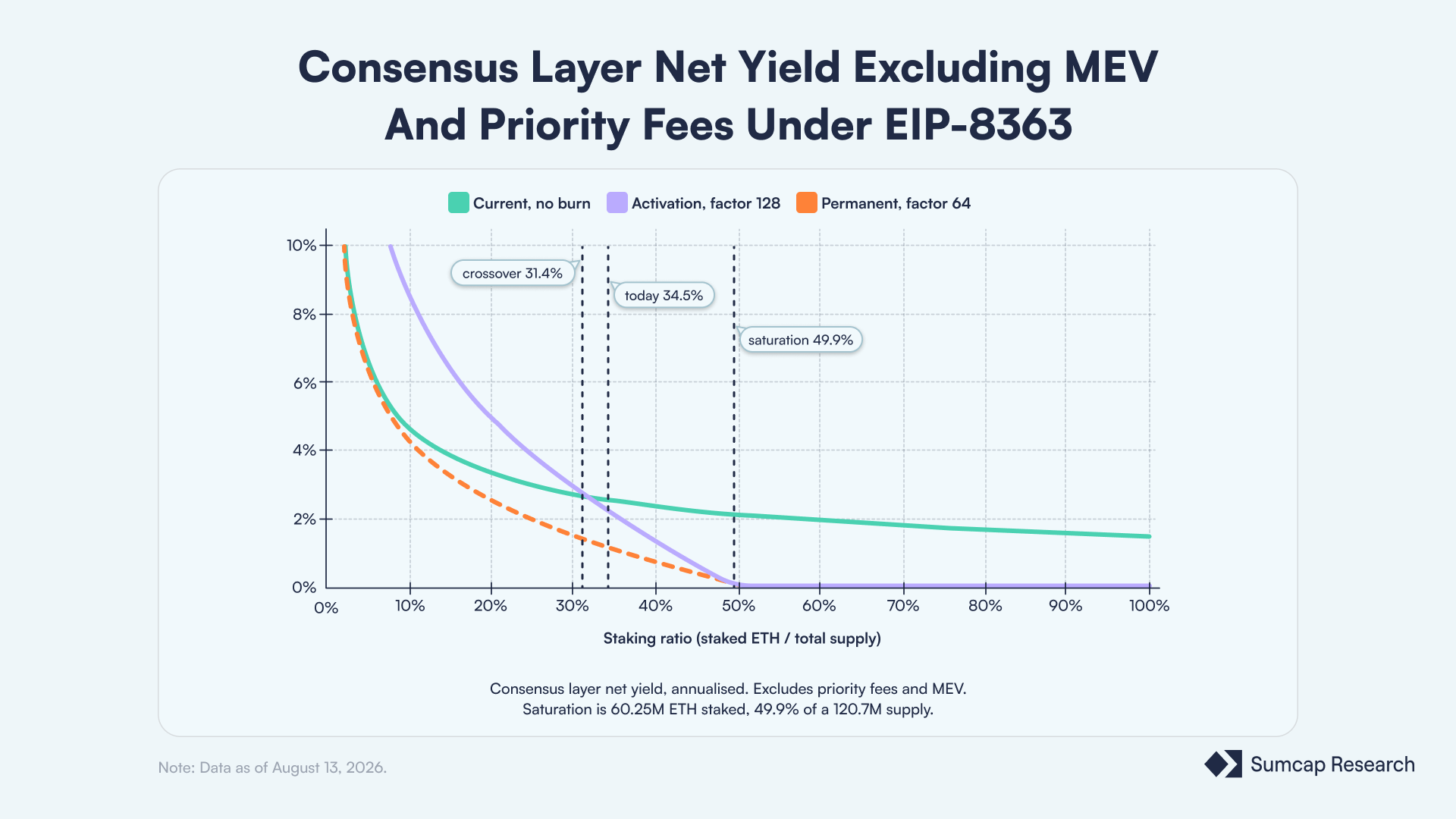
The two effects cancel exactly at 31.4% staked, which is the ratio where the burn fraction reaches 50% and a doubled factor meets a halved reward. Below that line, activation day pays more than today does.
With 41.7M ETH staked out of a 120.7M supply on 13 August, or 34.5%, the burn fraction is 57.6%. A 2.6% gross consensus-layer yield therefore lands at roughly 2.2% on day one, a cut of about 15%, and approximately 1.1% when BASE_REWARD_FACTOR returns to 64 after 18 months, a permanent cut of roughly 58% at an unchanged staking ratio. These figures cover consensus-layer yield only, execution-layer income is excluded.
None of this is a new fight. Ethereum has been arguing about how much it should pay for its own security for years, through stake ratio targeting in 2024 and Anders Elowsson's minimum viable issuance work before that. Of everything that came out of those rounds, only EIP-7514's churn cap ever made it into a fork.
2. The case on both sides
2.1 The case for
The case for cutting starts with a question the current curve cannot answer. Current issuance leaves a yield floor of roughly 1.5% at any staking ratio, so there is never a point at which staking stops making sense and the inflow stops. De Tychey frames that as a dilution tax, and every holder either stakes or pays it. Elowsson, dapplion and Drake add the capture argument, that past some threshold extra stake buys no marginal security and simply concentrates consensus in custodians, LSTs and ETFs, the entities least likely to ever be slashed. Grayscale's Zach Pandl takes the market side, arguing that supply reduction is positive for the price of ETH over time and that if you are going to act on capture risk you have to act before it is too late. On the numbers, the supply effect is real but gradual: the reduction is phased over 18 months and changes with the staking ratio rather than arriving as a one-off supply shock.
2.2 The case against
The case against opens by inverting the capture argument. Stani Kulechov (Aave), Mike Silagadze (ether.fi) and Marin Passadis (Lido) argue that a yield near zero purges the operators who need a return and leaves the ones with a zero cost of capital. Stani's second front is DeFi, and he says that consensus yield is the reference rate underneath lending, LST collateral and every leveraged staking position, and that a cut turns ETH borrowing strategies mostly unviable, and that may hurt DeFi. Both add the institutional point, that ETF and treasury demand was built on a passed through yield and does not price an unpredictable one.
Nobody is totally neutral, as Aave and ether.fi and Lido earn from the status quo and the authors have their own commitment to MVI as a philosophy. That is not a reason to discount either one, but it is a reason to price the incidence yourself.
3. Named beneficiaries, actual beneficiaries
Both sides are arguing about Ethereum. Nobody is pricing the incidence, which is the only question that decides who is right.
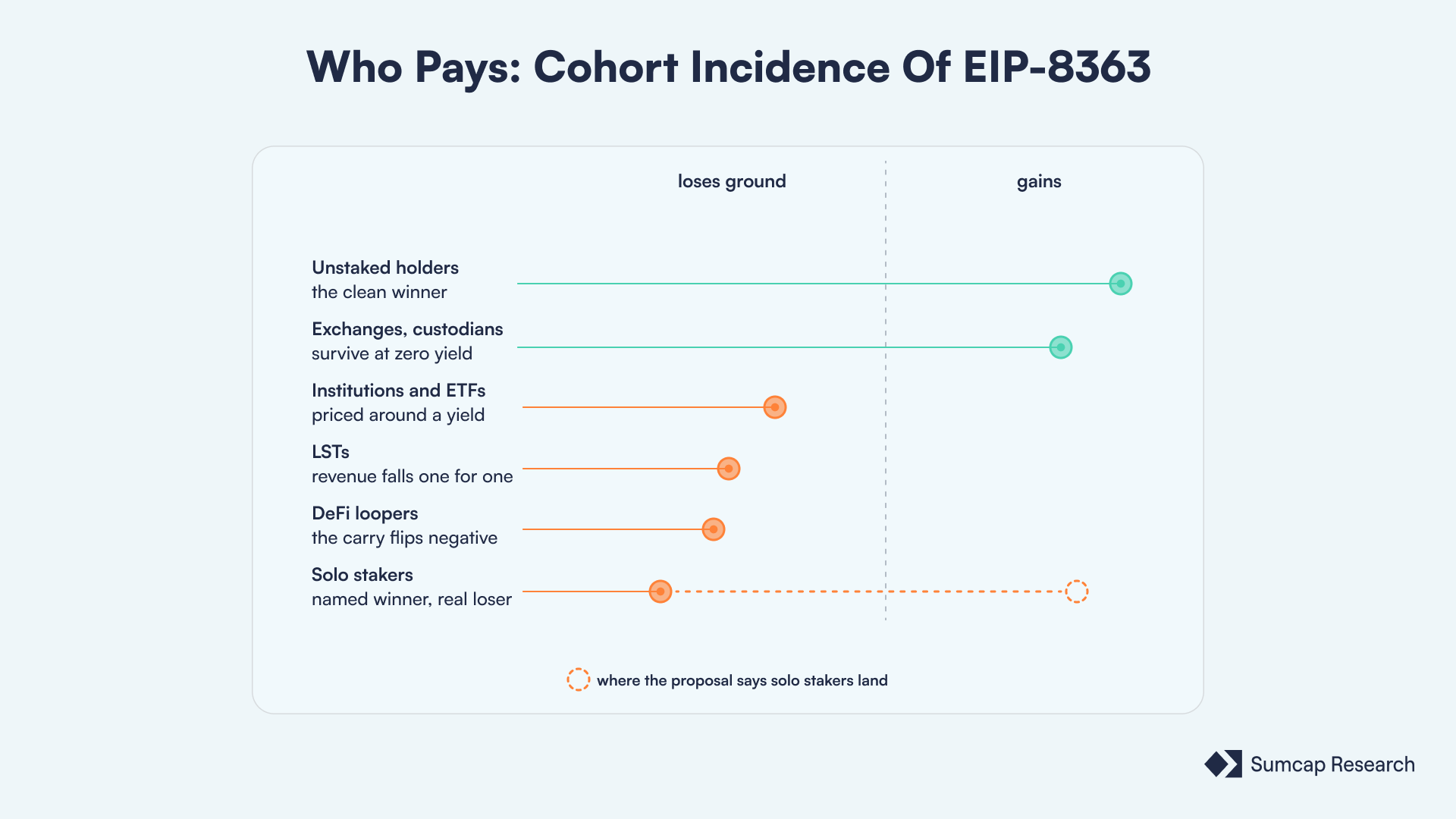
The EIP invokes solo stakers as beneficiaries, but they are among the cohorts with the least room to absorb lower consensus income. A home operator has no fleet across which to spread costs, no fee business to subsidise the validator and less operational redundancy. At today's staking ratio, consensus-layer yield falls by roughly 15% at activation and approximately 58% once the transition ends. On the EIP's own cost-of-downtime model, recovery from an outage takes roughly 4.2 times longer at the current ratio, because the burn is charged on the idealised reward whether the duty was performed or not, so an offline validator absorbs it on top of the ordinary penalty while earning less to climb back.
Tax treatment could make that worse, but the outcome is unresolved. The forum's widely circulated -77% after-tax estimate assumes that the pre-burn credit is taxable income, that the burn receives less favourable treatment, a 30% marginal tax rate and specified operating costs. Its author explicitly says no tax authority's position is known. Treat it as a stress case that demands written tax opinions, not as an established outcome. Claimed beneficiary, plausible loser.
The LSTs take the hit in full. Lido and ether.fi charge a percentage of staking rewards, so cutting the rewards cuts their revenue one for one. What they have is somewhere to go, a treasury and product lines that do not price off staking, which is survival at the entity level rather than a cushion on the margin. Exchanges and custodians are better insulated. Staking is a product line, marginal operating costs can be spread across large fleets, and some institutions stake for structural rather than purely yield-sensitive reasons. They are better positioned to operate close to break-even than a one-validator household. As protocol issuance approaches zero, the remaining validator set may therefore tilt towards the large operators the proposal was written to contain.
Staking-enabled ETFs, ETPs and corporate treasuries are a demand-side risk. Some products were built or marketed around a passed-through staking yield, and a near-zero yield that moves with the staking ratio is a less predictable input than a low yield that remains stable.
Then there is the cohort nobody is counting. Listed treasury companies now hold ETH at a scale that dwarfs the mechanism. BitMine alone reported roughly 4.9M ETH in its August filing, about 12% of all staked ETH. At the current rate of reduction, that single balance sheet represents close to 8 years of removed issuance, accumulated in 18 months.
Unstaked holders are the clean winners. Less dilution, and the burn accrues to every holder the way EIP-1559 does. DeFi users running staking loops are the clean losers, and that is the next section.
The EIP is sold as protecting solo stakers and ETH as money but the winners are passive holders and zero cost of capital custodians. The reliable losers include the solo stakers the proposal invokes as beneficiaries.
4. What breaks downstream
Staking yield is the reference rate that DeFi prices off, and the EIP does not model what happens to the things built on top of it.
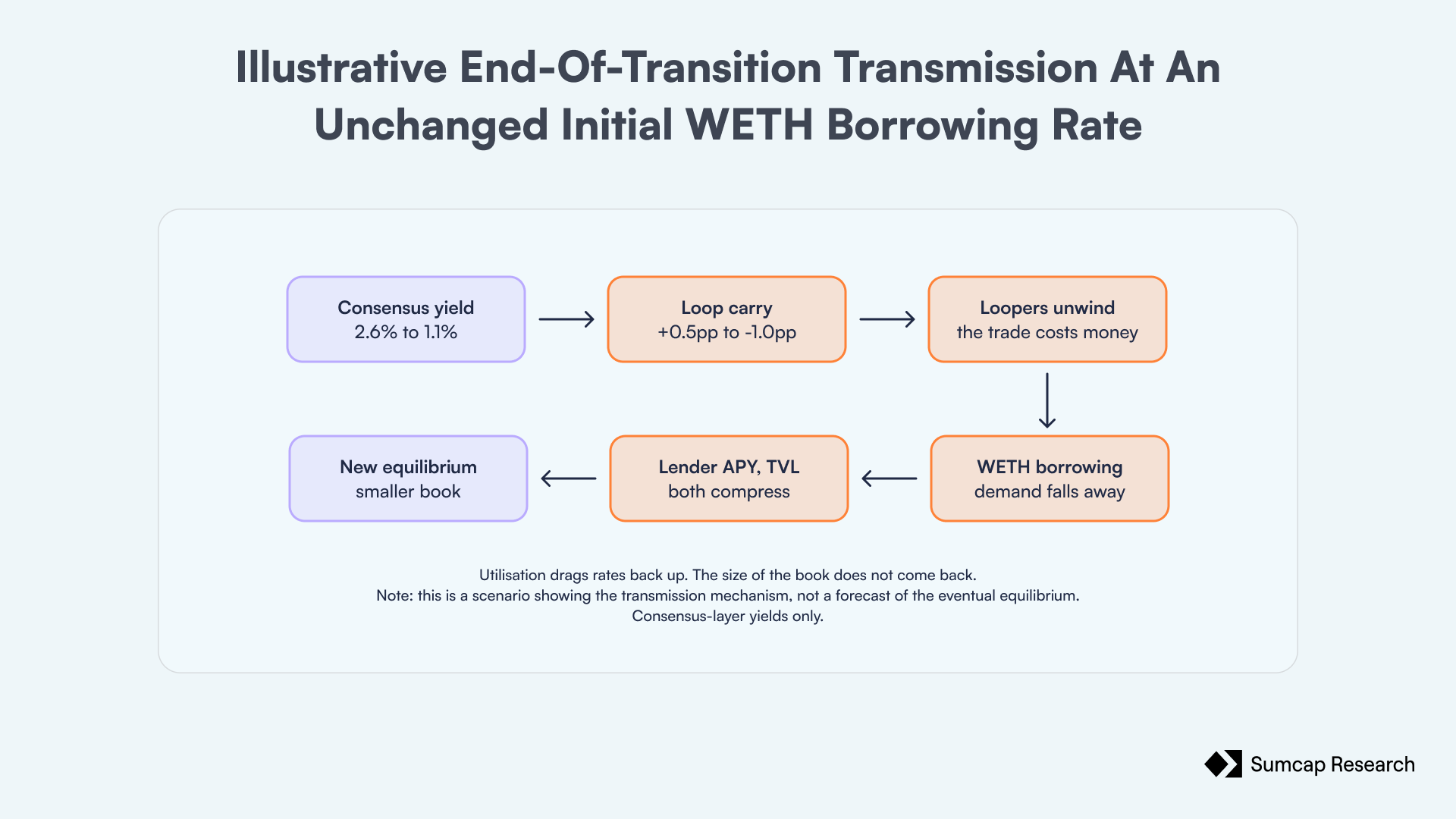
Start with the loop, because it is the most direct transmission. The trade is to stake ETH, post the LST as collateral, borrow WETH against it and repeat. It works because staking pays more than borrowing costs. Today that is a gross consensus-layer yield of 2.6% against a WETH borrow rate of 2.13% on Aave v3, so a carry of about 0.5 points, multiplied by the leverage. With the stake side at 1.1% the spread inverts to roughly -1.0 points, again multiplied by the leverage, a daily loss machine. In that case loopers would unwind, WETH borrowing demand would fall with them, and yields and TVL would shrink together. Lenders would leave too, and utilisation would drag rates back up until the market settles somewhere new. That equilibrium exists, but it is smaller, and money markets get paid on the size of the book rather than the level of the rate, so the recovery in rates does not make them whole.
Leaving MEV untouched also changes the composition of validator income. As consensus issuance falls, MEV becomes a larger share of the remaining return. That raises a separate modelling question: whether greater dependence on MEV strengthens incentives for aggressive extraction or timing strategies.
The collateral layer reprices next, more slowly and less visibly. A lower and more volatile staking yield changes both the value and the risk profile of LST and yield bearing stablecoin collateral across every lending market that accepts it, which is most of them. None of that appears in the EIP.
The tax wedge is the mechanism behind that, and it is the least discussed part of the design. Doubling BASE_REWARD_FACTOR to cushion the taper means the protocol mints roughly twice as much and destroys most of it. On chain the two cancel, but on a tax return they do not, because the gross reward would be the taxable event and the burn is not a deduction against it. The mechanism of mint then burn is exactly what creates the problem, and it is an artefact of the compensation mechanism rather than of the policy, which means it is fixable and nobody has proposed a fix.
5. Monetary policy
Ethereum's current consensus reward schedule produces a protocol-issued yield floor of roughly 1.5% within the possible staking-ratio range. EIP-8363 removes that floor and establishes a zero-issuance point at a fixed active balance of 60.25M ETH. At that point the issuance incentive to add stake switches off, although priority fees and MEV remain.
That is not a parameter change, it is a different monetary regime, and it deserves to be argued as one.
The philosophy behind it is coherent. Minimum viable issuance says a chain should pay for security and not a basis point more, and if you accept that premise the burn is a reasonable instrument for it. The question is not whether the philosophy holds together.
Recent net supply growth has oscillated with fee burn. At recent burn levels, removing roughly half a percentage point of annual issuance could push total supply growth below zero more often. That may be a desirable outcome, but it is a scenario rather than a guaranteed permanent state, and it is distinct from the question of how validator income is distributed.
The proposal also bundles three separate decisions into one vote. There is the intent, which is capping runaway issuance. There is a novel consensus-reward burn primitive, which has never run in production. And there is a BASE_REWARD_FACTOR change that touches the reward and penalty balance every validator operates under, and which turns out to be the source of the tax problem. Any one of the three would merit its own review.
The growth that motivates all this is real. Staking has passed a third of total supply, the entry queue still runs weeks, and every projection on the table has it climbing further. That justifies building the tool, but it does not justify taking yield to zero at 50%, or deciding that in 48 hours.
6. Not this, not now, not like this
So where does that leave the proposal? Directionally, the authors are right that unbounded issuance is a problem worth solving, and the capture argument is the strongest thing either side has said. The instrument is what fails, and it fails on three specifics.
Floor it, do not zero it. The taper should end at a positive net yield of around 1% to 1.5% instead of at nothing. That still removes the stake or be diluted dynamic, still caps the runaway, and still delivers most of the supply reduction, while leaving DeFi a reference rate and the solo staker a reason to keep the machine on. A version of this already exists in the forum thread and it is the most reasonable thing on the table.
Unbundle it. The burn primitive, the issuance intent and the BASE_REWARD_FACTOR change are three decisions wearing one number. The least contested piece should go first, with modelling behind it. The tax wedge alone is an argument for separating them, because it is a side effect of the compensation mechanism and not of the policy, and it would not survive its own review.
Model the second order effects before, not after. The collateral repricing and the receipt tax problem are load bearing, and neither is in the EIP. That work has to be done with the risk teams at Aave, Lido, ether.fi and the other protocols exposed to it, who are conflicted and who also hold the only data that would settle it. Conflicted counterparties are not a reason to skip the exercise.
On timing, the fork calendar has already been answered. 8363 did not make Hegotá, and de Tychey's own argument was that every month of delay strengthens the incumbents defending the status quo. He is right about that, which is the trap. Rushing a monetary regime change to get ahead of the lobby produces a worse instrument and a stronger lobby, because nothing recruits opposition like a process people did not get to participate in. The version that ships in 2028 after two years of modelling has a better chance than the version that was pushed at a fork deadline.
Zero is a policy choice, not a law of nature, and someone pays for it. The people it is sold as protecting are the ones with the least room to absorb the bill. That is not an argument for leaving issuance alone forever, but an argument for finding out who pays before deciding, which is work that has not been done yet, by anyone, on either side.


Zero Is a Policy: Who Pays for EIP-8363?
An EIP written to protect solo stakers might be the thing that finishes them off. Price out who actually pays and solo stakers end up near the bottom of the pile, below the custodians the proposal was written to contain.
1. What EIP-8363 actually does: the off switch, explained
EIP-8363 comes from six authors, among them the Ethereum Foundation's Justin Drake, and proposes burning a rising share of consensus-layer rewards as the staked balance grows. At 60.25M active ETH, the burn cancels the consensus issuance earned by a fully performing validator; priority fees and MEV remain. On 11 August the EIP was merged as a formal draft, and as of 13 August it does not appear on Hegotá’s official PFI, CFI or SFI lists. Its PFI request was discussed on 6 August, so its status is unresolved rather than finally rejected. The live question is what version advances, when, and against how much organised opposition.
The existing duty and reward machinery remains in place, but the transition temporarily changes its scale. At activation, BASE_REWARD_FACTOR rises from 64 to 128, doubling gross rewards, penalties and the burn basis together. It then decays to 64 over 18 months. Separately, a rising share of each duty's idealised reward is deducted from the validator's balance and burnt.
$$b = \left(\frac{D}{D_{\text{sat}}}\right)^{1.5} \qquad D_{\text{sat}} = 60.25\,\text{M ETH} \quad (49.9\% \text{ of supply})$$
Net consensus issuance falls with every validator that joins, and at saturation the protocol-issued portion of a fully performing validator's reward is zero. This is not the same as total validator income or Ethereum's network-wide supply change: priority fees and MEV remain, fee burn continues, and aggregate issuance also depends on network participation. Whether you describe it as a new reward curve or as a burn bolted onto the old one, the take-home result is a lower curve.
The 1.5 exponent makes the absolute deduction grow linearly with the staking ratio, so total issuance peaks at around 19.6% staked and declines from there.
The new curve's shape is live from day one; the income reduction is what phases in. BASE_REWARD_FACTOR starts at 128, scaling gross rewards, penalties and the burn together, and then declines to 64 over 18 months. The temporary boost is therefore largest at activation and phases out over time.
At today's staking ratio, that means gross credited rewards roughly double at activation while most of the larger amount is subsequently burnt. The construction is elegant on-chain, but it creates a potential tax ambiguity wherever credited rewards and subsequent balance reductions receive different treatment.
The two effects cancel exactly at 31.4% staked, which is the ratio where the burn fraction reaches 50% and a doubled factor meets a halved reward. Below that line, activation day pays more than today does.
With 41.7M ETH staked out of a 120.7M supply on 13 August, or 34.5%, the burn fraction is 57.6%. A 2.6% gross consensus-layer yield therefore lands at roughly 2.2% on day one, a cut of about 15%, and approximately 1.1% when BASE_REWARD_FACTOR returns to 64 after 18 months, a permanent cut of roughly 58% at an unchanged staking ratio. These figures cover consensus-layer yield only, execution-layer income is excluded.
None of this is a new fight. Ethereum has been arguing about how much it should pay for its own security for years, through stake ratio targeting in 2024 and Anders Elowsson's minimum viable issuance work before that. Of everything that came out of those rounds, only EIP-7514's churn cap ever made it into a fork.
2. The case on both sides
2.1 The case for
The case for cutting starts with a question the current curve cannot answer. Current issuance leaves a yield floor of roughly 1.5% at any staking ratio, so there is never a point at which staking stops making sense and the inflow stops. De Tychey frames that as a dilution tax, and every holder either stakes or pays it. Elowsson, dapplion and Drake add the capture argument, that past some threshold extra stake buys no marginal security and simply concentrates consensus in custodians, LSTs and ETFs, the entities least likely to ever be slashed. Grayscale's Zach Pandl takes the market side, arguing that supply reduction is positive for the price of ETH over time and that if you are going to act on capture risk you have to act before it is too late. On the numbers, the supply effect is real but gradual: the reduction is phased over 18 months and changes with the staking ratio rather than arriving as a one-off supply shock.
2.2 The case against
The case against opens by inverting the capture argument. Stani Kulechov (Aave), Mike Silagadze (ether.fi) and Marin Passadis (Lido) argue that a yield near zero purges the operators who need a return and leaves the ones with a zero cost of capital. Stani's second front is DeFi, and he says that consensus yield is the reference rate underneath lending, LST collateral and every leveraged staking position, and that a cut turns ETH borrowing strategies mostly unviable, and that may hurt DeFi. Both add the institutional point, that ETF and treasury demand was built on a passed through yield and does not price an unpredictable one.
Nobody is totally neutral, as Aave and ether.fi and Lido earn from the status quo and the authors have their own commitment to MVI as a philosophy. That is not a reason to discount either one, but it is a reason to price the incidence yourself.
3. Named beneficiaries, actual beneficiaries
Both sides are arguing about Ethereum. Nobody is pricing the incidence, which is the only question that decides who is right.
The EIP invokes solo stakers as beneficiaries, but they are among the cohorts with the least room to absorb lower consensus income. A home operator has no fleet across which to spread costs, no fee business to subsidise the validator and less operational redundancy. At today's staking ratio, consensus-layer yield falls by roughly 15% at activation and approximately 58% once the transition ends. On the EIP's own cost-of-downtime model, recovery from an outage takes roughly 4.2 times longer at the current ratio, because the burn is charged on the idealised reward whether the duty was performed or not, so an offline validator absorbs it on top of the ordinary penalty while earning less to climb back.
Tax treatment could make that worse, but the outcome is unresolved. The forum's widely circulated -77% after-tax estimate assumes that the pre-burn credit is taxable income, that the burn receives less favourable treatment, a 30% marginal tax rate and specified operating costs. Its author explicitly says no tax authority's position is known. Treat it as a stress case that demands written tax opinions, not as an established outcome. Claimed beneficiary, plausible loser.
The LSTs take the hit in full. Lido and ether.fi charge a percentage of staking rewards, so cutting the rewards cuts their revenue one for one. What they have is somewhere to go, a treasury and product lines that do not price off staking, which is survival at the entity level rather than a cushion on the margin. Exchanges and custodians are better insulated. Staking is a product line, marginal operating costs can be spread across large fleets, and some institutions stake for structural rather than purely yield-sensitive reasons. They are better positioned to operate close to break-even than a one-validator household. As protocol issuance approaches zero, the remaining validator set may therefore tilt towards the large operators the proposal was written to contain.
Staking-enabled ETFs, ETPs and corporate treasuries are a demand-side risk. Some products were built or marketed around a passed-through staking yield, and a near-zero yield that moves with the staking ratio is a less predictable input than a low yield that remains stable.
Then there is the cohort nobody is counting. Listed treasury companies now hold ETH at a scale that dwarfs the mechanism. BitMine alone reported roughly 4.9M ETH in its August filing, about 12% of all staked ETH. At the current rate of reduction, that single balance sheet represents close to 8 years of removed issuance, accumulated in 18 months.
Unstaked holders are the clean winners. Less dilution, and the burn accrues to every holder the way EIP-1559 does. DeFi users running staking loops are the clean losers, and that is the next section.
The EIP is sold as protecting solo stakers and ETH as money but the winners are passive holders and zero cost of capital custodians. The reliable losers include the solo stakers the proposal invokes as beneficiaries.
4. What breaks downstream
Staking yield is the reference rate that DeFi prices off, and the EIP does not model what happens to the things built on top of it.
Start with the loop, because it is the most direct transmission. The trade is to stake ETH, post the LST as collateral, borrow WETH against it and repeat. It works because staking pays more than borrowing costs. Today that is a gross consensus-layer yield of 2.6% against a WETH borrow rate of 2.13% on Aave v3, so a carry of about 0.5 points, multiplied by the leverage. With the stake side at 1.1% the spread inverts to roughly -1.0 points, again multiplied by the leverage, a daily loss machine. In that case loopers would unwind, WETH borrowing demand would fall with them, and yields and TVL would shrink together. Lenders would leave too, and utilisation would drag rates back up until the market settles somewhere new. That equilibrium exists, but it is smaller, and money markets get paid on the size of the book rather than the level of the rate, so the recovery in rates does not make them whole.
Leaving MEV untouched also changes the composition of validator income. As consensus issuance falls, MEV becomes a larger share of the remaining return. That raises a separate modelling question: whether greater dependence on MEV strengthens incentives for aggressive extraction or timing strategies.
The collateral layer reprices next, more slowly and less visibly. A lower and more volatile staking yield changes both the value and the risk profile of LST and yield bearing stablecoin collateral across every lending market that accepts it, which is most of them. None of that appears in the EIP.
The tax wedge is the mechanism behind that, and it is the least discussed part of the design. Doubling BASE_REWARD_FACTOR to cushion the taper means the protocol mints roughly twice as much and destroys most of it. On chain the two cancel, but on a tax return they do not, because the gross reward would be the taxable event and the burn is not a deduction against it. The mechanism of mint then burn is exactly what creates the problem, and it is an artefact of the compensation mechanism rather than of the policy, which means it is fixable and nobody has proposed a fix.
5. Monetary policy
Ethereum's current consensus reward schedule produces a protocol-issued yield floor of roughly 1.5% within the possible staking-ratio range. EIP-8363 removes that floor and establishes a zero-issuance point at a fixed active balance of 60.25M ETH. At that point the issuance incentive to add stake switches off, although priority fees and MEV remain.
That is not a parameter change, it is a different monetary regime, and it deserves to be argued as one.
The philosophy behind it is coherent. Minimum viable issuance says a chain should pay for security and not a basis point more, and if you accept that premise the burn is a reasonable instrument for it. The question is not whether the philosophy holds together.
Recent net supply growth has oscillated with fee burn. At recent burn levels, removing roughly half a percentage point of annual issuance could push total supply growth below zero more often. That may be a desirable outcome, but it is a scenario rather than a guaranteed permanent state, and it is distinct from the question of how validator income is distributed.
The proposal also bundles three separate decisions into one vote. There is the intent, which is capping runaway issuance. There is a novel consensus-reward burn primitive, which has never run in production. And there is a BASE_REWARD_FACTOR change that touches the reward and penalty balance every validator operates under, and which turns out to be the source of the tax problem. Any one of the three would merit its own review.
The growth that motivates all this is real. Staking has passed a third of total supply, the entry queue still runs weeks, and every projection on the table has it climbing further. That justifies building the tool, but it does not justify taking yield to zero at 50%, or deciding that in 48 hours.
6. Not this, not now, not like this
So where does that leave the proposal? Directionally, the authors are right that unbounded issuance is a problem worth solving, and the capture argument is the strongest thing either side has said. The instrument is what fails, and it fails on three specifics.
Floor it, do not zero it. The taper should end at a positive net yield of around 1% to 1.5% instead of at nothing. That still removes the stake or be diluted dynamic, still caps the runaway, and still delivers most of the supply reduction, while leaving DeFi a reference rate and the solo staker a reason to keep the machine on. A version of this already exists in the forum thread and it is the most reasonable thing on the table.
Unbundle it. The burn primitive, the issuance intent and the BASE_REWARD_FACTOR change are three decisions wearing one number. The least contested piece should go first, with modelling behind it. The tax wedge alone is an argument for separating them, because it is a side effect of the compensation mechanism and not of the policy, and it would not survive its own review.
Model the second order effects before, not after. The collateral repricing and the receipt tax problem are load bearing, and neither is in the EIP. That work has to be done with the risk teams at Aave, Lido, ether.fi and the other protocols exposed to it, who are conflicted and who also hold the only data that would settle it. Conflicted counterparties are not a reason to skip the exercise.
On timing, the fork calendar has already been answered. 8363 did not make Hegotá, and de Tychey's own argument was that every month of delay strengthens the incumbents defending the status quo. He is right about that, which is the trap. Rushing a monetary regime change to get ahead of the lobby produces a worse instrument and a stronger lobby, because nothing recruits opposition like a process people did not get to participate in. The version that ships in 2028 after two years of modelling has a better chance than the version that was pushed at a fork deadline.
Zero is a policy choice, not a law of nature, and someone pays for it. The people it is sold as protecting are the ones with the least room to absorb the bill. That is not an argument for leaving issuance alone forever, but an argument for finding out who pays before deciding, which is work that has not been done yet, by anyone, on either side.
.svg)