
The Stablecoin With a Credit Rating
Sky calls itself a savings and capital allocation network. We check that description against the chain, the Atlas and the accounts: the debt book, the six-layer loss waterfall, and the credit rating almost nothing else in crypto carries.
1. Introduction
Sky, the protocol that used to be MakerDAO, runs a debt book above $12b. It issues $USDS, lends billions of it to agents onboarded through its governance, and pays depositors out of the margin. In front of those depositors sit about $187m of loss-absorbing capital, a negative operating cash balance, and a backstop that mints the governance token. S&P rates it B minus. Sky calls itself a savings and capital allocation network, run under limits set in public and enforced automatically. This piece checks that description against the chain, the Atlas and the accounts.
2. Origins
MakerDAO began as a Reddit post. In March 2015, months before Ethereum’s mainnet went live, Rune Christensen proposed eDollar, a dollar-pegged token that anyone could create by locking crypto as collateral. That idea became practical through the Collateralised Debt Position (CDP), where users deposited $ETH, borrowed $DAI against it within a set LTV limit, and paid an ongoing stability fee.
MakerDAO was launched in December 2017 with $ETH as its only accepted collateral. Alongside it was $MKR, initially used for governance, but later given a second role as backstop. If Maker became undercollateralised, new $MKR could be issued and sold to recapitalise the system. That mechanism faced its first real test during Black Thursday in March 2020, when it ultimately restored the system to solvency.
3. The MakerDAO era
By late 2019 the single-collateral system had outgrown its limits. In November, Multi-Collateral DAI launched: a new token, mintable against a basket of assets rather than $ETH alone, took the $DAI name, and the original single-collateral version was renamed $SAI to free it up. Holders weren't forced to move, but the new token's wider utility drew them across.
Then, on March 12, 2020, $ETH lost roughly half its value in a day. The network congested, gas fees spiked, and the keeper bots meant to bid on liquidated collateral couldn't get their transactions confirmed. The auctions cleared at zero and the collateral was sold for nothing: around $8m of $ETH gone in exchange for no $DAI at all. When the dust settled, the protocol was roughly $4.5m undercollateralised.
That crisis played out on the new multi-collateral system, and it settled the fate of the old one. Retiring single-collateral had been the plan since MCD launched, but running two protocols and two pegs through that kind of stress made finishing the job urgent. A governance poll at the end of March and an executive vote on April 24 set a grace period ending May 12, 2020, when the $SAI system was formally shut down. Each $SAI was made redeemable for $ETH worth about a dollar at the prevailing price near $189 (roughly 0.00529 $ETH) and has been converted at that fixed $ETH rate ever since.
Solvency wasn't the only problem the crash left behind. For much of 2020, $DAI traded persistently above its dollar peg. The only way to create $DAI was to open an overcollateralised vault, and that is a poor instrument for correcting a premium. An arbitrageur wanting to mint $DAI and sell it above a dollar had to lock up more value than they received, pay a running stability fee, and carry liquidation risk on the collateral the whole time. The friction was enough that the premium didn't close on its own. Elevated demand, as $DAI became a base asset across DeFi's 2020 yield-farming boom, only widened the gap.
In December 2020, Maker shipped the Peg Stability Module (PSM), which let anyone swap $USDC for $DAI 1:1 and back, with no vault, no liquidation risk, and a near-zero fee, effectively pegging $DAI to $USDC.
4. Endgame and the move to Sky
In 2022, Rune Christensen proposed a sweeping restructuring of the protocol, which he called Endgame. By then a large share of $DAI's backing sat in $USDC, and sanctions enforcement that year had shown that the issuers of centralised stablecoins would freeze addresses when compelled to. A stablecoin built to resist censorship now depended, in substance, on an asset that could be frozen at a government's request. Endgame was the plan to build a system that could withstand that kind of pressure by making it more modular, broken into semi-independent units, and eventually able to reduce its reliance on any single point of control.
The community approved the plan in October 2022. Two years of engineering followed, and in September of 2024 the rebrand went live. MakerDAO became Sky, $USDS launched as $DAI’s upgradeable successor, and $MKR was replaced by $SKY at a rate of 1:24,000.
At that moment, governance was rewritten around the Atlas, the protocol's public constitution and documentation hub, which codifies its governing rules, technical architecture, voting processes, and economic parameters in one canonical reference. Final authority still rests with $SKY holders, exercised mostly through delegates who vote on their behalf.
Migrating from $DAI to $USDS introduced an upgradeable contract that could be given the power to freeze specific addresses.
The semi-independent units the plan described became the agent network.
5. The Sky Agent Network
The Protocol issues $USDS, but it does not put that $USDS to work itself. That job belongs to a network of independent but aligned operators called agents, and how capital reaches them is the key to what Sky has become.
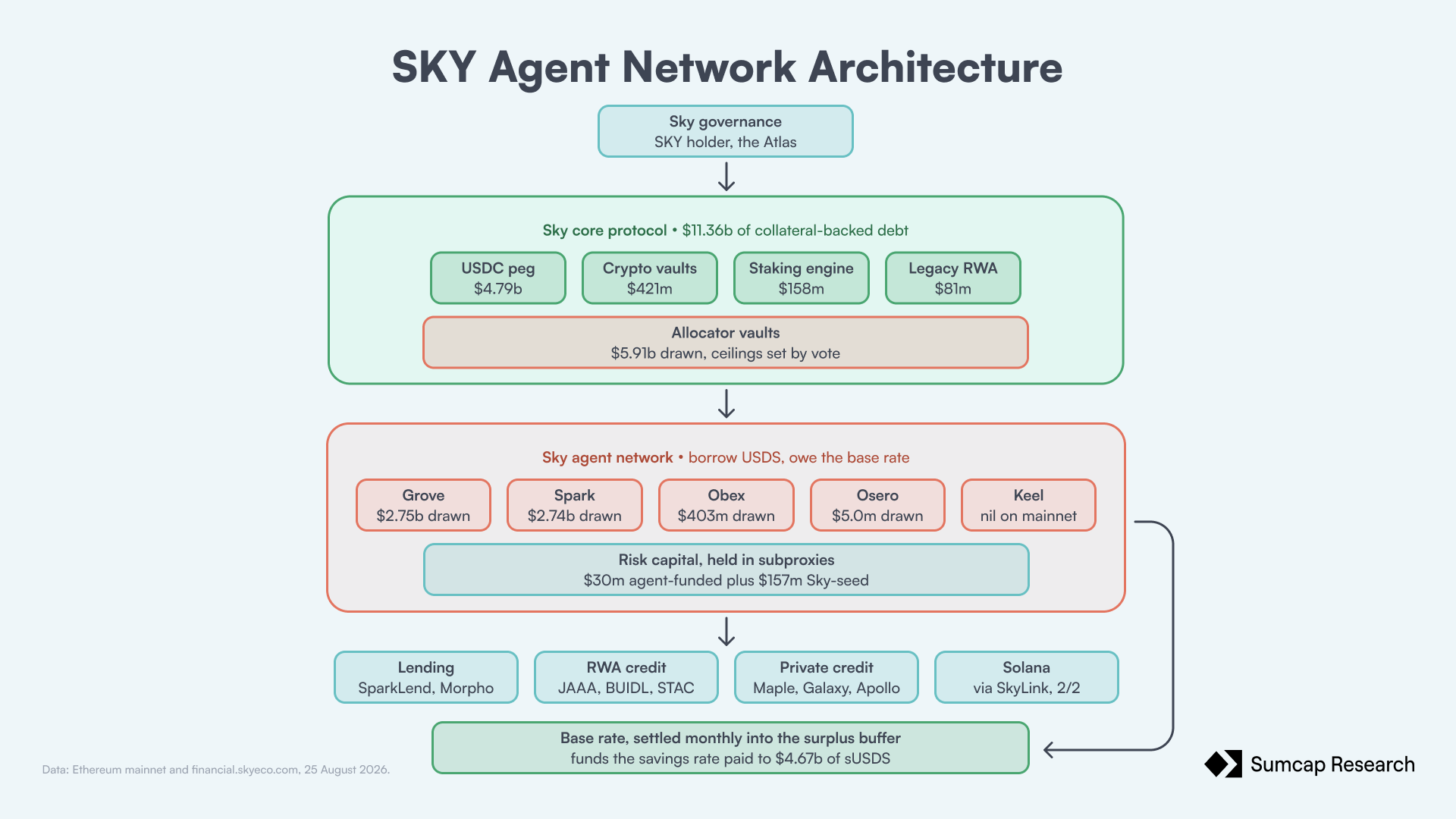
Agent is the functional role: any unit that draws $USDS and deploys it. Prime Agent is the standing designation for the units that borrow from Sky at the Base Rate and deploy into whitelisted opportunities. There are five: Spark, Grove, Obex, Keel and Osero. Sky used to call them Stars; that term has been retired. Spark and Grove have gone furthest, each with its own token and its own governance, effectively a mini-protocol inside Sky, but that is a difference of maturity rather than of status.
A second role sits alongside them. Executor Agents do not allocate capital, they run the protocol's operations. Amatsu and Ozone hold that role and produce the monthly settlement calculations that appear later in this piece.
Every Prime Agent is granted a dedicated Allocator Vault. Through that vault the agent can draw newly issued $USDS up to a ceiling that governance sets. No collateral is posted against the debt line itself. What the agent must fund instead is Risk Capital, held in a separate account and sized by the Capital Requirement Ratio: a percentage of each allocation, set according to what that allocation is invested in. Risk Capital is the first thing a loss consumes, and the loss waterfall section returns to it.
The agent deploys the drawn $USDS into yield-bearing strategies and owes a governance-set Base Rate on the amount it has drawn.
No interest accrues against the agent's vault day to day. Once a month governance executes a settlement that mints fresh debt inside the agent's own vault and transfers the proceeds to a reserve called the Surplus Buffer. In July 2026 that meant creating $9.5m of new debt in Spark's vault, $9.7m in Grove's, and $2.5m in Obex's. This means that no agent has to send money. Each simply owes more than it did the month before, and the protocol books the difference as revenue.
From the Surplus Buffer, that revenue funds the Sky Savings Rate paid to anyone who deposits $USDS into the savings module.
The Base Rate is uniform. Every Prime Agent borrows at the Sky Savings Rate + 20 bps Distribution Reward Fee, 3.72% in August. There used to be a second component: governance levied a further 10bps called the Sky Spread, which the Atlas describes as the margin Sky retains for facilitating the ecosystem's financing. An Atlas edit in July 2026 cut it to zero, this means that on the agent book; the margin Sky reserves for itself is now nothing at all.
What varies is how much of the rate Sky actually charges. The Atlas carries provisions for subsidised borrowing and for reimbursing direct exposures, so an agent's book splits between capital paying the full rate and capital that is exempt, and what qualifies is decided by governance and kept as a list of named exposures. Spark's Uniswap v4 stablecoin pools are the clearest case. They earn swap fees that come nowhere near the Base Rate on the capital deployed, but the position exists to give $USDS depth, so Sky waives the rate and pays Spark separately for the adoption it drives.
The network's capital is concentrated in five agents.
5.1 Spark
Spark was the first to reach full independence, in June 2025, with its own token $SPK and its own governance. It runs three products.
- SparkLend: a lending market forked from Aave v3, lending against blue-chip collateral.
- Spark Savings: a set of vaults that take in several stablecoins and route them into $USDS-backed yield.
- The Spark Liquidity Layer: a non-custodial router that moves stablecoins across pre-approved venues under hard, contract-enforced limits on how much can move and how fast.
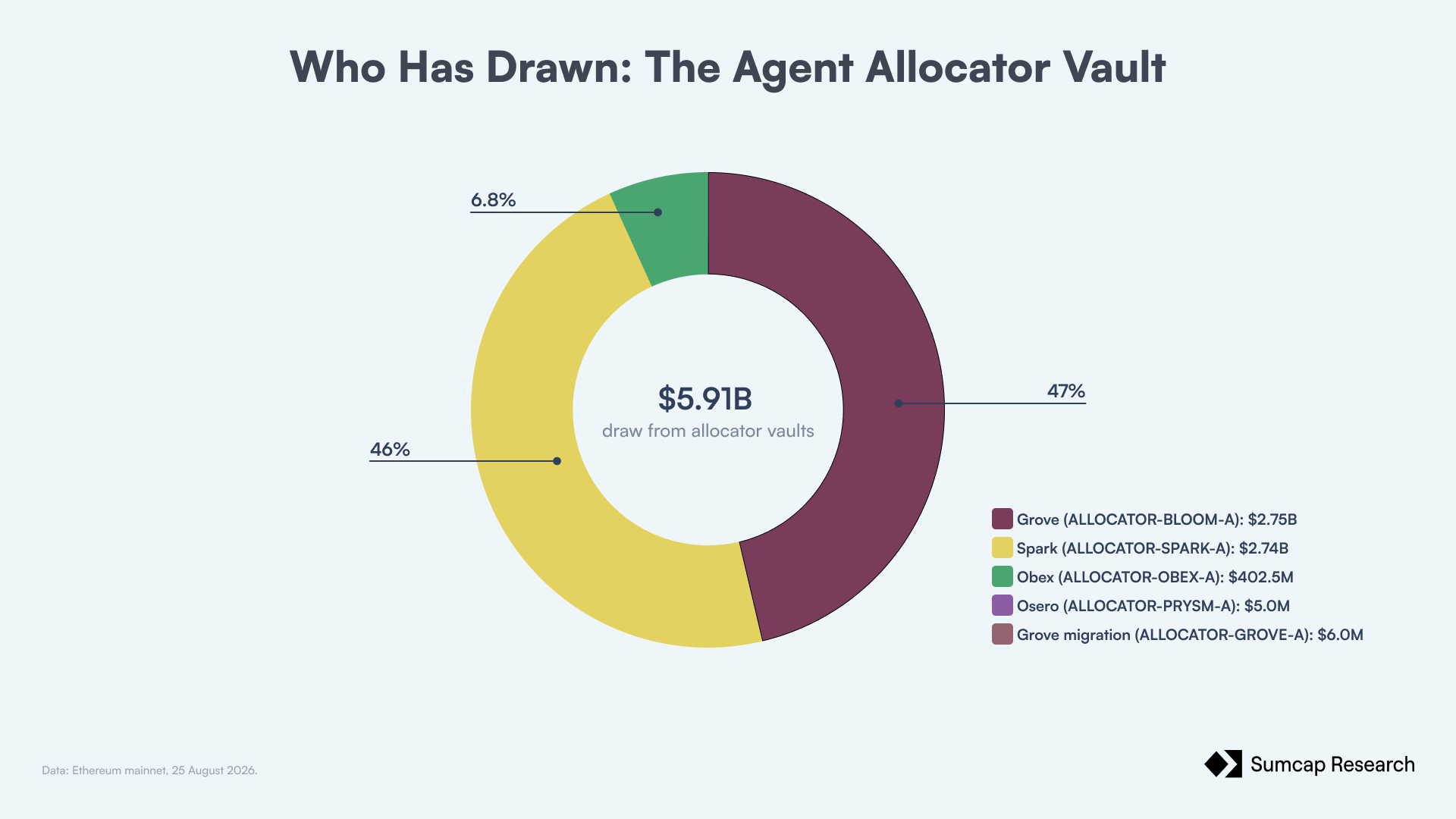
Spark's TVL is around $4.5b, the largest of any Sky agent, most of it held in the savings vaults and the SparkLend market, with a further $2.6b deployed through the liquidity layer. That dwarfs the roughly $2.74b Spark draws from Sky, because Spark also intermediates billions in outside user deposits. Spark is defined less by any one strategy than by the plumbing itself, the layer that turns $USDS into working liquidity across DeFi.
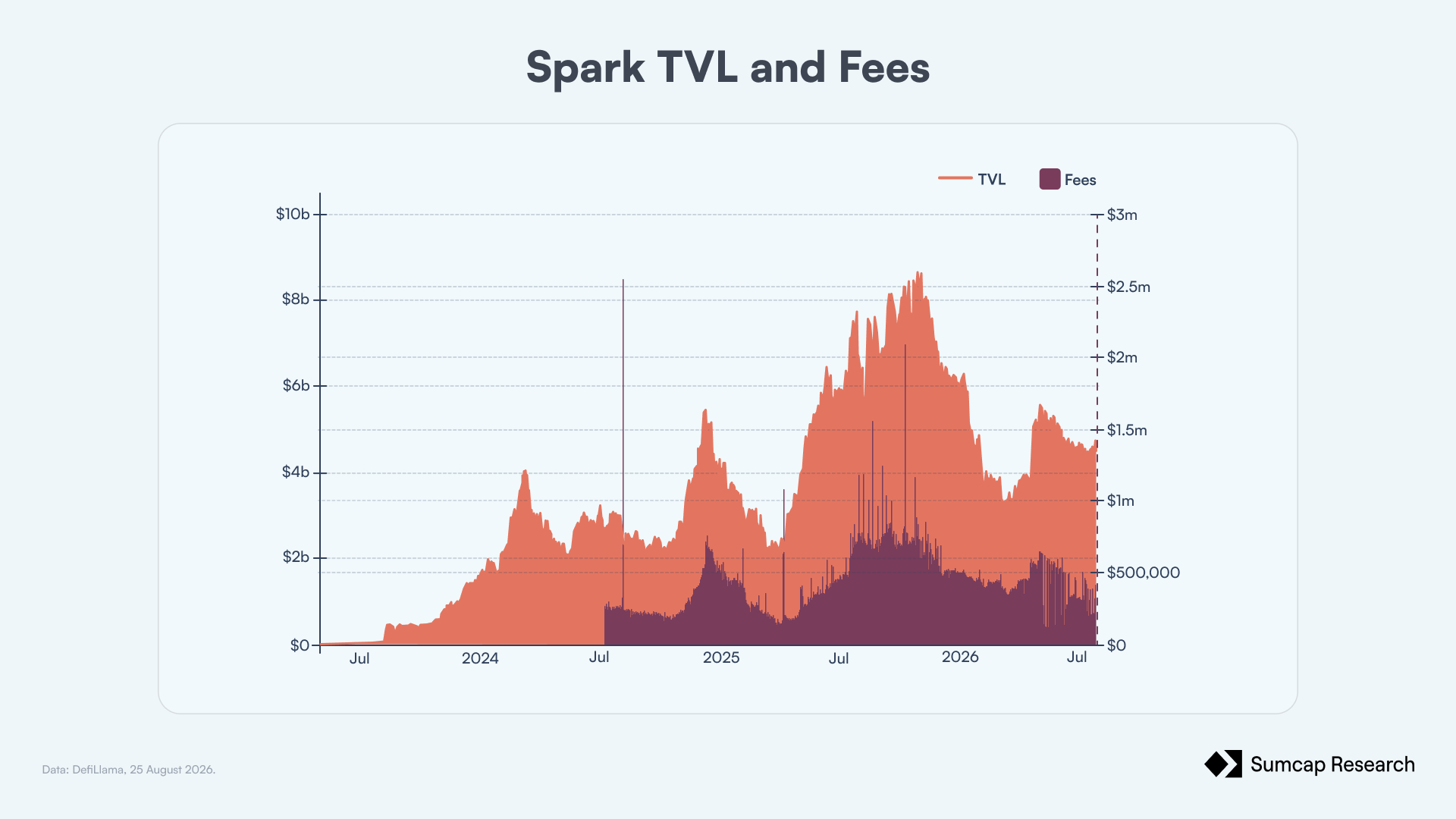
In the July 2026 settlement, $9.47m of new debt was minted into Spark's vault. Spark kept $3.41m of it and $6.06m went to Sky, which then paid Spark $1.03m back for the adoption it drives, leaving $5.02m with the protocol. That payment did not go to Spark as income; it went to Spark's subproxy, the account that holds its risk capital.
5.2 Grove
Grove was incubated by Steakhouse Financial and is the second Prime Agent and it describes itself as protocol credit infrastructure focused on settlement financing. Where Spark works in crypto-native lending, Grove deploys into offchain and tokenised structured credit from traditional finance.
Of the $2.75b Grove holds today, $1.53b sits in tokenised Treasuries, split between a Janus Henderson fund and BlackRock's BUIDL, which makes government paper the majority of the book. AAA CLO exposure is the next line at just under $500m, spread across two Janus Henderson vehicles issued through Centrifuge and a Securitize fund. The remainder is a $304m warehouse facility with Galaxy, roughly $92m of on-chain lending through Morpho vaults curated by Steakhouse, and small allocations to an Apollo credit fund.
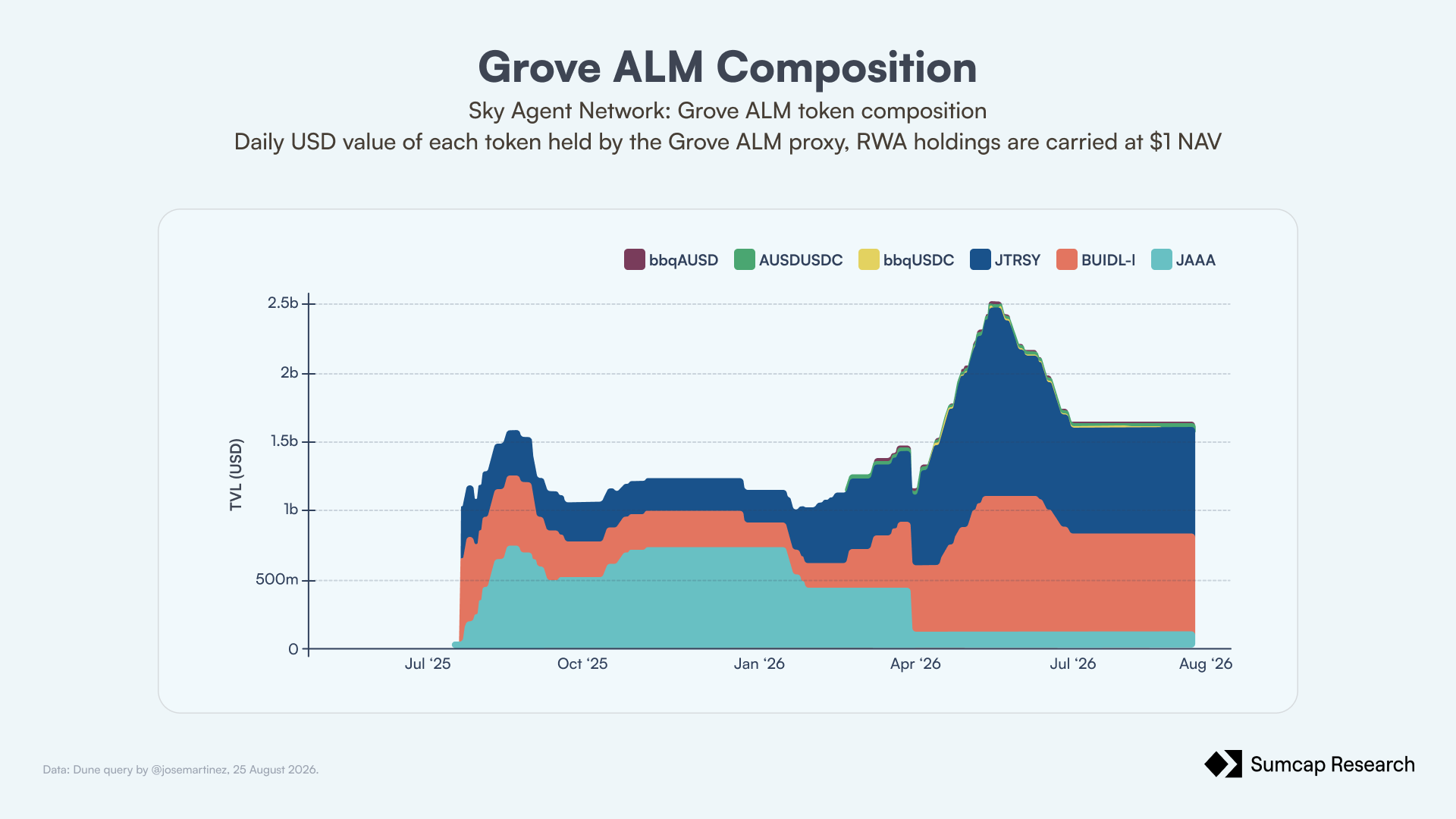
It has since added Basin, a facility offering up to $1b a day in stablecoin liquidity so institutions can redeem RWA instantly, and Grove Financing, a set of bespoke financing and liquidity solutions for tokenised asset issuers and credit originators. Through it, Grove gives partners access to capital via DEX liquidity, supply into lending markets, offchain private credit facilities, and structured products.
Grove draws about $2.75b from Sky, which makes it fractionally the largest borrower in the network, ahead of Spark. Its TVL sits near the same figure, because Grove is largely a conduit for Sky's own capital into institutional credit, which is the opposite of Spark's shape.
Grove's July settlement minted $9.69m, of which Grove kept $1.64m and Sky $8.04m, with $0.17m returned as adoption incentives. That left $7.88m with the protocol, the largest contribution of any agent that month, and roughly four fifths of what Grove's position generated. Spark handed over just over half of its own.
5.3 Obex
Obex is not an allocator in the same sense as the others. It is an incubator, and its job is to find institutional capital allocators, structure the legal and operational arrangements, and bring them into Sky as agents, so that each new firm does not have to build its own relationship with Sky. It is authorised to draw as much as $2.5b and today it draws about $402m, against a live ceiling of $450m that ratchets upward as it proves itself. At the latest dashboard snapshot, Obex owed approximately $402.5 million to Sky and held around $403 million of deployed assets, all of it in Maple’s syrupUSDC.
Its inaugural cohort also includes Securitize, Centrifuge, Daylight, USD.ai, Better, River, and TVL Capital, and was announced with up to $1 billion of aggregate deployment. For now, however, only Maple appears as an active allocation in Obex’s book.
The other names represent its broader onboarding pipeline.
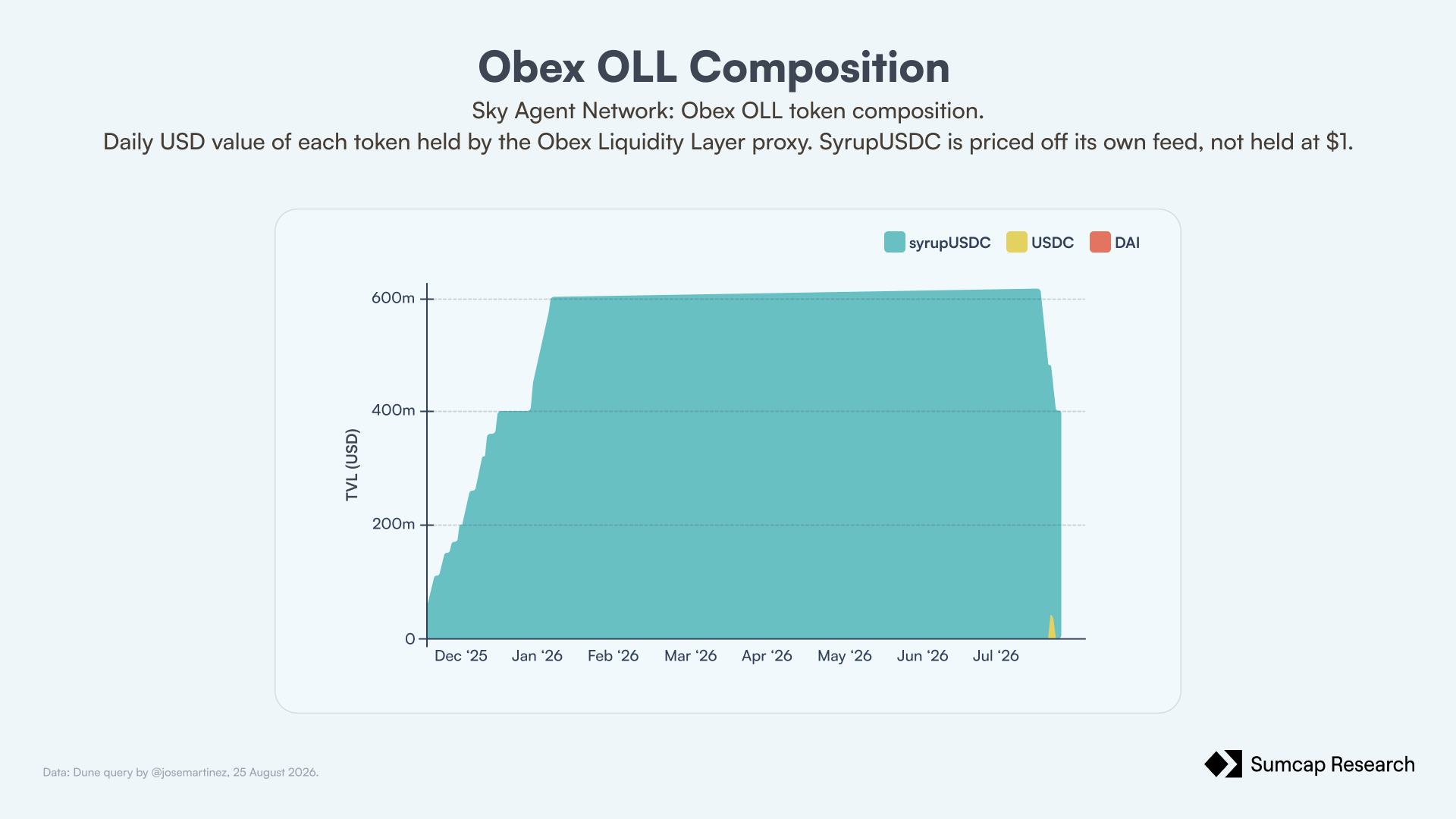
Obex runs its own liquidity layer, modelled on Spark's, with the same style of rate limits. Its July settlement minted $2.54m, split $0.85m to Obex and $1.69m to Sky, with $0.07m returned as incentives.
5.4 Keel
Keel launched in September 2025 as Sky’s Solana-focused allocator. Unlike the other agents, its Ethereum mainnet allocator vault shows no outstanding debt. Instead, the $USDS it deploys on Solana is bridged through SkyLink, Sky’s cross-chain infrastructure, and allocated across the chain’s lending and liquidity markets. Keel began as Sky’s beachhead into a non-EVM ecosystem, with an initial deployment of roughly $10 million. It later launched Tokenisation Regatta, a separate initiative aimed at attracting up to $500 million of tokenised real-world assets to Solana, while its broader mandate has since expanded beyond the chain.
5.5 Osero
Osero is the fifth Prime Agent, the newest, and the only one whose main business is not allocation. It was incubated by Stablewatch, a stablecoin yield analytics firm, in partnership with Soter Labs, and operates as a legally separate foundation with Stablewatch as its core contributor. In May 2026 it raised $13.5m in a seed round co-led by Sky itself and Plasma, and announced that the money would serve as the risk capital backing its first allocations.
Its mandate runs in two directions. One is distribution: Osero Earn lets wallets, neobanks, custodians and exchanges embed the Sky Savings Rate in their own interfaces, and Osero App offers the same rate directly. The other is allocation, through Osero Foundry, an origination platform for asset managers and fund issuers, with $2.5b of capacity extended by Sky. It earns on both sides, taking a share of the balances it distributes and the spread between what its allocations return and the Base Rate it pays.
On-chain, almost none of that has happened yet. The vault carries $5.0m of drawn $USDS against a $7.0m ceiling, all of it supplied into SparkLend. Its ceiling was cut in July from $10m to $5m while the plumbing was rebuilt, and governance has since raised it again.
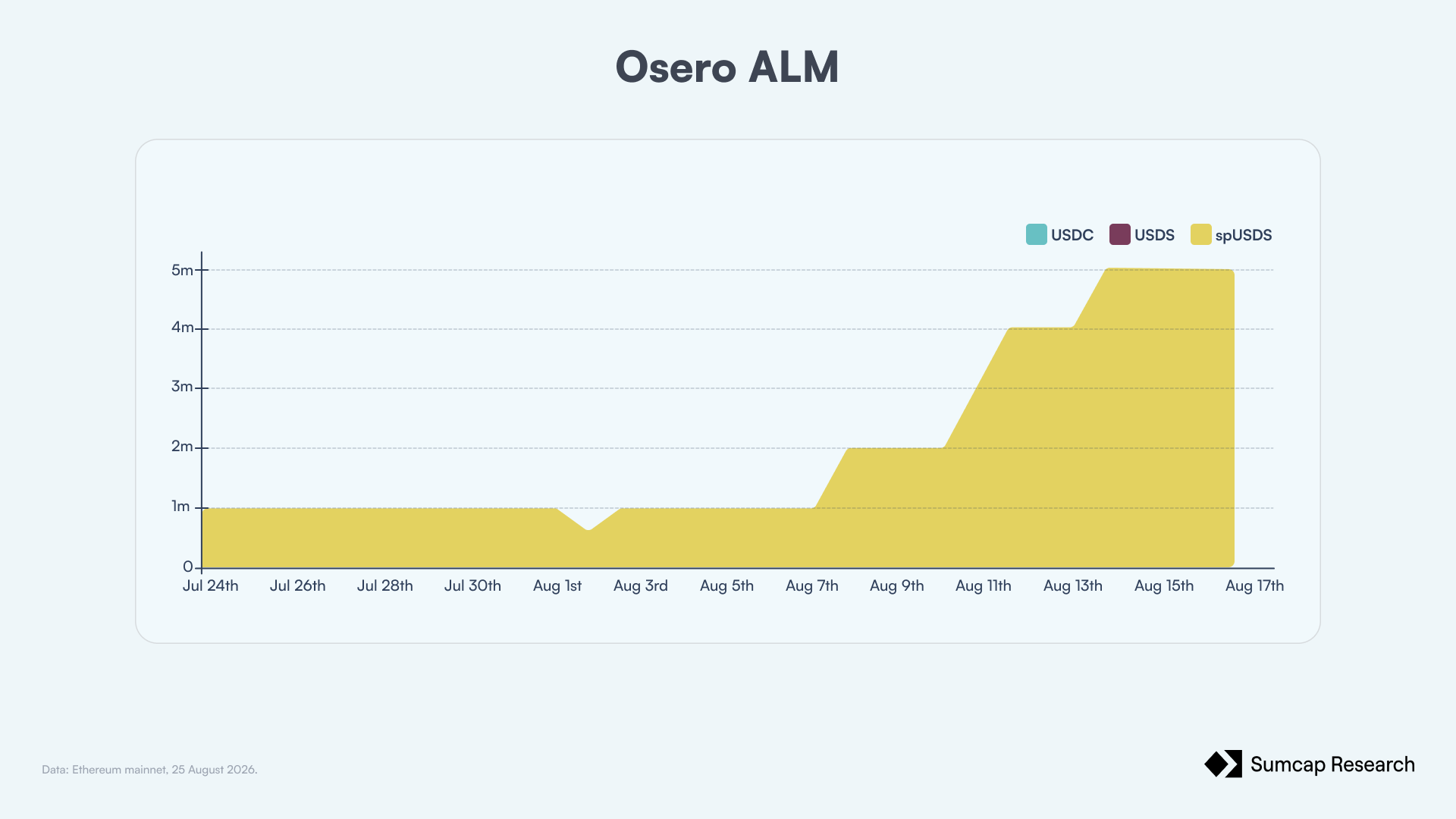
Behind the five sit vaults that are plumbed and undrawn: Pattern at a $50m ceiling and Interval at $10m. Amatsu and Ozone are not in this queue at all as they are Executor Agents, and their function is different.
5.6 Balance sheet
Sky's ledger records what it has lent and against what. When an agent draws $USDS from its vault and buys tokenised Treasuries with it, the ledger still shows a loan to that agent, because the ledger stops at the point the money leaves. Understanding the balance sheet therefore means reading it twice, once for what Sky has issued and once for what the money ended up in.
5.6.1 Debt
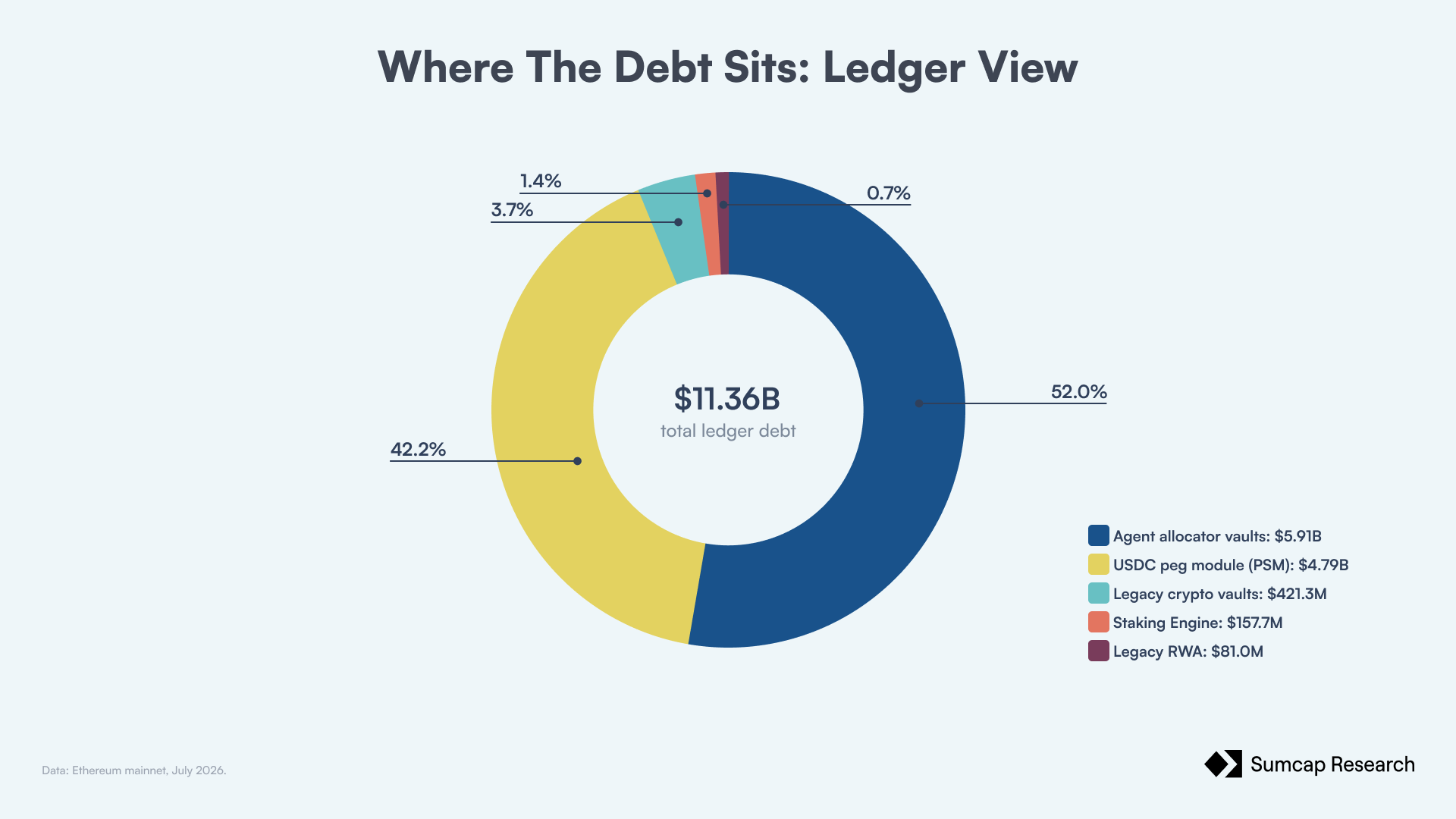
The first is the ledger view, and it is the one governance controls, because ceilings are what votes adjust. Reading every registered debt line directly gives $11.36b of collateral-backed debt. Just over half of it ($5.91b) sits in the agent vaults, and another $4.79b sits in the USDC peg module. The remainder is legacy crypto vaults still carrying $421.3m, mostly in two of the original $ETH lines. The Staking Engine holds $157.7m, and $81.0m of Centrifuge-era RWA survives across four lines.
One figure needs care. The protocol's headline debt is $12.04b, larger than the sum of those lines, because it also counts $681m of debt that no borrower owes. That amount was created to pay the savings rate, and it exists as the accounting counterpart of interest already handed to depositors. That $681m is the gross figure, accumulated over years of paying savings. Against it the protocol holds $621m of surplus it has earned back, and the difference between the two, negative $60.42m, is the OCB. These are ledger figures, not market ones. A good part of that debt is stablecoin the protocol has minted into its own peg module and not yet sold, so the amount actually circulating is smaller: $9.75b against the $12.04b the ledger records.
5.6.2 USDS allocation
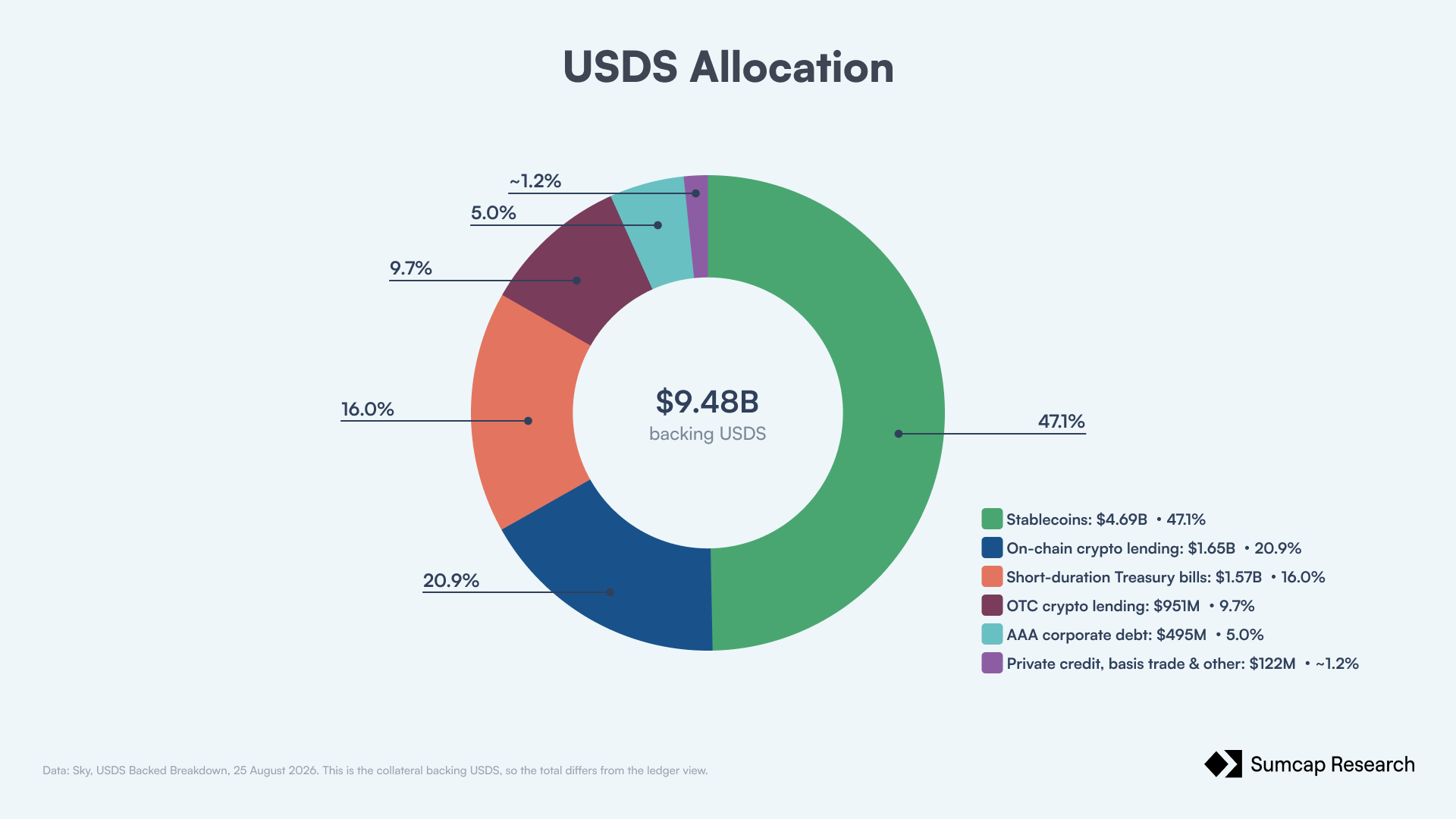
The second is the look-through view, where the money works once agents have deployed it. There the composition is 47.1% stablecoins, mostly $USDC earning T-bill yield, 16.0% in short-duration Treasury bills through Janus Henderson and BlackRock, and 5.0% in AAA-rated corporate debt and collateralised loan obligations. On-chain lending structured only around blue-chip assets is 20.9%, and over-the-counter lending governed by legal agreements rather than smart contracts is another 9.7%. The remainder, just over one per cent, is private credit and basis trade.
5.7 The capital requirement
How much capital an agent must hold against each of those positions is set in the Atlas, position by position, and changed by governance vote.
Every allocation an agent makes carries a Capital Ratio Requirement, a percentage set according to what the money is invested in, and multiplying the two gives the capital the agent must hold against that position. The percentages run from nothing to everything, and each is a governance judgement about what that particular thing can lose: private credit, warehouse facilities, tokenised CLOs and a basis trade at a prime broker all carry different weights, and the same asset held on a different chain carries a different weight again.
The number that matters most is zero. Tokenised Treasuries require no capital at all. Neither Grove's $858m of Janus Henderson paper nor its $668m of BlackRock BUIDL generates a single dollar of requirement, and nor do the $150m of Uniswap pools that give $USDS its depth. Between them, positions weighted at zero account for most of what the two largest agents hold.
The requirement is then measured against what the agent actually holds. That ratio has a name, a constitutional reference and a ceiling: Sky calls it the Encumbrance Ratio and requires it to stay below 90%.
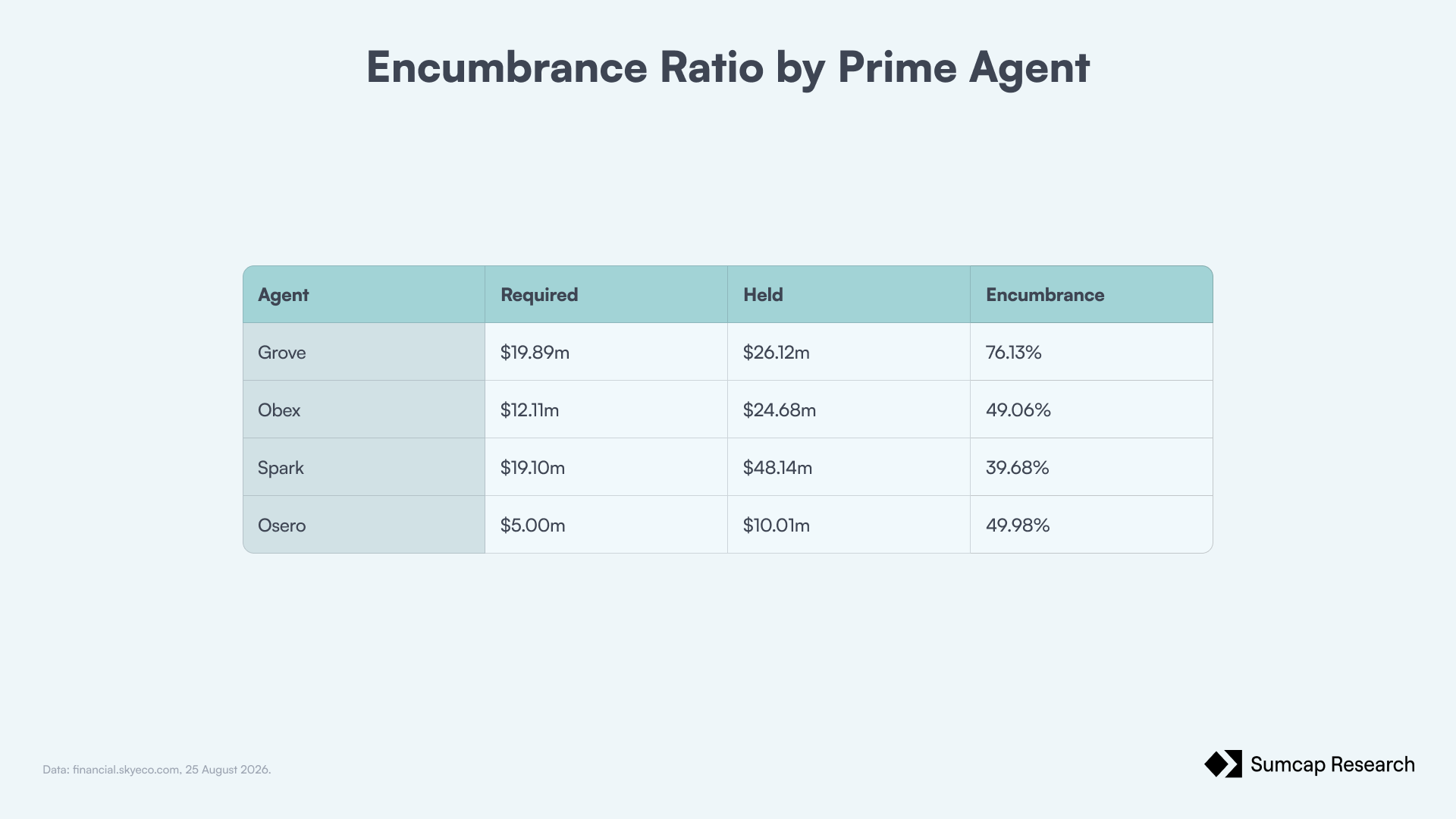
Grove and Spark need almost exactly the same capital, $19.89m against $19.10m, on books of similar size. Spark holds nearly twice as much of it. Grove sits at 76.13% with $3.62m of headroom, and Sky's own dashboard flags it as approaching the limit. It is the most encumbered agent in the network, and it is also the one running the most conservative book by risk weight. Both are true, and they have the same cause.
What happens when the requirement turns out to have been wrong is a separate architecture.
5.8 The loss waterfall
Sky publishes its loss absorption as six steps, four capital reserves followed by two recovery options. The stated priority is that every $USDS stays worth a dollar, and the ordering exists so that the parties earning the most sit closest to any loss.
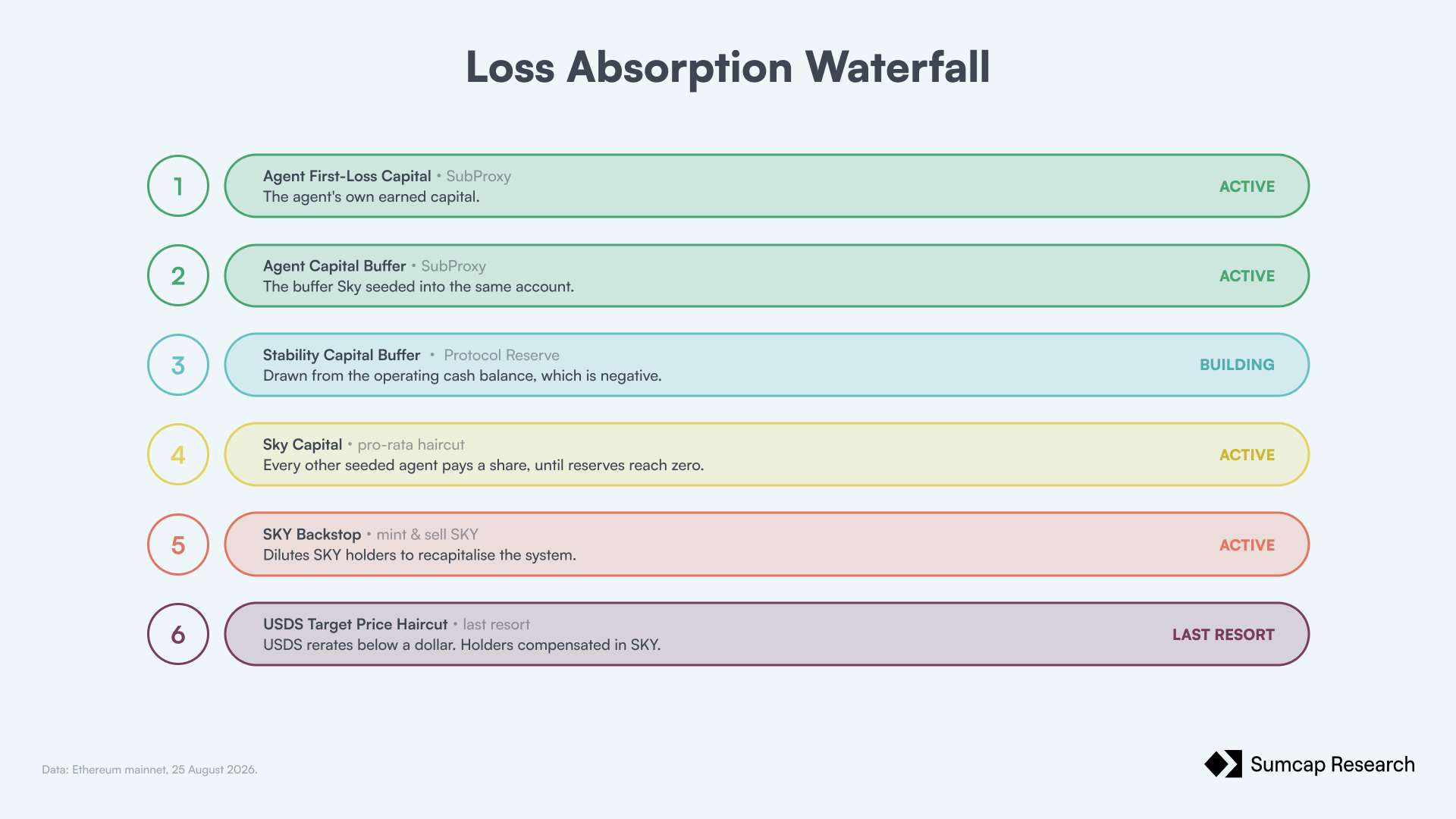
The architecture rests on one structural choice. Each agent operates two separate on-chain accounts. The allocator vault is where it draws borrowed $USDS to deploy. The subproxy is a distinct contract that holds its risk capital. Money reaches the subproxy from the agent's own funds and from Sky, through the Genesis seeding programme and the monthly settlement.
The subproxy is the agent's account, but it executes only transactions that Sky's governance has whitelisted in advance, through a permission module that governance controls. That arrangement is what makes the capital inside it both the agent's to lose and Sky's to reach.
Layer 1. The agent's own capital
Every loss lands first on capital the agent funded itself, and on nobody else. No other agent contributes, the protocol contributes nothing, and $USDS holders are untouched. The layer gives way only when that agent's own capital is fully consumed.
Sky defines that capital precisely: each agent's earned capital above the floor Sky seeded it with. It is not equity anyone injected. It is settlement income the agent has left in its account rather than taken out, and it only begins to count once the balance rises past what Sky put in. Below that line an agent can be earning steadily and still show nothing of its own.
The purpose is alignment. An agent that loses principal is not only out the capital itself; it then earns the same rate on a smaller base, so the loss carries into every period that follows.
Layer 2. The agent's seeded buffer
Each agent also holds a capital buffer inside the same subproxy, funded by Sky, through the Genesis programme that seeded the network. It absorbs next, and it still belongs to the agent that caused the loss. Losses remain contained to a single agent until that agent's own capital plus buffer is empty.
The Genesis programme is set to be phased out once Aggregate Backstop Capital reaches 125 million $USDS, each eligible agent's Genesis Capital is written down by a base of $1m a month plus a tenth of whatever the backstop exceeds that threshold by, and the write-down pauses if the backstop falls back under. Nothing is repaid: the reduction is an accounting one, and it lowers the amount subject to the layer-4 haircut. Sky is building toward a network where the protocol's own seed no longer stands behind its agents, and the agents' retained earnings do instead.
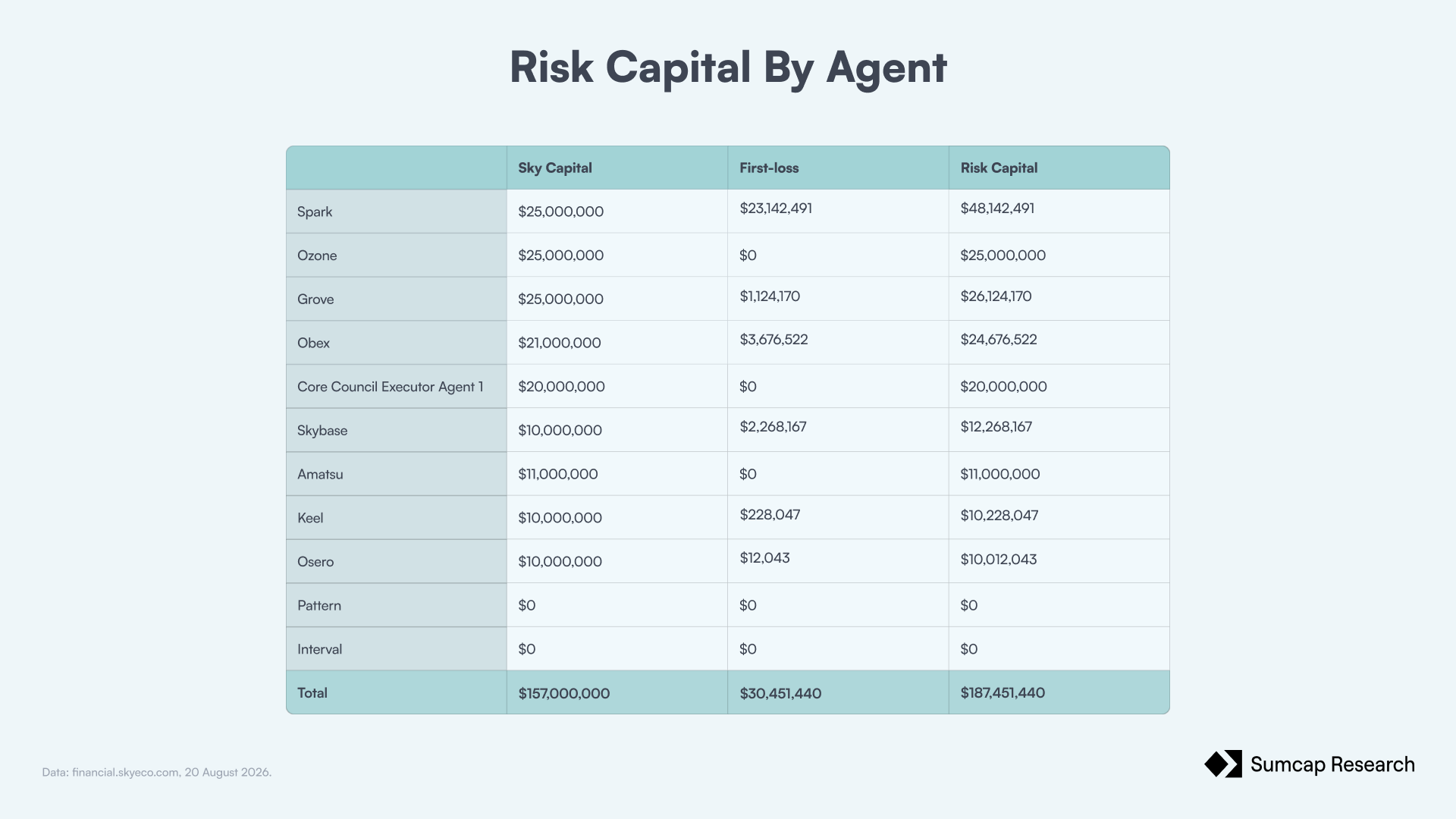
Agent-funded capital across the whole network is $30.45m against Sky's full $12.04b of debt. That is 0.25%. But more than $5.3b of that debt is the USDC peg module, which cannot lose money the way a deployed strategy can. Measured against the $5.91b the agents actually draw and deploy, agent-funded capital is 0.52%. It is also heavily concentrated: three quarters of it is Spark's, and Spark is no longer the largest borrower.
Adding the Sky-seeded buffers, the headline risk capital is $187.45m, about 1.5% of all debt. Sixteen per cent of that was put there by the agents. The rest is Sky's own money, held in the agents' accounts.
That figure is a stock rather than a defence, and two things cut it down before it reaches a $USDS holder.
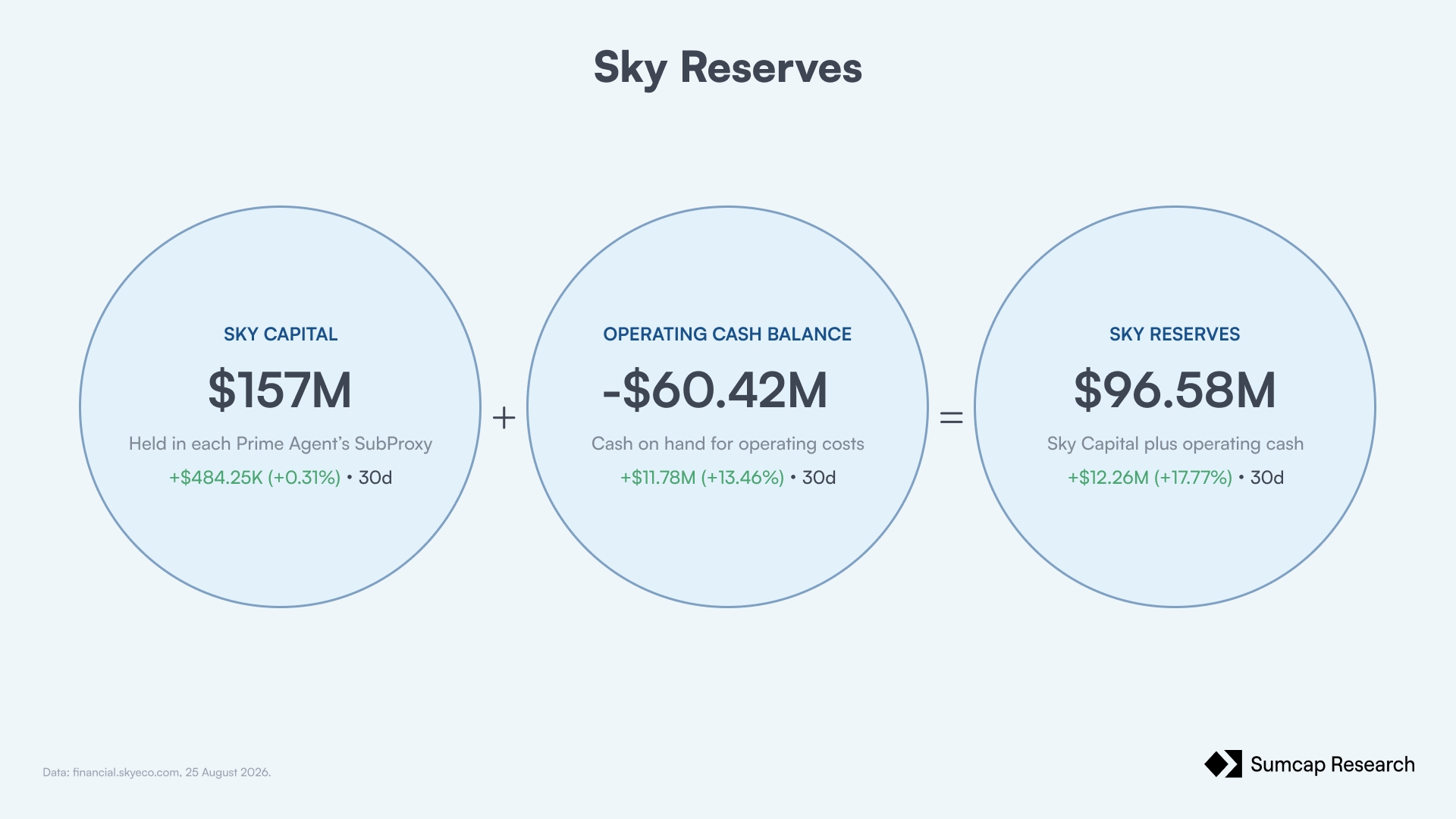
The first is the operating cash balance. The haircut stops once Sky's reserves reach zero. The Atlas defines the seeded capital that has already been spent as the negative of the surplus buffer, and subtracts it to arrive at what it calls Aggregate Backstop Capital. With the buffer at minus $60.42m, $157m of seeded capital becomes $96.58m of usable backstop.
The second is that each agent's own capital only answers for its own mistakes. Of the $25.13m the agents have funded between them, only the losing agent's share counts, and the rest never enters the calculation. So what stands in front of a holder depends on which agent fails, and by less than it should.
The thinness and the concentration are almost certainly part of why the outside assessment landed where it did. S&P Global rates Sky B-, putting its risk-adjusted capital ratio at 0.4% (as of July 2025) and citing weak capitalisation alongside depositor concentration and reliance on its founder.
Layer 3. The stability capital buffer
This is the protocol's own reserve, funded from its operating cash balance. It is currently unfunded, because that balance stands at negative $60.42m, so the layer absorbs nothing and losses pass straight through it. Fees and agent settlements increase it, while savings payouts, buybacks, operating costs, grants, and transfers into protocol-controlled buffers reduce it.
A transfer can therefore drain the Operating Cash Balance (OCB) even when it is not an expense and the $USDS remains under Sky’s control.
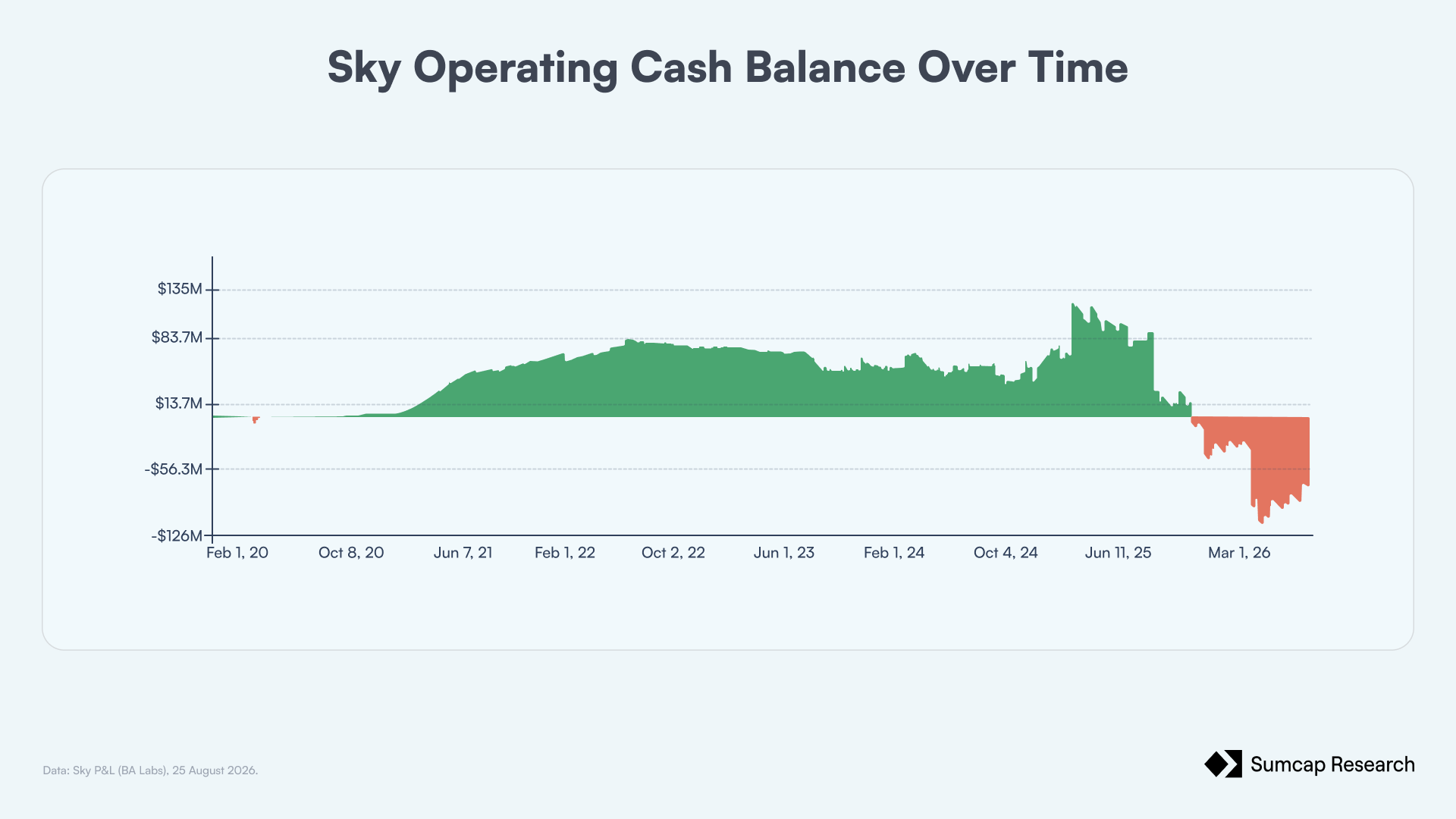
The first large drawdown came in June 2025, when Sky transferred $20.6 million of initial capital to Spark. Then in August another $62.3 million left the operating balance, including $50 million for the Sky Frontier Foundation, $10 million for the Fortification Foundation and roughly $2.3 million of liquidity funding, revenue sharing and operating payments. That package explains almost exactly the visible fall from around $90 million to $28 million.
Recurring savings payouts, buybacks and operating costs then continued to erode the remaining balance and in November, Sky authorised $21 million of Genesis Capital for Obex. With the OCB standing at roughly $16.5 million shortly beforehand, that transfer was sufficient by itself to push it below zero.
Further capital allocations to other subproxies deepened the deficit with $25 million for the Core Council Executor Agent, $15 million for Skybase, $70 million distributed across Amatsu, Ozone, Keel, and Launch Agent 6, and another $20.8 million for Grove. Protocol fees and monthly agent settlements periodically replenished the balance, which explains the upward rebounds in the chart, but they were not sufficient to offset the new allocations and recurring disbursements.
Those figures are what left the operating balance, which is not the same as what sits in each subproxy today.
Layer 4. Sky Capital
Here the loss stops being one agent's problem. Sky applies a pro-rata haircut to the seeded buffers of every other agent in the network, in proportion to what each one holds. The base is the $156.3m of seeded capital across the network, less whatever was already consumed at layer 2. The haircut continues until protocol reserves reach zero and the agents that have made no error still pay their share.
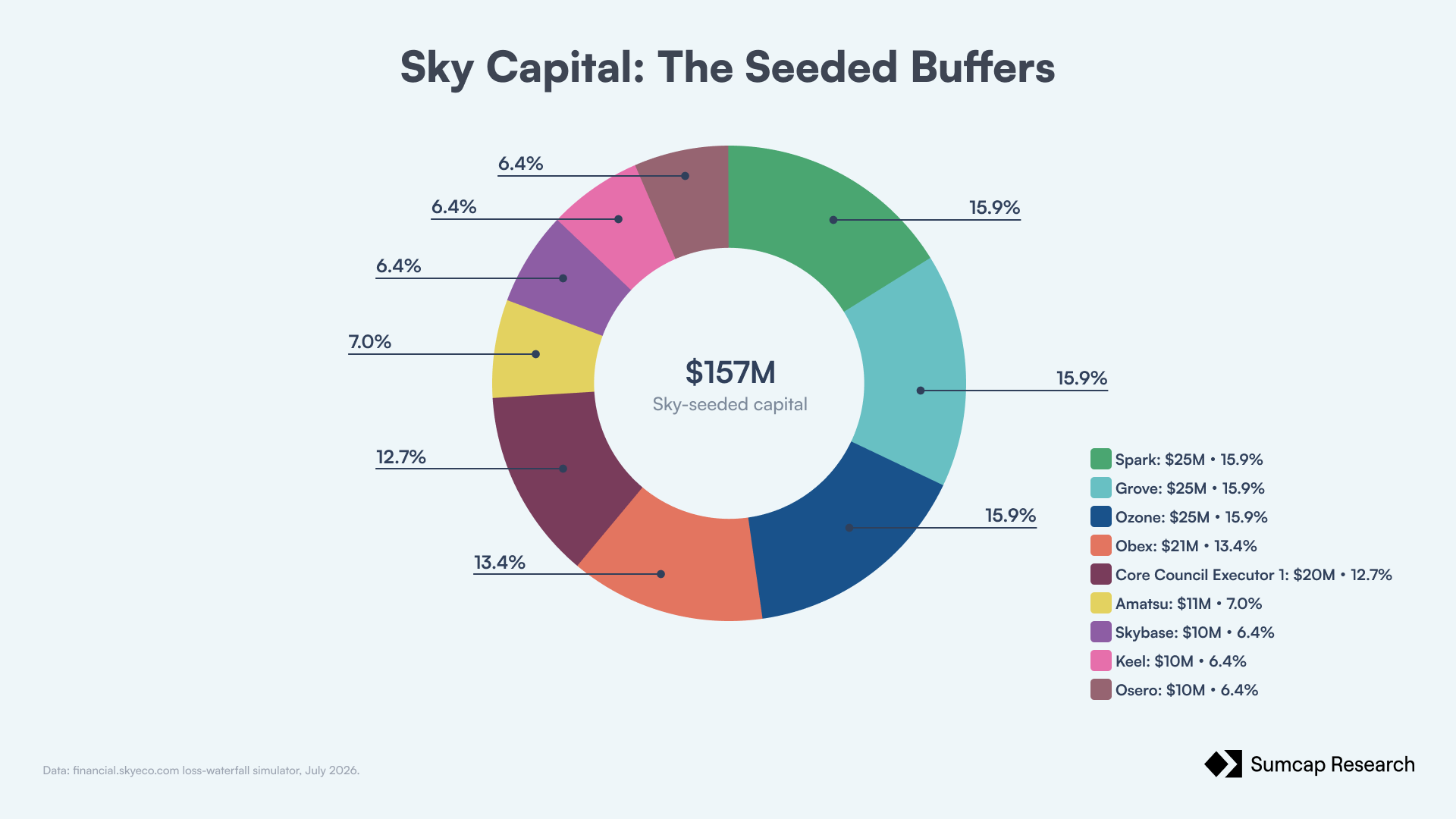
The agent subproxies are not sealed accounts, and governance can move capital through them for reasons that have nothing to do with losses. Allocations arrive split, so the Core Council executor's $25m landed as $20m in its subproxy and $5m elsewhere. Capital leaves again, as when $14m of Amatsu's $25m was transferred on to the Sky Frontier Foundation.
Importantly, this haircut is not automatic. The Atlas says these transfers are made through executive votes, may be made through emergency spells, and that a solution "must be developed" to accomplish them without waiting for the governance security delay. The largest loss-absorbing layer in the system is a manual governance action carrying a delay measured in days.
Layer 5. The $SKY backstop
With every reserve exhausted, governance mints $SKY and sells it to recapitalise. Sky classifies this as a recovery option, a contingent action rather than money standing ready, and the outcome of how much this backstop could help is uncertain, since it depends on market conditions and risk appetite at the moment it is needed.
In March 2020, after the crash left the system roughly $4.5m short, Maker ran the first and only debt auction in its history. It sold 20,980 $MKR across 106 lots between the 19th and the 28th of March 2020, raising 5.3m $DAI and closing the hole. The format was a reverse auction, with each lot bid at a fixed 50,000 $DAI and participants competing by accepting fewer tokens. The total dilution came to about 2% of supply.
Layer 6. The $USDS haircut
The last resort. $USDS rerates below a dollar and holders receive up to 24b $SKY as compensation. It is reached only after $SKY holders have been fully diluted and every agent's backstop capital has been seized.
$USDS and $sUSDS are the most senior claim, and that is the point of everything above it. The six layers are not a general reserve against adversity. They are a sequence built so that a loss has to pass through the agents, the protocol, and the token before it can touch the stablecoin. The whole structure exists to defend this one asset.
5.9 Who pays when the haircut arrives
Each agent's exposure at layer 4 is fixed by its share of the seeded capital, whatever the loss and wherever it happened.
The shares track seed size, so an agent's exposure to its peers' mistakes bears no relation to what it has borrowed or how it invests.
The published total of $157m overstates what is available. The haircut at layer 4 runs only until reserves hit zero, and reserves are defined as Sky Capital plus the operating cash balance. With that balance at negative $60.42m, only $96.58m of the $157m can absorb anything.
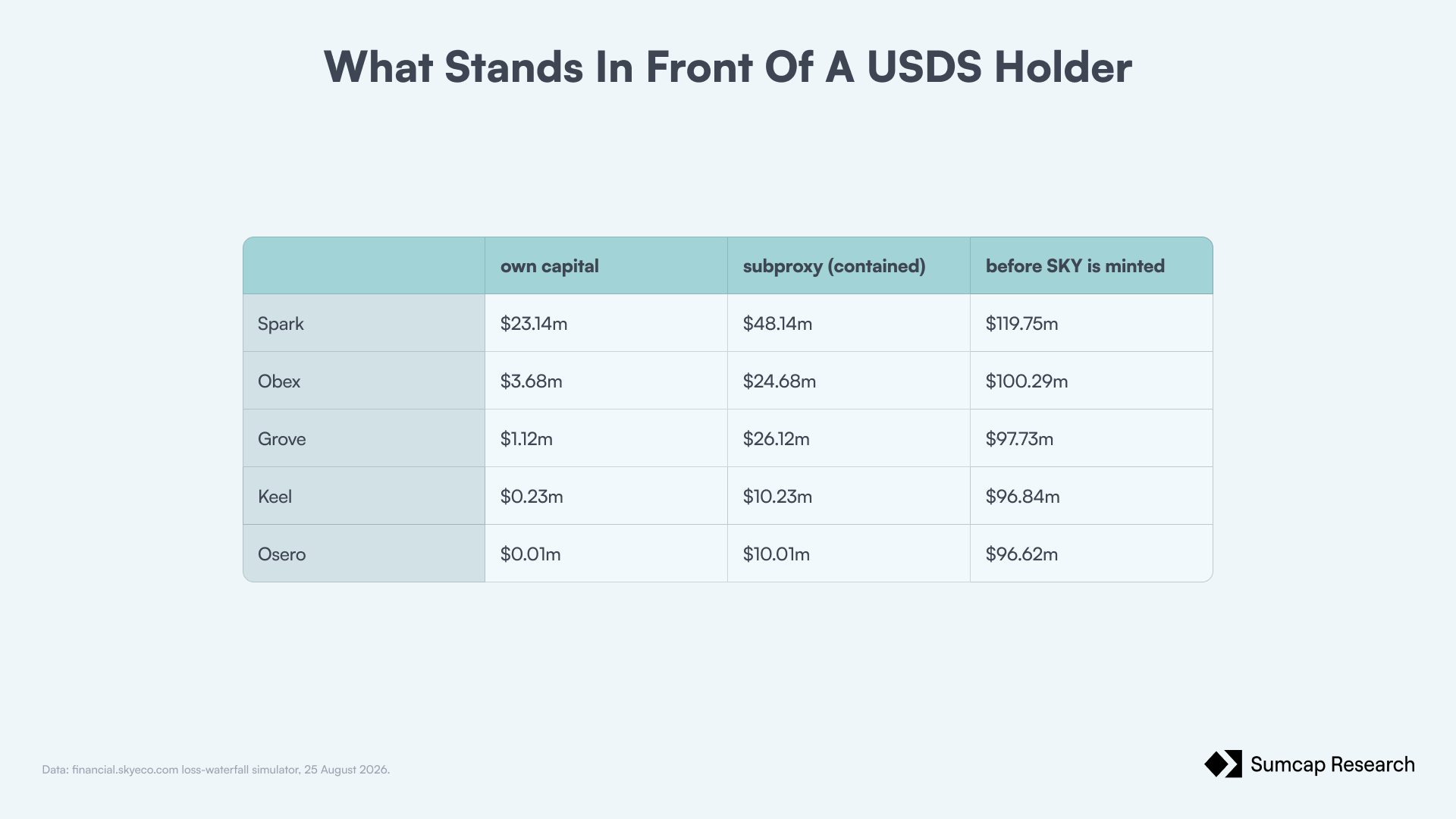
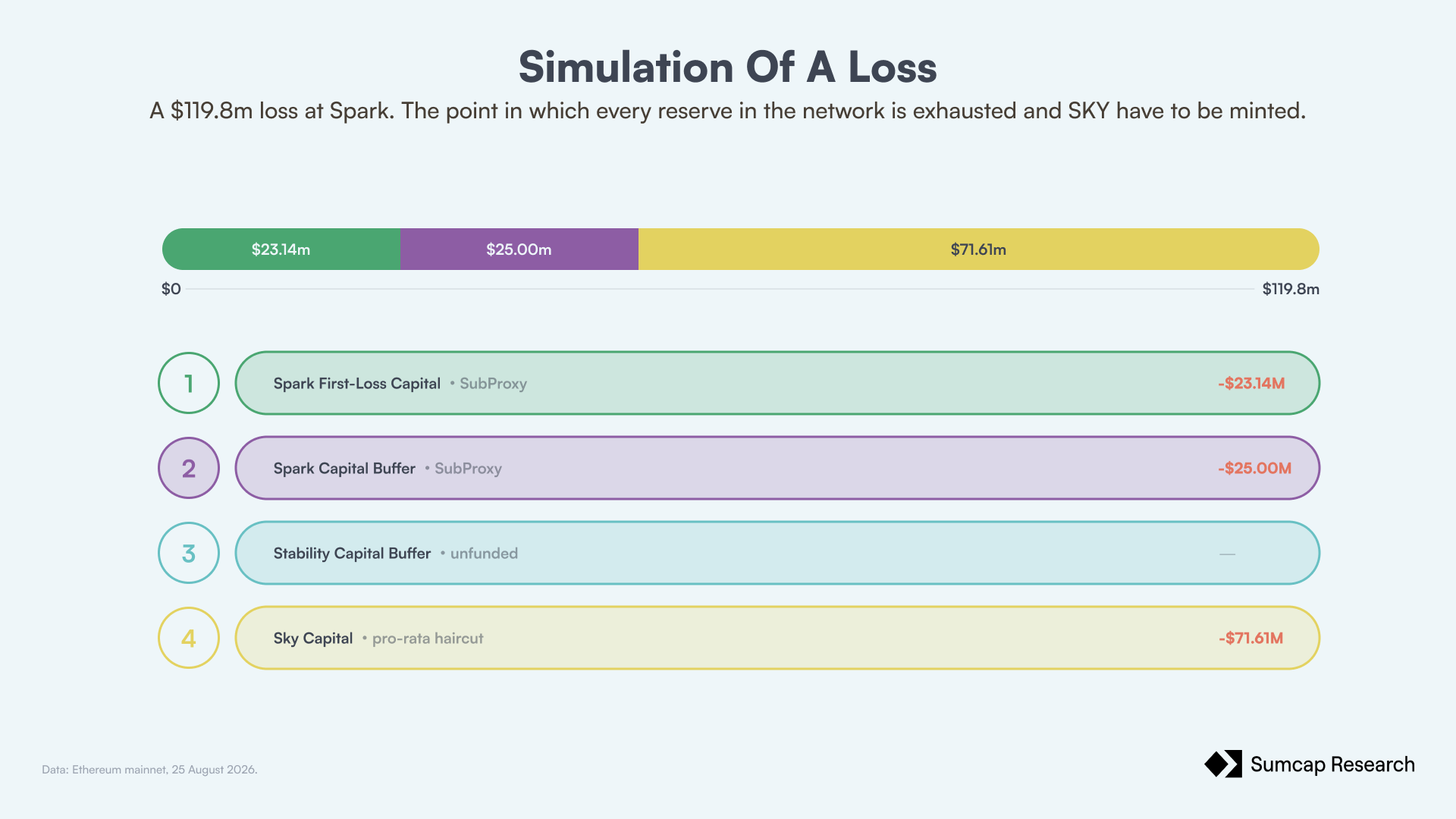
The practical consequence is a ceiling, and one that moves depending on who fails. A loss of about $119.8m at Spark is enough to consume its own capital, run through its seeded buffer, pass through the empty stability layer, exhaust every remaining reserve in the network and reach the point where $SKY has to be minted. At Osero the same point arrives at $96.62m. The gap between the best-defended agent and the worst is $23.1m, and all of it is money the agents put up themselves.
That $23.1m is what separates the two ends of a network holding $187.45m of risk capital against a $12.04b book. Everything else is the same pool, drawn on in the same order, whoever made the mistake.
The effect runs the wrong way round. Ozone holds the second-largest share of the pool, $25m, and has never drawn a dollar. Grove has drawn $2.75b and holds $26.12m. The agent that allocates nothing carries almost exactly the same exposure to everyone else's mistakes as the agent that allocates the most, and a haircut that lands on Ozone, Amatsu and the Core Council executor falls on capital that was never at risk in the first place, taken to cover a loss those entities had no part in and no ability to prevent.
5.10 Liquidity
Solvency is one half of resilience. The other is whether assets convert to dollars fast enough when holders leave together.
Sky binds itself to a rule. Assets redeemable for dollars are classified as Actively Stabilizing Collateral, and the Atlas requires that they never fall below 25% of the aggregate portfolio. The category splits in two.
- Resting collateral sits as on-demand limit orders, executable immediately.
- Latent collateral converts automatically into Resting within a short window.
Today the protocol holds $5b of it, $4.58b of that Resting, against a ratio of 50.44%. The protocol itself holds $4.54b, Spark holds $409m, mostly Latent, and Grove holds $45.6m. Every other agent holds effectively nothing.
The rule sets a floor. What it does not describe is shape, and shape is what decides whether a floor holds. For that Sky publishes a maturity ladder, sorting $9.66b of liquidatable assets by how long each one takes to turn into dollars, and modelling it twice: once under normal conditions and once under stress.
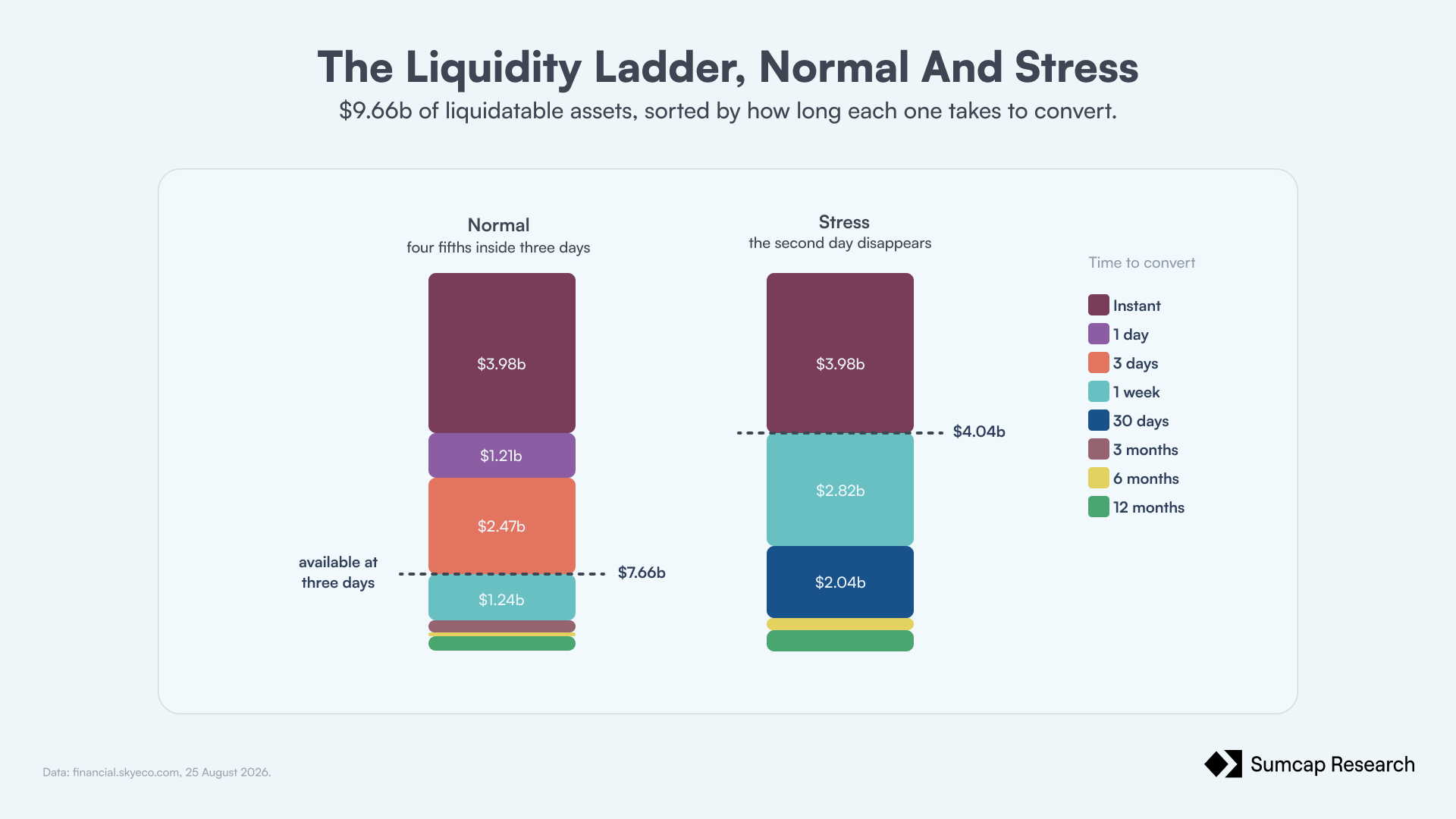
Under normal conditions, $3.98b converts instantly, another $1.21b within a day, and $2.47b more within three, so roughly four fifths of the book is available inside three days. Under stress that shape breaks. The instant layer is unchanged, but the one-day bucket collapses from $1.21b to $60.5m, a fall of 95%. Everything that made the second day work (the Galaxy warehouse, the PYUSD holding, the Uniswap pools, the tokenised funds at Centrifuge and BlackRock) moves out to a week or beyond. At the three-day mark, the point most people think of as the liquidity horizon, a stressed Sky has $4.04b rather than $7.66b.
Then there is what the instant layer is made of. All $3.98b of it is the Lite-PSM, the USDC peg module, and nothing else. Not one dollar of instant liquidity sits with an agent. The stablecoin reserves that back the peg are the same assets that make the portfolio liquid.
That is worth holding against the liability side. The savings module alone holds around $4.67b of $USDS earning the Sky Savings Rate. Instant liquidity does not cover it. Nearly all of the $9.75b of $USDS and $DAI in circulation can be turned into dollars eventually: the ladder reaches $9.66b at twelve months. What it cannot do is turn it into dollars quickly. Instant liquidity covers 41% of the circulating supply, and under stress that is still all there is at the three-day mark.
5.11 Bridges
Cross-chain infrastructure is the least mature part of Sky's design. SkyLink, Sky's own bridge, separates governance messages from token transfers and secures both through LayerZero Decentralized Verifier Networks (DVNs), which independently attest that a cross-chain message is valid. SkyLink's governance channel requires 4/7 DVNs on both Solana and Avalanche. Its token channel, the one that actually carries value, requires both LayerZero and Nethermind, a strict 2/2 configuration, so a forged transfer needs two verifiers compromised.
Spark runs a separate governance bridge to Avalanche of its own, also on 2/2. In April 2026 Spark said it intended to widen SkyLink's token verifier set and move its own Avalanche bridge to 4/7, although no subsequent official record confirms that either upgrade has shipped.
On Solana, a $5 million daily net transfer limit and emergency freezer roles are intended to contain the immediate damage. The less clearly specified case is a failure of SkyLink itself. A core bridge failure could create a protocol-level loss immediately and may not map cleanly to a single agent before emergency controls respond. The weakness is therefore not the absence of a backstop, but the gap between an instantaneous cross-chain failure and the slower process of attribution, containment, and recapitalisation.
6. Product lines
Everything the agent network earns has to reach users through something. Sky's product surface is the set of instruments that do that, and they differ mainly in how much risk the holder is taking to get paid.
$USDS is the base layer (the stablecoin) and the successor to $DAI. Holding it earns nothing on its own but can be used in DeFi. The combined supply across $USDS and $DAI sits near $9.75b, and Sky reports $9.71b of collateral backing it. A $USDS holder is the most protected participant in the system.
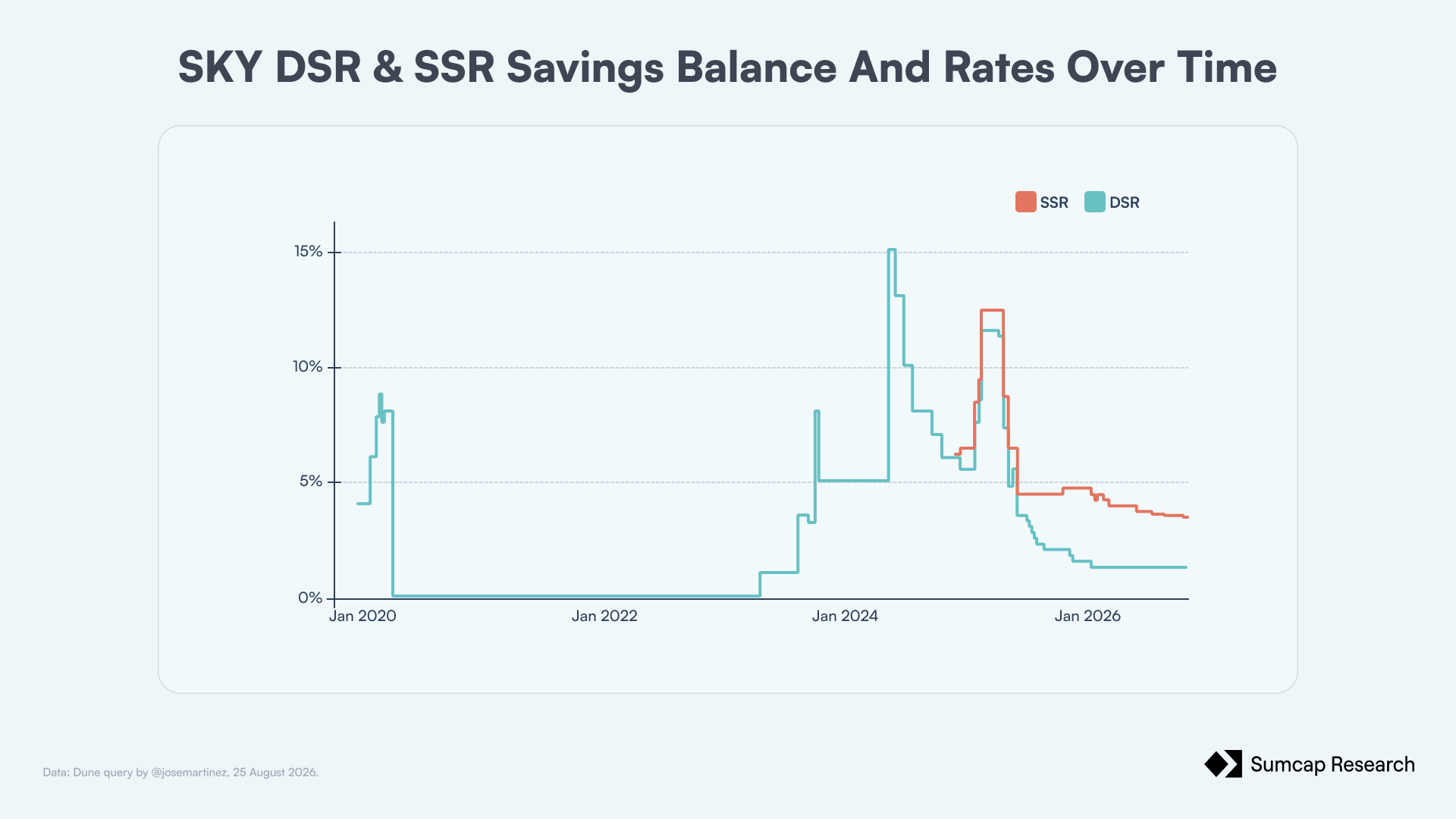
Depositing $USDS into the savings module returns $sUSDS, a token whose value grows against $USDS as the Sky Savings Rate (SSR) accrues to it every second. There is no lockup, no minimum, and no exit fee. The rate itself is set by governance votes and funded out of protocol revenue; SSR has moved between 3.5 and 4.8% over the past year as Treasury yields and competing on-chain rates have shifted. This is the main savings product, holding around $4.67b, and it has paid out $278.8m in interest since launching in September 2024.
$stUSDS is the sharpest departure, as it looks like a savings product but is not one. Supplying $USDS to the stUSDS module funds the borrowing that $SKY stakers do against their staked $SKY. Sky describes it as segregated risk capital where depositors provide insurance funds. If a staker's position is liquidated and the auction fails to cover the debt, that bad debt is written off against the $stUSDS pool, and governance slashing operations can hit it too. The yield is also higher than the $sUSDS yield, at more than twice the APY, reflecting that risk. When the capital is being borrowed, holders earn the $SKY borrow rate, and when it is idle, it falls back to the Savings Rate.
The collateral is valued in an unusual way, and it is what protects the pool. Rather than taking $SKY from the market, the system values it at the lower of the market price and a fixed oracle cap, currently $0.025, against a 120% liquidation ratio. With $SKY trading near $0.056, the system counts less than half of it. A rise in the price adds no borrowing capacity, and a fall changes nothing until the price crosses the cap. The effect is that the liquidation threshold sits where governance put the cap rather than where the market is, and a position borrowed to the limit is carrying close to 270% collateral.
Spark Savings extends the same yield to stablecoins that are not $USDS, and it now runs in two generations. The older vaults convert the deposit into $USDS through the PSM and park it in the Sky Savings Rate, so the depositor is holding $sUSDS exposure denominated in another currency. The newer ones, covering $USDC, $USDT, $PYUSD, and $USDG, are backed by $USDS but generate their return by deploying the underlying stablecoin through the Spark Liquidity Layer across vetted venues, with rates set by Spark's own governance rather than Sky's.
The backing is what places these holders alongside $USDS holders rather than below them, and the pooling is what makes that work. Deposits into the USDS, USDC, USDT and PYUSD vaults share the same underlying credit exposure and are gathered into common collateral portfolios regardless of which stablecoin came in. Spark is just the distributor, but the owner is Sky, and the structuring and origination sit with Sky.
Sky's products also circulate through the wider ecosystem. Pendle splits $sUSDS into principal and yield tokens for anyone wanting a fixed rate to maturity, and the stablecoins appear across Morpho, Sky Vaults, and Aave.
7. Sky financials
7.1 Revenue
Sky publishes a full income statement produced by BA Labs (Block Analitica), updated daily, and kept on an accrual basis, so revenue is recognised as it is earned. In the first eight months of 2026 the protocol recognised $298.83m of revenue and $164.91m of costs.
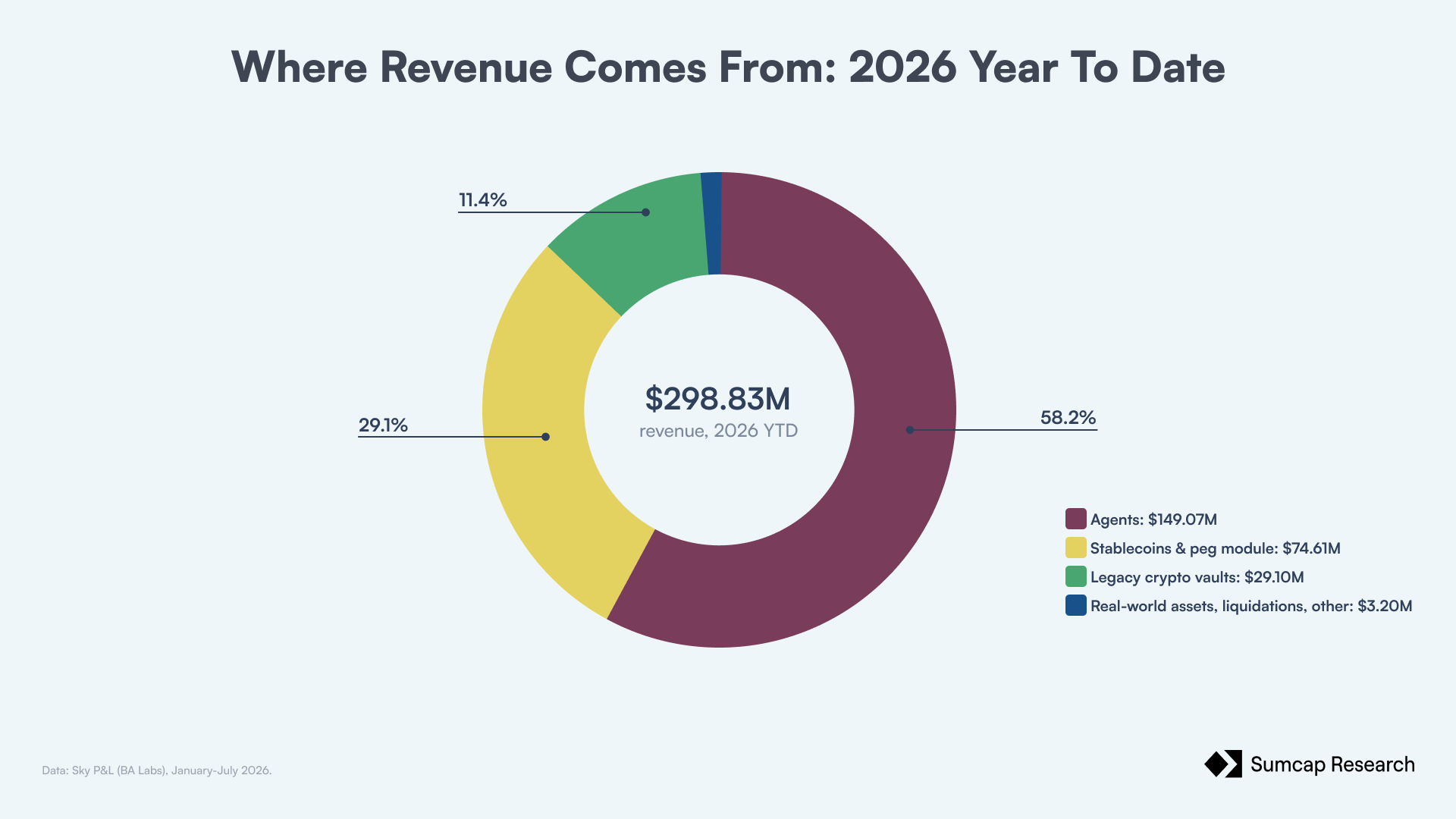
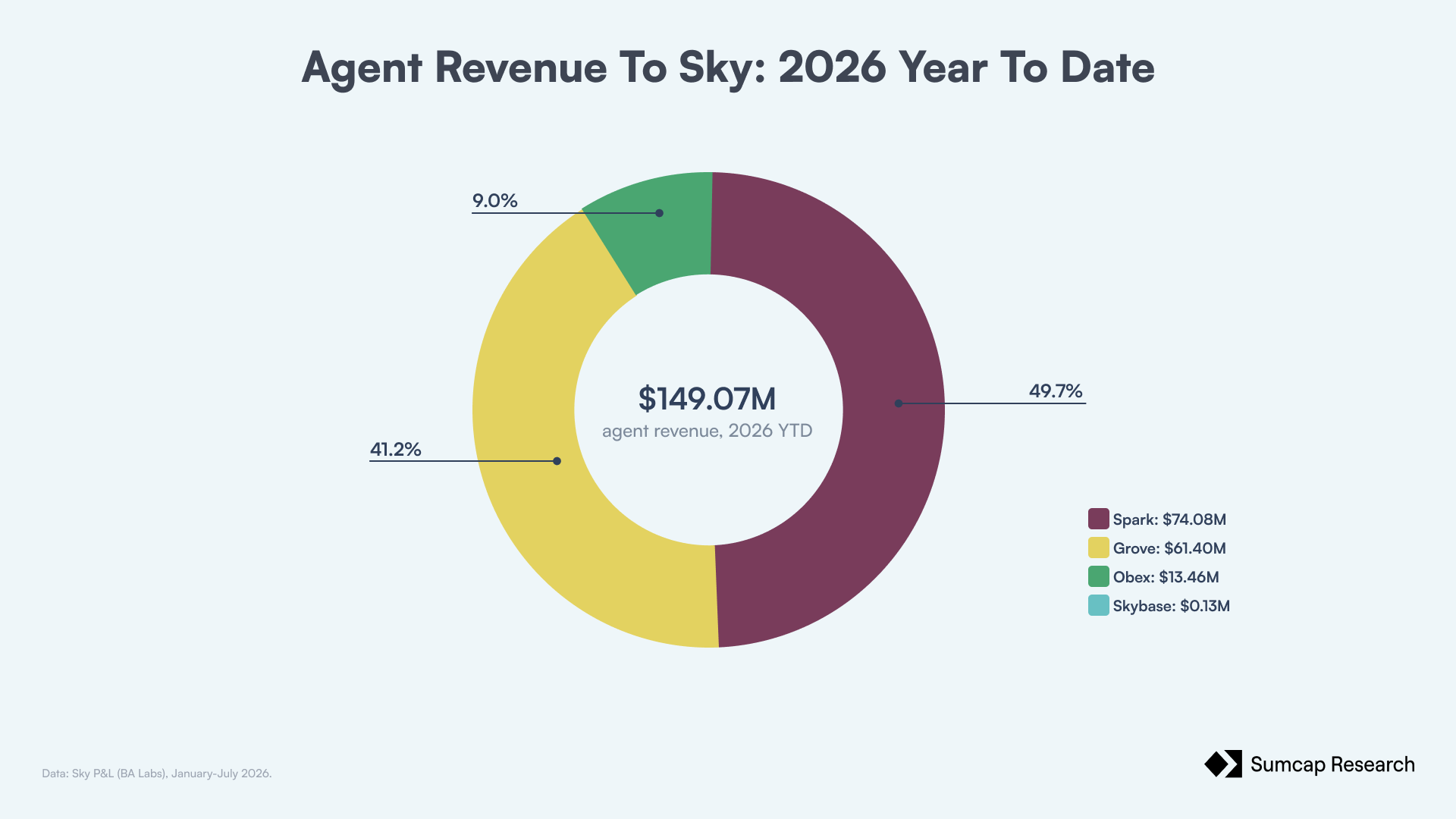
The agent network is the main Sky business: Spark contributed $79.90m, Grove $69.58m, and Obex $15.16m, with Osero booking its first $603 in August. About seventy percent of the rest comes from the $USDC in the peg module, which earns the T-bill rate while it waits. The third line is the old crypto vaults, which nobody markets and which cannot take on new borrowers at scale.
Nothing an agent owes accrues day to day. Read the blockchain and the interest rate is zero, and has been since 2025. Spark's rate index sits frozen at the level it reached before the change, a fossil of the old system.
Instead, the commercial settlement is calculated off-chain through the Monthly Settlement Cycle. The Operational Executor Agent, a role held by Amatsu and Ozone, produces the initial calculation, and Core GovOps, the operational arm of the Core Council, publishes the final calculation, and governance capitalises the result on-chain. The settlement does not move money from the agent but mints fresh debt inside the agent's own vault and transfers the proceeds to the protocol's surplus buffer. In July 2026 that meant creating $9.47m of new debt against Spark, $9.69m against Grove, and $2.54m against Obex. The minted figure covers both sides of the split, which is why it exceeds the share Sky retains.
Money does flow the other way in the same transaction. Agents can also be paid for the adoption they drive and reimbursed for exposures Sky has chosen not to charge for, so the July settlement sent $3.41m back to Spark, $1.64m to Grove, and $0.85m to Obex.
7.2 Expenses
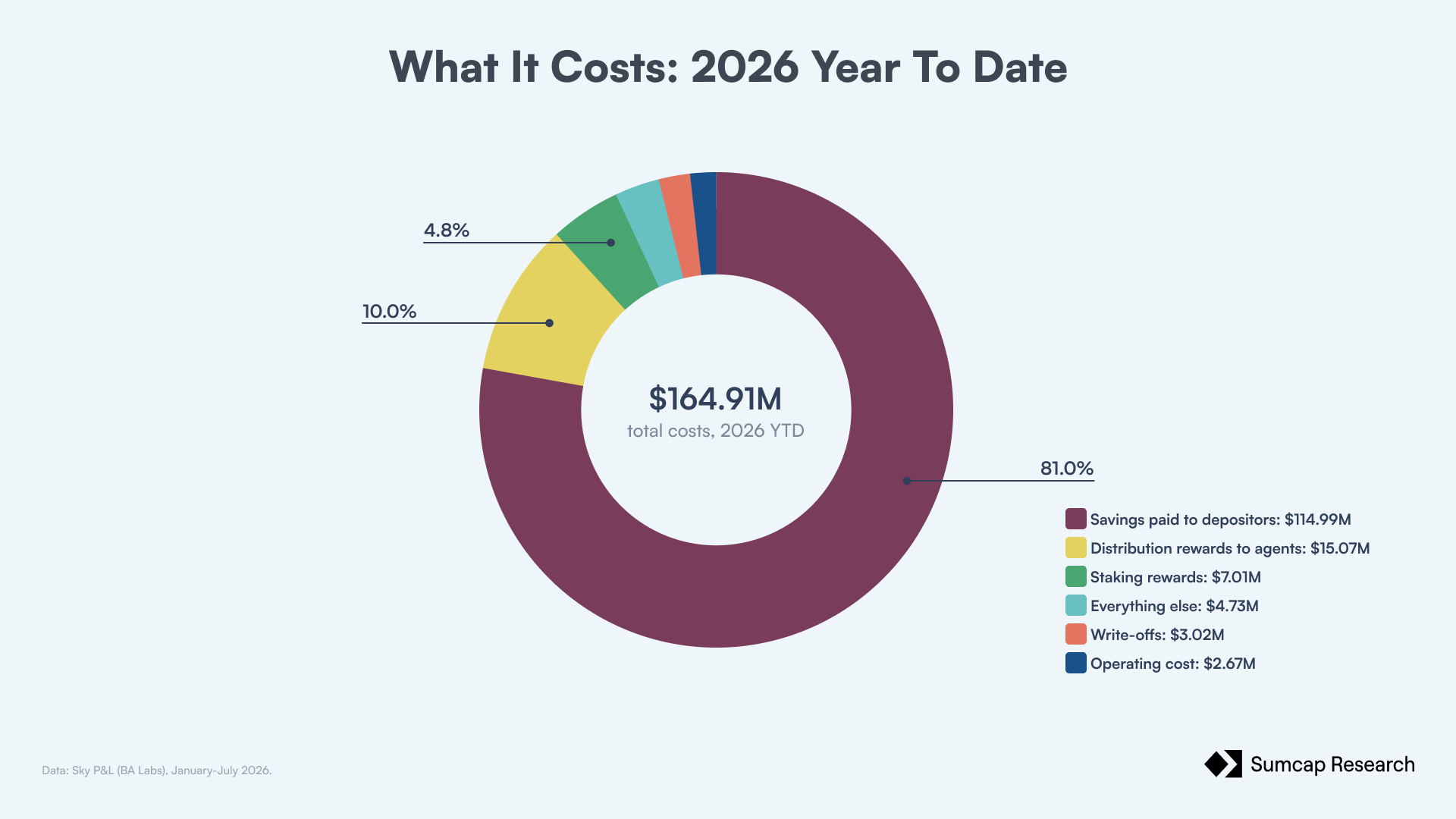
The cost base is almost entirely the savings rate paid to $USDS depositors, which accounts for 80.7% of what Sky spends. The money that goes back to agents for bringing in users (Distribution rewards) is the second line, at 9.9% of the total. Running the organisation costs $2.34m, almost all of it a single $2m Core Simplification Buffer draw in March.
7.3 Net interest
Sky publishes the spread directly, and it is negative. Net interest income over the trailing twelve months is $202.82m against a net interest margin of 1.84%, but the net interest spread, the gap between the average rate earned on assets and the average rate paid on funding, sits at minus 0.41%. The protocol earns 3.58% on its collateral and pays 3.99% on its deposits. On average, a dollar of funding costs Sky more than a dollar of lending brings in.
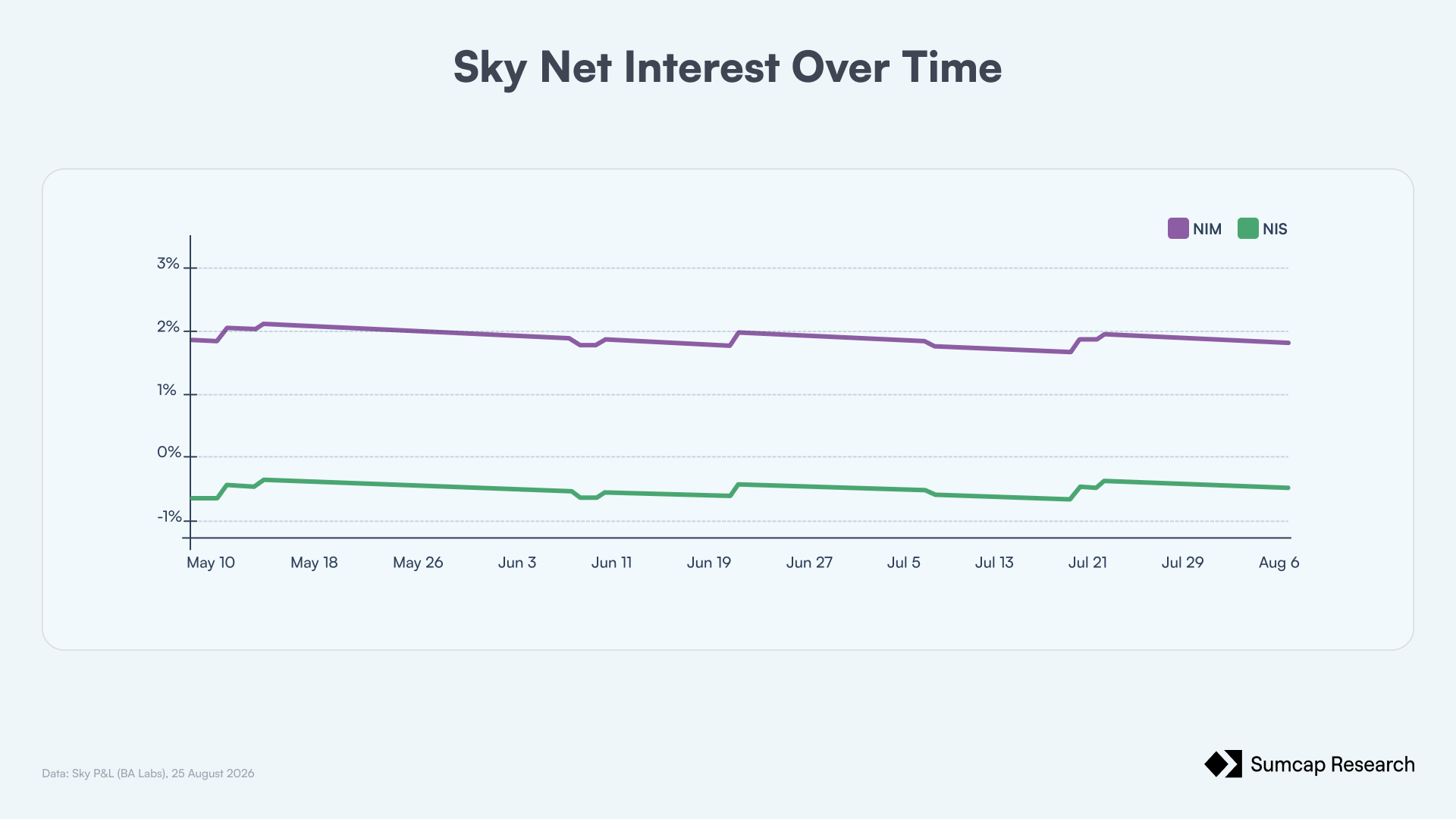
The margin survives that because the two sides are not the same size. Sky earns on the whole collateral book, close to $11b of loans to agents, $USDC in the peg module and legacy vaults. It pays on far less. Around $4.67b sits in the savings module earning the Sky Savings Rate, with a few hundred million more in staked $USDS and legacy $DAI savings, so only roughly $5.1b of the liability side costs anything at all. The remaining $6b or so of $USDS circulates in wallets, pools and other protocols, paying its holders nothing and costing Sky nothing.
That is the commercial banking model exactly. The current account funds the mortgage. Sky's profitability rests less on the gap between what it earns and what it pays than on how much of its stablecoin never asks to be paid at all.
7.4 Net revenue
Revenue minus costs gives $133.91m of net revenue, a margin of 44.8%. That is not what reaches the reserves. Two further deductions sit below the line, $26.97m for security and maintenance and $26.40m allocated to buyback $SKY which together take 40% of what was earned. What remains, $80.55m, is remitted to Sky Reserves.
7.5 Margin
The protocol has grown revenue almost every year and has been steadily worse at keeping it until this year.
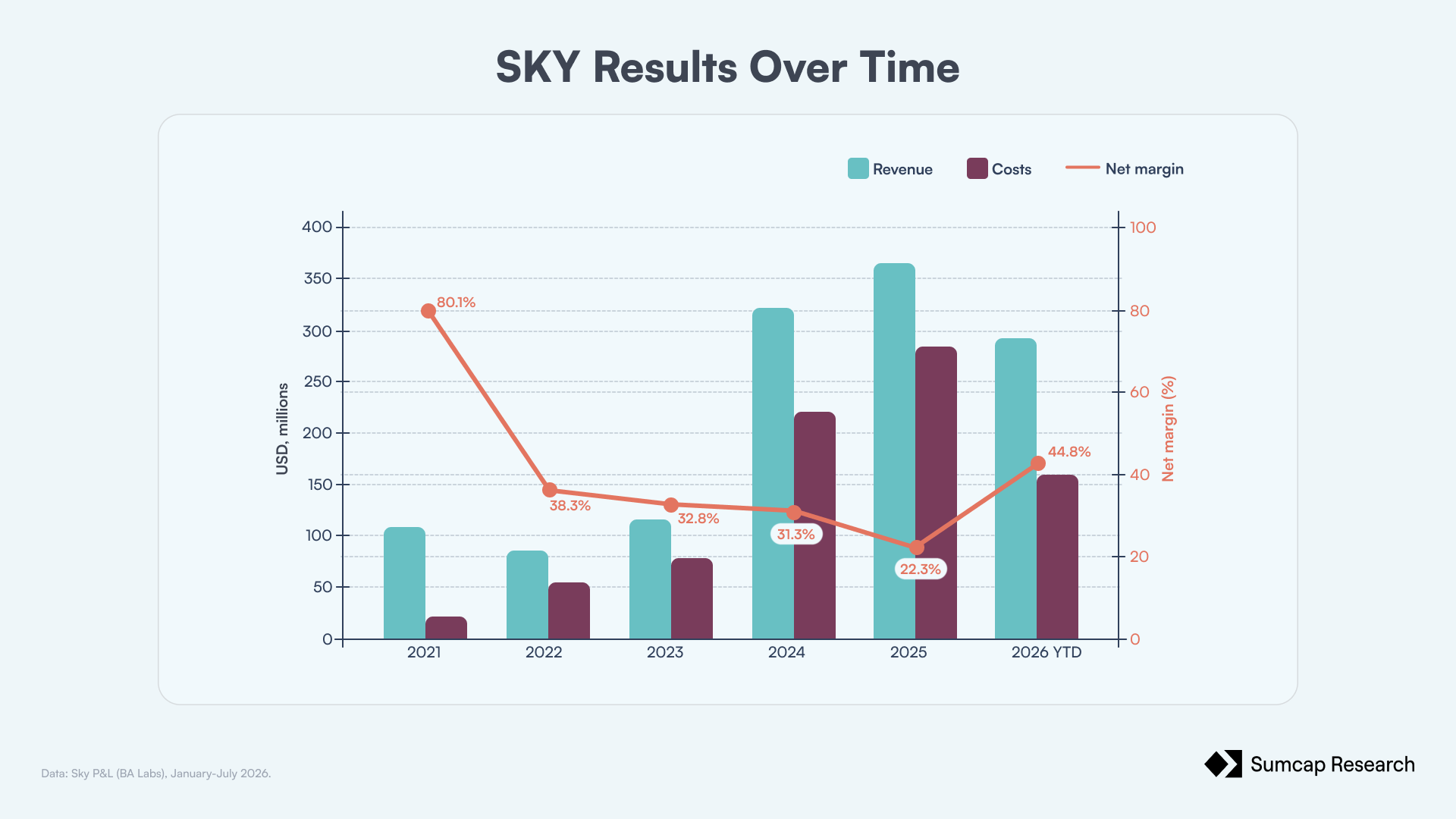
In 2021, Maker retained roughly 80% of its revenue. That margin reflected a large crypto-backed loan book, a Dai Savings Rate set at almost zero, and a relatively light operating cost base. From late 2022 onward, the model changed on both sides of the balance sheet. Maker shifted capital into yield-bearing RWAs while raising the savings rate to attract and retain DAI deposits. Those payments became a material funding cost. Between 2023 and 2025, revenue tripled, but expenses grew faster and compressed the protocol’s margin.
The trough was 2025, when $365m of revenue produced $81m of net, a margin of 22%. That is the year the reserves emptied. By December they were down to $23.2m against a balance sheet above $11b.
That changed materially during 2026. BA Labs reports $399.44m of trailing-twelve-month revenue and $153.21m of net income, producing a net margin of 38.36%. Revenue grew 6% year over year while net income grew 98%, and the gap between those two rates is the whole story: the recovery came from cost, not from size. The same balance sheet that returned a 20.6% margin a year ago now returns 38.4%.
The current settlement run-rate points in the same direction. Annualising the April, May, and June settlement cycles produces approximately $447.88 million of Income, $264.72 million of Expenses, $183.16 million of Net Revenue and $145.29 million of Net Surplus. That projection is indicative rather than a forecast, since rates, allocations and one-off expenses can change materially from one settlement to the next.
7.6 Who keeps the books
The parties involved are worth naming, because the income statement is the one part of Sky that cannot be verified against the chain.
The monthly calculations are produced by Soter Labs, working on behalf of two agents that hold the role of Operational Executor Agent. Amatsu computes the figures for Spark, Grove, and Keel. Ozone does the same for Osero, Obex and Skybase. Governance then enacts what they publish, and the financial reporting (including the statement quoted throughout this section) is published by BA Labs.
That arrangement has a consequence worth stating. Sky's vaults, ceilings, collateral, debt, and loss waterfall are all on-chain, and every figure in the balance sheet and loss waterfall sections was read directly from it. Its revenue is not. What an agent owes is a contractual arrangement computed off-chain, enacted monthly by vote, and reported by a third party. The numbers are published and reconciled openly, including the corrections.
8. Conclusions
It funds itself with deposits, and pays for them at a rate it sets. It runs a loan book, $5.91b lent to agents and $4.79b held as $USDC in the peg module, and it earns a margin on both. It holds a capital stack with a defined order of absorption, junior capital first and the most senior claim last, ordered the way a bank regulator would recognise. It binds itself to a liquidity rule of the same kind, requiring that assets redeemable for dollars never fall below a quarter of the portfolio. It carries a credit rating. What it does not have is a deposit guarantee or a lender of last resort, which is precisely why the capital stack has to be explicit.
The transparency is unusual and uneven, and both halves are worth stating. Every vault, ceiling, collateral position, debt balance, and layer of the loss waterfall can be read from the chain by anyone, and Sky publishes a simulator that computes the exact haircut every agent would take for any loss size. That is more disclosure than most regulated institutions offer about their own capital. The income statement is a different matter. What each agent owes is computed off-chain by two other agents in the same network, both financially exposed to the answer, enacted monthly by vote, and reported by an independent firm.
S&P rates Sky B-, with a risk-adjusted capital ratio of 0.4%, citing weak capitalisation. Almost nothing in the sector carries a rating at all, and obtaining one meant accepting that the agency would publish what it found. Sky publishes a capital ratio of its own, agent by agent and updated daily, against a ceiling written into its constitution. Very few regulated banks disclose that much about their own adequacy, and the number it currently shows for its largest borrower is 76%.
But both ratios measure a structure that is only partly built. The third layer of the waterfall is designed to be funded and is not. The operating cash balance is negative by $60.42m, which leaves more than a third of the layer below it out of reach. Governance has set a $150m solvency reserve and is roughly two thirds of the way there, funded by the margin recovery. B- describes the balance sheet as it stands, not as it is designed to stand, and if those layers fill, the coverage in front of $USDS changes materially. A rerating would be the appropriate response, and worth watching for as the measure of whether the design was real.

The Stablecoin With a Credit Rating
Sky calls itself a savings and capital allocation network. We check that description against the chain, the Atlas and the accounts: the debt book, the six-layer loss waterfall, and the credit rating almost nothing else in crypto carries.
1. Introduction
Sky, the protocol that used to be MakerDAO, runs a debt book above $12b. It issues $USDS, lends billions of it to agents onboarded through its governance, and pays depositors out of the margin. In front of those depositors sit about $187m of loss-absorbing capital, a negative operating cash balance, and a backstop that mints the governance token. S&P rates it B minus. Sky calls itself a savings and capital allocation network, run under limits set in public and enforced automatically. This piece checks that description against the chain, the Atlas and the accounts.
2. Origins
MakerDAO began as a Reddit post. In March 2015, months before Ethereum’s mainnet went live, Rune Christensen proposed eDollar, a dollar-pegged token that anyone could create by locking crypto as collateral. That idea became practical through the Collateralised Debt Position (CDP), where users deposited $ETH, borrowed $DAI against it within a set LTV limit, and paid an ongoing stability fee.
MakerDAO was launched in December 2017 with $ETH as its only accepted collateral. Alongside it was $MKR, initially used for governance, but later given a second role as backstop. If Maker became undercollateralised, new $MKR could be issued and sold to recapitalise the system. That mechanism faced its first real test during Black Thursday in March 2020, when it ultimately restored the system to solvency.
3. The MakerDAO era
By late 2019 the single-collateral system had outgrown its limits. In November, Multi-Collateral DAI launched: a new token, mintable against a basket of assets rather than $ETH alone, took the $DAI name, and the original single-collateral version was renamed $SAI to free it up. Holders weren't forced to move, but the new token's wider utility drew them across.
Then, on March 12, 2020, $ETH lost roughly half its value in a day. The network congested, gas fees spiked, and the keeper bots meant to bid on liquidated collateral couldn't get their transactions confirmed. The auctions cleared at zero and the collateral was sold for nothing: around $8m of $ETH gone in exchange for no $DAI at all. When the dust settled, the protocol was roughly $4.5m undercollateralised.
That crisis played out on the new multi-collateral system, and it settled the fate of the old one. Retiring single-collateral had been the plan since MCD launched, but running two protocols and two pegs through that kind of stress made finishing the job urgent. A governance poll at the end of March and an executive vote on April 24 set a grace period ending May 12, 2020, when the $SAI system was formally shut down. Each $SAI was made redeemable for $ETH worth about a dollar at the prevailing price near $189 (roughly 0.00529 $ETH) and has been converted at that fixed $ETH rate ever since.
Solvency wasn't the only problem the crash left behind. For much of 2020, $DAI traded persistently above its dollar peg. The only way to create $DAI was to open an overcollateralised vault, and that is a poor instrument for correcting a premium. An arbitrageur wanting to mint $DAI and sell it above a dollar had to lock up more value than they received, pay a running stability fee, and carry liquidation risk on the collateral the whole time. The friction was enough that the premium didn't close on its own. Elevated demand, as $DAI became a base asset across DeFi's 2020 yield-farming boom, only widened the gap.
In December 2020, Maker shipped the Peg Stability Module (PSM), which let anyone swap $USDC for $DAI 1:1 and back, with no vault, no liquidation risk, and a near-zero fee, effectively pegging $DAI to $USDC.
4. Endgame and the move to Sky
In 2022, Rune Christensen proposed a sweeping restructuring of the protocol, which he called Endgame. By then a large share of $DAI's backing sat in $USDC, and sanctions enforcement that year had shown that the issuers of centralised stablecoins would freeze addresses when compelled to. A stablecoin built to resist censorship now depended, in substance, on an asset that could be frozen at a government's request. Endgame was the plan to build a system that could withstand that kind of pressure by making it more modular, broken into semi-independent units, and eventually able to reduce its reliance on any single point of control.
The community approved the plan in October 2022. Two years of engineering followed, and in September of 2024 the rebrand went live. MakerDAO became Sky, $USDS launched as $DAI’s upgradeable successor, and $MKR was replaced by $SKY at a rate of 1:24,000.
At that moment, governance was rewritten around the Atlas, the protocol's public constitution and documentation hub, which codifies its governing rules, technical architecture, voting processes, and economic parameters in one canonical reference. Final authority still rests with $SKY holders, exercised mostly through delegates who vote on their behalf.
Migrating from $DAI to $USDS introduced an upgradeable contract that could be given the power to freeze specific addresses.
The semi-independent units the plan described became the agent network.
5. The Sky Agent Network
The Protocol issues $USDS, but it does not put that $USDS to work itself. That job belongs to a network of independent but aligned operators called agents, and how capital reaches them is the key to what Sky has become.
Agent is the functional role: any unit that draws $USDS and deploys it. Prime Agent is the standing designation for the units that borrow from Sky at the Base Rate and deploy into whitelisted opportunities. There are five: Spark, Grove, Obex, Keel and Osero. Sky used to call them Stars; that term has been retired. Spark and Grove have gone furthest, each with its own token and its own governance, effectively a mini-protocol inside Sky, but that is a difference of maturity rather than of status.
A second role sits alongside them. Executor Agents do not allocate capital, they run the protocol's operations. Amatsu and Ozone hold that role and produce the monthly settlement calculations that appear later in this piece.
Every Prime Agent is granted a dedicated Allocator Vault. Through that vault the agent can draw newly issued $USDS up to a ceiling that governance sets. No collateral is posted against the debt line itself. What the agent must fund instead is Risk Capital, held in a separate account and sized by the Capital Requirement Ratio: a percentage of each allocation, set according to what that allocation is invested in. Risk Capital is the first thing a loss consumes, and the loss waterfall section returns to it.
The agent deploys the drawn $USDS into yield-bearing strategies and owes a governance-set Base Rate on the amount it has drawn.
No interest accrues against the agent's vault day to day. Once a month governance executes a settlement that mints fresh debt inside the agent's own vault and transfers the proceeds to a reserve called the Surplus Buffer. In July 2026 that meant creating $9.5m of new debt in Spark's vault, $9.7m in Grove's, and $2.5m in Obex's. This means that no agent has to send money. Each simply owes more than it did the month before, and the protocol books the difference as revenue.
From the Surplus Buffer, that revenue funds the Sky Savings Rate paid to anyone who deposits $USDS into the savings module.
The Base Rate is uniform. Every Prime Agent borrows at the Sky Savings Rate + 20 bps Distribution Reward Fee, 3.72% in August. There used to be a second component: governance levied a further 10bps called the Sky Spread, which the Atlas describes as the margin Sky retains for facilitating the ecosystem's financing. An Atlas edit in July 2026 cut it to zero, this means that on the agent book; the margin Sky reserves for itself is now nothing at all.
What varies is how much of the rate Sky actually charges. The Atlas carries provisions for subsidised borrowing and for reimbursing direct exposures, so an agent's book splits between capital paying the full rate and capital that is exempt, and what qualifies is decided by governance and kept as a list of named exposures. Spark's Uniswap v4 stablecoin pools are the clearest case. They earn swap fees that come nowhere near the Base Rate on the capital deployed, but the position exists to give $USDS depth, so Sky waives the rate and pays Spark separately for the adoption it drives.
The network's capital is concentrated in five agents.
5.1 Spark
Spark was the first to reach full independence, in June 2025, with its own token $SPK and its own governance. It runs three products.
- SparkLend: a lending market forked from Aave v3, lending against blue-chip collateral.
- Spark Savings: a set of vaults that take in several stablecoins and route them into $USDS-backed yield.
- The Spark Liquidity Layer: a non-custodial router that moves stablecoins across pre-approved venues under hard, contract-enforced limits on how much can move and how fast.
Spark's TVL is around $4.5b, the largest of any Sky agent, most of it held in the savings vaults and the SparkLend market, with a further $2.6b deployed through the liquidity layer. That dwarfs the roughly $2.74b Spark draws from Sky, because Spark also intermediates billions in outside user deposits. Spark is defined less by any one strategy than by the plumbing itself, the layer that turns $USDS into working liquidity across DeFi.
In the July 2026 settlement, $9.47m of new debt was minted into Spark's vault. Spark kept $3.41m of it and $6.06m went to Sky, which then paid Spark $1.03m back for the adoption it drives, leaving $5.02m with the protocol. That payment did not go to Spark as income; it went to Spark's subproxy, the account that holds its risk capital.
5.2 Grove
Grove was incubated by Steakhouse Financial and is the second Prime Agent and it describes itself as protocol credit infrastructure focused on settlement financing. Where Spark works in crypto-native lending, Grove deploys into offchain and tokenised structured credit from traditional finance.
Of the $2.75b Grove holds today, $1.53b sits in tokenised Treasuries, split between a Janus Henderson fund and BlackRock's BUIDL, which makes government paper the majority of the book. AAA CLO exposure is the next line at just under $500m, spread across two Janus Henderson vehicles issued through Centrifuge and a Securitize fund. The remainder is a $304m warehouse facility with Galaxy, roughly $92m of on-chain lending through Morpho vaults curated by Steakhouse, and small allocations to an Apollo credit fund.
It has since added Basin, a facility offering up to $1b a day in stablecoin liquidity so institutions can redeem RWA instantly, and Grove Financing, a set of bespoke financing and liquidity solutions for tokenised asset issuers and credit originators. Through it, Grove gives partners access to capital via DEX liquidity, supply into lending markets, offchain private credit facilities, and structured products.
Grove draws about $2.75b from Sky, which makes it fractionally the largest borrower in the network, ahead of Spark. Its TVL sits near the same figure, because Grove is largely a conduit for Sky's own capital into institutional credit, which is the opposite of Spark's shape.
Grove's July settlement minted $9.69m, of which Grove kept $1.64m and Sky $8.04m, with $0.17m returned as adoption incentives. That left $7.88m with the protocol, the largest contribution of any agent that month, and roughly four fifths of what Grove's position generated. Spark handed over just over half of its own.
5.3 Obex
Obex is not an allocator in the same sense as the others. It is an incubator, and its job is to find institutional capital allocators, structure the legal and operational arrangements, and bring them into Sky as agents, so that each new firm does not have to build its own relationship with Sky. It is authorised to draw as much as $2.5b and today it draws about $402m, against a live ceiling of $450m that ratchets upward as it proves itself. At the latest dashboard snapshot, Obex owed approximately $402.5 million to Sky and held around $403 million of deployed assets, all of it in Maple’s syrupUSDC.
Its inaugural cohort also includes Securitize, Centrifuge, Daylight, USD.ai, Better, River, and TVL Capital, and was announced with up to $1 billion of aggregate deployment. For now, however, only Maple appears as an active allocation in Obex’s book.
The other names represent its broader onboarding pipeline.
Obex runs its own liquidity layer, modelled on Spark's, with the same style of rate limits. Its July settlement minted $2.54m, split $0.85m to Obex and $1.69m to Sky, with $0.07m returned as incentives.
5.4 Keel
Keel launched in September 2025 as Sky’s Solana-focused allocator. Unlike the other agents, its Ethereum mainnet allocator vault shows no outstanding debt. Instead, the $USDS it deploys on Solana is bridged through SkyLink, Sky’s cross-chain infrastructure, and allocated across the chain’s lending and liquidity markets. Keel began as Sky’s beachhead into a non-EVM ecosystem, with an initial deployment of roughly $10 million. It later launched Tokenisation Regatta, a separate initiative aimed at attracting up to $500 million of tokenised real-world assets to Solana, while its broader mandate has since expanded beyond the chain.
5.5 Osero
Osero is the fifth Prime Agent, the newest, and the only one whose main business is not allocation. It was incubated by Stablewatch, a stablecoin yield analytics firm, in partnership with Soter Labs, and operates as a legally separate foundation with Stablewatch as its core contributor. In May 2026 it raised $13.5m in a seed round co-led by Sky itself and Plasma, and announced that the money would serve as the risk capital backing its first allocations.
Its mandate runs in two directions. One is distribution: Osero Earn lets wallets, neobanks, custodians and exchanges embed the Sky Savings Rate in their own interfaces, and Osero App offers the same rate directly. The other is allocation, through Osero Foundry, an origination platform for asset managers and fund issuers, with $2.5b of capacity extended by Sky. It earns on both sides, taking a share of the balances it distributes and the spread between what its allocations return and the Base Rate it pays.
On-chain, almost none of that has happened yet. The vault carries $5.0m of drawn $USDS against a $7.0m ceiling, all of it supplied into SparkLend. Its ceiling was cut in July from $10m to $5m while the plumbing was rebuilt, and governance has since raised it again.
Behind the five sit vaults that are plumbed and undrawn: Pattern at a $50m ceiling and Interval at $10m. Amatsu and Ozone are not in this queue at all as they are Executor Agents, and their function is different.
5.6 Balance sheet
Sky's ledger records what it has lent and against what. When an agent draws $USDS from its vault and buys tokenised Treasuries with it, the ledger still shows a loan to that agent, because the ledger stops at the point the money leaves. Understanding the balance sheet therefore means reading it twice, once for what Sky has issued and once for what the money ended up in.
5.6.1 Debt
The first is the ledger view, and it is the one governance controls, because ceilings are what votes adjust. Reading every registered debt line directly gives $11.36b of collateral-backed debt. Just over half of it ($5.91b) sits in the agent vaults, and another $4.79b sits in the USDC peg module. The remainder is legacy crypto vaults still carrying $421.3m, mostly in two of the original $ETH lines. The Staking Engine holds $157.7m, and $81.0m of Centrifuge-era RWA survives across four lines.
One figure needs care. The protocol's headline debt is $12.04b, larger than the sum of those lines, because it also counts $681m of debt that no borrower owes. That amount was created to pay the savings rate, and it exists as the accounting counterpart of interest already handed to depositors. That $681m is the gross figure, accumulated over years of paying savings. Against it the protocol holds $621m of surplus it has earned back, and the difference between the two, negative $60.42m, is the OCB. These are ledger figures, not market ones. A good part of that debt is stablecoin the protocol has minted into its own peg module and not yet sold, so the amount actually circulating is smaller: $9.75b against the $12.04b the ledger records.
5.6.2 USDS allocation
The second is the look-through view, where the money works once agents have deployed it. There the composition is 47.1% stablecoins, mostly $USDC earning T-bill yield, 16.0% in short-duration Treasury bills through Janus Henderson and BlackRock, and 5.0% in AAA-rated corporate debt and collateralised loan obligations. On-chain lending structured only around blue-chip assets is 20.9%, and over-the-counter lending governed by legal agreements rather than smart contracts is another 9.7%. The remainder, just over one per cent, is private credit and basis trade.
5.7 The capital requirement
How much capital an agent must hold against each of those positions is set in the Atlas, position by position, and changed by governance vote.
Every allocation an agent makes carries a Capital Ratio Requirement, a percentage set according to what the money is invested in, and multiplying the two gives the capital the agent must hold against that position. The percentages run from nothing to everything, and each is a governance judgement about what that particular thing can lose: private credit, warehouse facilities, tokenised CLOs and a basis trade at a prime broker all carry different weights, and the same asset held on a different chain carries a different weight again.
The number that matters most is zero. Tokenised Treasuries require no capital at all. Neither Grove's $858m of Janus Henderson paper nor its $668m of BlackRock BUIDL generates a single dollar of requirement, and nor do the $150m of Uniswap pools that give $USDS its depth. Between them, positions weighted at zero account for most of what the two largest agents hold.
The requirement is then measured against what the agent actually holds. That ratio has a name, a constitutional reference and a ceiling: Sky calls it the Encumbrance Ratio and requires it to stay below 90%.
Grove and Spark need almost exactly the same capital, $19.89m against $19.10m, on books of similar size. Spark holds nearly twice as much of it. Grove sits at 76.13% with $3.62m of headroom, and Sky's own dashboard flags it as approaching the limit. It is the most encumbered agent in the network, and it is also the one running the most conservative book by risk weight. Both are true, and they have the same cause.
What happens when the requirement turns out to have been wrong is a separate architecture.
5.8 The loss waterfall
Sky publishes its loss absorption as six steps, four capital reserves followed by two recovery options. The stated priority is that every $USDS stays worth a dollar, and the ordering exists so that the parties earning the most sit closest to any loss.
The architecture rests on one structural choice. Each agent operates two separate on-chain accounts. The allocator vault is where it draws borrowed $USDS to deploy. The subproxy is a distinct contract that holds its risk capital. Money reaches the subproxy from the agent's own funds and from Sky, through the Genesis seeding programme and the monthly settlement.
The subproxy is the agent's account, but it executes only transactions that Sky's governance has whitelisted in advance, through a permission module that governance controls. That arrangement is what makes the capital inside it both the agent's to lose and Sky's to reach.
Layer 1. The agent's own capital
Every loss lands first on capital the agent funded itself, and on nobody else. No other agent contributes, the protocol contributes nothing, and $USDS holders are untouched. The layer gives way only when that agent's own capital is fully consumed.
Sky defines that capital precisely: each agent's earned capital above the floor Sky seeded it with. It is not equity anyone injected. It is settlement income the agent has left in its account rather than taken out, and it only begins to count once the balance rises past what Sky put in. Below that line an agent can be earning steadily and still show nothing of its own.
The purpose is alignment. An agent that loses principal is not only out the capital itself; it then earns the same rate on a smaller base, so the loss carries into every period that follows.
Layer 2. The agent's seeded buffer
Each agent also holds a capital buffer inside the same subproxy, funded by Sky, through the Genesis programme that seeded the network. It absorbs next, and it still belongs to the agent that caused the loss. Losses remain contained to a single agent until that agent's own capital plus buffer is empty.
The Genesis programme is set to be phased out once Aggregate Backstop Capital reaches 125 million $USDS, each eligible agent's Genesis Capital is written down by a base of $1m a month plus a tenth of whatever the backstop exceeds that threshold by, and the write-down pauses if the backstop falls back under. Nothing is repaid: the reduction is an accounting one, and it lowers the amount subject to the layer-4 haircut. Sky is building toward a network where the protocol's own seed no longer stands behind its agents, and the agents' retained earnings do instead.
Agent-funded capital across the whole network is $30.45m against Sky's full $12.04b of debt. That is 0.25%. But more than $5.3b of that debt is the USDC peg module, which cannot lose money the way a deployed strategy can. Measured against the $5.91b the agents actually draw and deploy, agent-funded capital is 0.52%. It is also heavily concentrated: three quarters of it is Spark's, and Spark is no longer the largest borrower.
Adding the Sky-seeded buffers, the headline risk capital is $187.45m, about 1.5% of all debt. Sixteen per cent of that was put there by the agents. The rest is Sky's own money, held in the agents' accounts.
That figure is a stock rather than a defence, and two things cut it down before it reaches a $USDS holder.
The first is the operating cash balance. The haircut stops once Sky's reserves reach zero. The Atlas defines the seeded capital that has already been spent as the negative of the surplus buffer, and subtracts it to arrive at what it calls Aggregate Backstop Capital. With the buffer at minus $60.42m, $157m of seeded capital becomes $96.58m of usable backstop.
The second is that each agent's own capital only answers for its own mistakes. Of the $25.13m the agents have funded between them, only the losing agent's share counts, and the rest never enters the calculation. So what stands in front of a holder depends on which agent fails, and by less than it should.
The thinness and the concentration are almost certainly part of why the outside assessment landed where it did. S&P Global rates Sky B-, putting its risk-adjusted capital ratio at 0.4% (as of July 2025) and citing weak capitalisation alongside depositor concentration and reliance on its founder.
Layer 3. The stability capital buffer
This is the protocol's own reserve, funded from its operating cash balance. It is currently unfunded, because that balance stands at negative $60.42m, so the layer absorbs nothing and losses pass straight through it. Fees and agent settlements increase it, while savings payouts, buybacks, operating costs, grants, and transfers into protocol-controlled buffers reduce it.
A transfer can therefore drain the Operating Cash Balance (OCB) even when it is not an expense and the $USDS remains under Sky’s control.
The first large drawdown came in June 2025, when Sky transferred $20.6 million of initial capital to Spark. Then in August another $62.3 million left the operating balance, including $50 million for the Sky Frontier Foundation, $10 million for the Fortification Foundation and roughly $2.3 million of liquidity funding, revenue sharing and operating payments. That package explains almost exactly the visible fall from around $90 million to $28 million.
Recurring savings payouts, buybacks and operating costs then continued to erode the remaining balance and in November, Sky authorised $21 million of Genesis Capital for Obex. With the OCB standing at roughly $16.5 million shortly beforehand, that transfer was sufficient by itself to push it below zero.
Further capital allocations to other subproxies deepened the deficit with $25 million for the Core Council Executor Agent, $15 million for Skybase, $70 million distributed across Amatsu, Ozone, Keel, and Launch Agent 6, and another $20.8 million for Grove. Protocol fees and monthly agent settlements periodically replenished the balance, which explains the upward rebounds in the chart, but they were not sufficient to offset the new allocations and recurring disbursements.
Those figures are what left the operating balance, which is not the same as what sits in each subproxy today.
Layer 4. Sky Capital
Here the loss stops being one agent's problem. Sky applies a pro-rata haircut to the seeded buffers of every other agent in the network, in proportion to what each one holds. The base is the $156.3m of seeded capital across the network, less whatever was already consumed at layer 2. The haircut continues until protocol reserves reach zero and the agents that have made no error still pay their share.
The agent subproxies are not sealed accounts, and governance can move capital through them for reasons that have nothing to do with losses. Allocations arrive split, so the Core Council executor's $25m landed as $20m in its subproxy and $5m elsewhere. Capital leaves again, as when $14m of Amatsu's $25m was transferred on to the Sky Frontier Foundation.
Importantly, this haircut is not automatic. The Atlas says these transfers are made through executive votes, may be made through emergency spells, and that a solution "must be developed" to accomplish them without waiting for the governance security delay. The largest loss-absorbing layer in the system is a manual governance action carrying a delay measured in days.
Layer 5. The $SKY backstop
With every reserve exhausted, governance mints $SKY and sells it to recapitalise. Sky classifies this as a recovery option, a contingent action rather than money standing ready, and the outcome of how much this backstop could help is uncertain, since it depends on market conditions and risk appetite at the moment it is needed.
In March 2020, after the crash left the system roughly $4.5m short, Maker ran the first and only debt auction in its history. It sold 20,980 $MKR across 106 lots between the 19th and the 28th of March 2020, raising 5.3m $DAI and closing the hole. The format was a reverse auction, with each lot bid at a fixed 50,000 $DAI and participants competing by accepting fewer tokens. The total dilution came to about 2% of supply.
Layer 6. The $USDS haircut
The last resort. $USDS rerates below a dollar and holders receive up to 24b $SKY as compensation. It is reached only after $SKY holders have been fully diluted and every agent's backstop capital has been seized.
$USDS and $sUSDS are the most senior claim, and that is the point of everything above it. The six layers are not a general reserve against adversity. They are a sequence built so that a loss has to pass through the agents, the protocol, and the token before it can touch the stablecoin. The whole structure exists to defend this one asset.
5.9 Who pays when the haircut arrives
Each agent's exposure at layer 4 is fixed by its share of the seeded capital, whatever the loss and wherever it happened.
The shares track seed size, so an agent's exposure to its peers' mistakes bears no relation to what it has borrowed or how it invests.
The published total of $157m overstates what is available. The haircut at layer 4 runs only until reserves hit zero, and reserves are defined as Sky Capital plus the operating cash balance. With that balance at negative $60.42m, only $96.58m of the $157m can absorb anything.
The practical consequence is a ceiling, and one that moves depending on who fails. A loss of about $119.8m at Spark is enough to consume its own capital, run through its seeded buffer, pass through the empty stability layer, exhaust every remaining reserve in the network and reach the point where $SKY has to be minted. At Osero the same point arrives at $96.62m. The gap between the best-defended agent and the worst is $23.1m, and all of it is money the agents put up themselves.
That $23.1m is what separates the two ends of a network holding $187.45m of risk capital against a $12.04b book. Everything else is the same pool, drawn on in the same order, whoever made the mistake.
The effect runs the wrong way round. Ozone holds the second-largest share of the pool, $25m, and has never drawn a dollar. Grove has drawn $2.75b and holds $26.12m. The agent that allocates nothing carries almost exactly the same exposure to everyone else's mistakes as the agent that allocates the most, and a haircut that lands on Ozone, Amatsu and the Core Council executor falls on capital that was never at risk in the first place, taken to cover a loss those entities had no part in and no ability to prevent.
5.10 Liquidity
Solvency is one half of resilience. The other is whether assets convert to dollars fast enough when holders leave together.
Sky binds itself to a rule. Assets redeemable for dollars are classified as Actively Stabilizing Collateral, and the Atlas requires that they never fall below 25% of the aggregate portfolio. The category splits in two.
- Resting collateral sits as on-demand limit orders, executable immediately.
- Latent collateral converts automatically into Resting within a short window.
Today the protocol holds $5b of it, $4.58b of that Resting, against a ratio of 50.44%. The protocol itself holds $4.54b, Spark holds $409m, mostly Latent, and Grove holds $45.6m. Every other agent holds effectively nothing.
The rule sets a floor. What it does not describe is shape, and shape is what decides whether a floor holds. For that Sky publishes a maturity ladder, sorting $9.66b of liquidatable assets by how long each one takes to turn into dollars, and modelling it twice: once under normal conditions and once under stress.
Under normal conditions, $3.98b converts instantly, another $1.21b within a day, and $2.47b more within three, so roughly four fifths of the book is available inside three days. Under stress that shape breaks. The instant layer is unchanged, but the one-day bucket collapses from $1.21b to $60.5m, a fall of 95%. Everything that made the second day work (the Galaxy warehouse, the PYUSD holding, the Uniswap pools, the tokenised funds at Centrifuge and BlackRock) moves out to a week or beyond. At the three-day mark, the point most people think of as the liquidity horizon, a stressed Sky has $4.04b rather than $7.66b.
Then there is what the instant layer is made of. All $3.98b of it is the Lite-PSM, the USDC peg module, and nothing else. Not one dollar of instant liquidity sits with an agent. The stablecoin reserves that back the peg are the same assets that make the portfolio liquid.
That is worth holding against the liability side. The savings module alone holds around $4.67b of $USDS earning the Sky Savings Rate. Instant liquidity does not cover it. Nearly all of the $9.75b of $USDS and $DAI in circulation can be turned into dollars eventually: the ladder reaches $9.66b at twelve months. What it cannot do is turn it into dollars quickly. Instant liquidity covers 41% of the circulating supply, and under stress that is still all there is at the three-day mark.
5.11 Bridges
Cross-chain infrastructure is the least mature part of Sky's design. SkyLink, Sky's own bridge, separates governance messages from token transfers and secures both through LayerZero Decentralized Verifier Networks (DVNs), which independently attest that a cross-chain message is valid. SkyLink's governance channel requires 4/7 DVNs on both Solana and Avalanche. Its token channel, the one that actually carries value, requires both LayerZero and Nethermind, a strict 2/2 configuration, so a forged transfer needs two verifiers compromised.
Spark runs a separate governance bridge to Avalanche of its own, also on 2/2. In April 2026 Spark said it intended to widen SkyLink's token verifier set and move its own Avalanche bridge to 4/7, although no subsequent official record confirms that either upgrade has shipped.
On Solana, a $5 million daily net transfer limit and emergency freezer roles are intended to contain the immediate damage. The less clearly specified case is a failure of SkyLink itself. A core bridge failure could create a protocol-level loss immediately and may not map cleanly to a single agent before emergency controls respond. The weakness is therefore not the absence of a backstop, but the gap between an instantaneous cross-chain failure and the slower process of attribution, containment, and recapitalisation.
6. Product lines
Everything the agent network earns has to reach users through something. Sky's product surface is the set of instruments that do that, and they differ mainly in how much risk the holder is taking to get paid.
$USDS is the base layer (the stablecoin) and the successor to $DAI. Holding it earns nothing on its own but can be used in DeFi. The combined supply across $USDS and $DAI sits near $9.75b, and Sky reports $9.71b of collateral backing it. A $USDS holder is the most protected participant in the system.
Depositing $USDS into the savings module returns $sUSDS, a token whose value grows against $USDS as the Sky Savings Rate (SSR) accrues to it every second. There is no lockup, no minimum, and no exit fee. The rate itself is set by governance votes and funded out of protocol revenue; SSR has moved between 3.5 and 4.8% over the past year as Treasury yields and competing on-chain rates have shifted. This is the main savings product, holding around $4.67b, and it has paid out $278.8m in interest since launching in September 2024.
$stUSDS is the sharpest departure, as it looks like a savings product but is not one. Supplying $USDS to the stUSDS module funds the borrowing that $SKY stakers do against their staked $SKY. Sky describes it as segregated risk capital where depositors provide insurance funds. If a staker's position is liquidated and the auction fails to cover the debt, that bad debt is written off against the $stUSDS pool, and governance slashing operations can hit it too. The yield is also higher than the $sUSDS yield, at more than twice the APY, reflecting that risk. When the capital is being borrowed, holders earn the $SKY borrow rate, and when it is idle, it falls back to the Savings Rate.
The collateral is valued in an unusual way, and it is what protects the pool. Rather than taking $SKY from the market, the system values it at the lower of the market price and a fixed oracle cap, currently $0.025, against a 120% liquidation ratio. With $SKY trading near $0.056, the system counts less than half of it. A rise in the price adds no borrowing capacity, and a fall changes nothing until the price crosses the cap. The effect is that the liquidation threshold sits where governance put the cap rather than where the market is, and a position borrowed to the limit is carrying close to 270% collateral.
Spark Savings extends the same yield to stablecoins that are not $USDS, and it now runs in two generations. The older vaults convert the deposit into $USDS through the PSM and park it in the Sky Savings Rate, so the depositor is holding $sUSDS exposure denominated in another currency. The newer ones, covering $USDC, $USDT, $PYUSD, and $USDG, are backed by $USDS but generate their return by deploying the underlying stablecoin through the Spark Liquidity Layer across vetted venues, with rates set by Spark's own governance rather than Sky's.
The backing is what places these holders alongside $USDS holders rather than below them, and the pooling is what makes that work. Deposits into the USDS, USDC, USDT and PYUSD vaults share the same underlying credit exposure and are gathered into common collateral portfolios regardless of which stablecoin came in. Spark is just the distributor, but the owner is Sky, and the structuring and origination sit with Sky.
Sky's products also circulate through the wider ecosystem. Pendle splits $sUSDS into principal and yield tokens for anyone wanting a fixed rate to maturity, and the stablecoins appear across Morpho, Sky Vaults, and Aave.
7. Sky financials
7.1 Revenue
Sky publishes a full income statement produced by BA Labs (Block Analitica), updated daily, and kept on an accrual basis, so revenue is recognised as it is earned. In the first eight months of 2026 the protocol recognised $298.83m of revenue and $164.91m of costs.
The agent network is the main Sky business: Spark contributed $79.90m, Grove $69.58m, and Obex $15.16m, with Osero booking its first $603 in August. About seventy percent of the rest comes from the $USDC in the peg module, which earns the T-bill rate while it waits. The third line is the old crypto vaults, which nobody markets and which cannot take on new borrowers at scale.
Nothing an agent owes accrues day to day. Read the blockchain and the interest rate is zero, and has been since 2025. Spark's rate index sits frozen at the level it reached before the change, a fossil of the old system.
Instead, the commercial settlement is calculated off-chain through the Monthly Settlement Cycle. The Operational Executor Agent, a role held by Amatsu and Ozone, produces the initial calculation, and Core GovOps, the operational arm of the Core Council, publishes the final calculation, and governance capitalises the result on-chain. The settlement does not move money from the agent but mints fresh debt inside the agent's own vault and transfers the proceeds to the protocol's surplus buffer. In July 2026 that meant creating $9.47m of new debt against Spark, $9.69m against Grove, and $2.54m against Obex. The minted figure covers both sides of the split, which is why it exceeds the share Sky retains.
Money does flow the other way in the same transaction. Agents can also be paid for the adoption they drive and reimbursed for exposures Sky has chosen not to charge for, so the July settlement sent $3.41m back to Spark, $1.64m to Grove, and $0.85m to Obex.
7.2 Expenses
The cost base is almost entirely the savings rate paid to $USDS depositors, which accounts for 80.7% of what Sky spends. The money that goes back to agents for bringing in users (Distribution rewards) is the second line, at 9.9% of the total. Running the organisation costs $2.34m, almost all of it a single $2m Core Simplification Buffer draw in March.
7.3 Net interest
Sky publishes the spread directly, and it is negative. Net interest income over the trailing twelve months is $202.82m against a net interest margin of 1.84%, but the net interest spread, the gap between the average rate earned on assets and the average rate paid on funding, sits at minus 0.41%. The protocol earns 3.58% on its collateral and pays 3.99% on its deposits. On average, a dollar of funding costs Sky more than a dollar of lending brings in.
The margin survives that because the two sides are not the same size. Sky earns on the whole collateral book, close to $11b of loans to agents, $USDC in the peg module and legacy vaults. It pays on far less. Around $4.67b sits in the savings module earning the Sky Savings Rate, with a few hundred million more in staked $USDS and legacy $DAI savings, so only roughly $5.1b of the liability side costs anything at all. The remaining $6b or so of $USDS circulates in wallets, pools and other protocols, paying its holders nothing and costing Sky nothing.
That is the commercial banking model exactly. The current account funds the mortgage. Sky's profitability rests less on the gap between what it earns and what it pays than on how much of its stablecoin never asks to be paid at all.
7.4 Net revenue
Revenue minus costs gives $133.91m of net revenue, a margin of 44.8%. That is not what reaches the reserves. Two further deductions sit below the line, $26.97m for security and maintenance and $26.40m allocated to buyback $SKY which together take 40% of what was earned. What remains, $80.55m, is remitted to Sky Reserves.
7.5 Margin
The protocol has grown revenue almost every year and has been steadily worse at keeping it until this year.
In 2021, Maker retained roughly 80% of its revenue. That margin reflected a large crypto-backed loan book, a Dai Savings Rate set at almost zero, and a relatively light operating cost base. From late 2022 onward, the model changed on both sides of the balance sheet. Maker shifted capital into yield-bearing RWAs while raising the savings rate to attract and retain DAI deposits. Those payments became a material funding cost. Between 2023 and 2025, revenue tripled, but expenses grew faster and compressed the protocol’s margin.
The trough was 2025, when $365m of revenue produced $81m of net, a margin of 22%. That is the year the reserves emptied. By December they were down to $23.2m against a balance sheet above $11b.
That changed materially during 2026. BA Labs reports $399.44m of trailing-twelve-month revenue and $153.21m of net income, producing a net margin of 38.36%. Revenue grew 6% year over year while net income grew 98%, and the gap between those two rates is the whole story: the recovery came from cost, not from size. The same balance sheet that returned a 20.6% margin a year ago now returns 38.4%.
The current settlement run-rate points in the same direction. Annualising the April, May, and June settlement cycles produces approximately $447.88 million of Income, $264.72 million of Expenses, $183.16 million of Net Revenue and $145.29 million of Net Surplus. That projection is indicative rather than a forecast, since rates, allocations and one-off expenses can change materially from one settlement to the next.
7.6 Who keeps the books
The parties involved are worth naming, because the income statement is the one part of Sky that cannot be verified against the chain.
The monthly calculations are produced by Soter Labs, working on behalf of two agents that hold the role of Operational Executor Agent. Amatsu computes the figures for Spark, Grove, and Keel. Ozone does the same for Osero, Obex and Skybase. Governance then enacts what they publish, and the financial reporting (including the statement quoted throughout this section) is published by BA Labs.
That arrangement has a consequence worth stating. Sky's vaults, ceilings, collateral, debt, and loss waterfall are all on-chain, and every figure in the balance sheet and loss waterfall sections was read directly from it. Its revenue is not. What an agent owes is a contractual arrangement computed off-chain, enacted monthly by vote, and reported by a third party. The numbers are published and reconciled openly, including the corrections.
8. Conclusions
It funds itself with deposits, and pays for them at a rate it sets. It runs a loan book, $5.91b lent to agents and $4.79b held as $USDC in the peg module, and it earns a margin on both. It holds a capital stack with a defined order of absorption, junior capital first and the most senior claim last, ordered the way a bank regulator would recognise. It binds itself to a liquidity rule of the same kind, requiring that assets redeemable for dollars never fall below a quarter of the portfolio. It carries a credit rating. What it does not have is a deposit guarantee or a lender of last resort, which is precisely why the capital stack has to be explicit.
The transparency is unusual and uneven, and both halves are worth stating. Every vault, ceiling, collateral position, debt balance, and layer of the loss waterfall can be read from the chain by anyone, and Sky publishes a simulator that computes the exact haircut every agent would take for any loss size. That is more disclosure than most regulated institutions offer about their own capital. The income statement is a different matter. What each agent owes is computed off-chain by two other agents in the same network, both financially exposed to the answer, enacted monthly by vote, and reported by an independent firm.
S&P rates Sky B-, with a risk-adjusted capital ratio of 0.4%, citing weak capitalisation. Almost nothing in the sector carries a rating at all, and obtaining one meant accepting that the agency would publish what it found. Sky publishes a capital ratio of its own, agent by agent and updated daily, against a ceiling written into its constitution. Very few regulated banks disclose that much about their own adequacy, and the number it currently shows for its largest borrower is 76%.
But both ratios measure a structure that is only partly built. The third layer of the waterfall is designed to be funded and is not. The operating cash balance is negative by $60.42m, which leaves more than a third of the layer below it out of reach. Governance has set a $150m solvency reserve and is roughly two thirds of the way there, funded by the margin recovery. B- describes the balance sheet as it stands, not as it is designed to stand, and if those layers fill, the coverage in front of $USDS changes materially. A rerating would be the appropriate response, and worth watching for as the measure of whether the design was real.
.svg)