
The Reinvention of Ethena: History, Risk, and Trajectory
Ethena has cemented itself as the largest synthetic dollar issuer in crypto, but the protocol underneath is nothing like it was at launch. From delta-neutral hedging to actively managed yield, a new collateral mix, and a very different risk profile: what changed, and what does it mean for USDe?
1. Introduction
You can’t talk about stablecoin issuers without mentioning Ethena. At its peak the protocol held $15B in TVL and ran the biggest basis trade operation in the history of DeFi, all while paying ~8% APY to sUSDe holders. Nowadays however, after a 71% drawdown, Ethena sits as the 9th largest protocol by TVL (with $4.4B “under management”), and is a professionally managed balance sheet rather than a stablecoin issuer. USDe’s backing is also no longer a monolithic bet on perp funding, with Ethena cutting its basis sizing from 33% of the book to 1% between April and June, to make space for a more actively managed portfolio. It has since rebuilt to ~14% as funding recovered, but it is one sleeve among five now rather than the whole thing.
To put it in perspective, the size of the basis sleeve on its own was once bigger than everything Ethena manages today (it ran at over $8B at its peak, against ~$4.4B for everything Ethena manages today). So why did the protocol move away from a seemingly profitable strategy that allowed it to capture $15B in market share?
2. From NakaDollar to the pivot
2.1 The NakaDollar
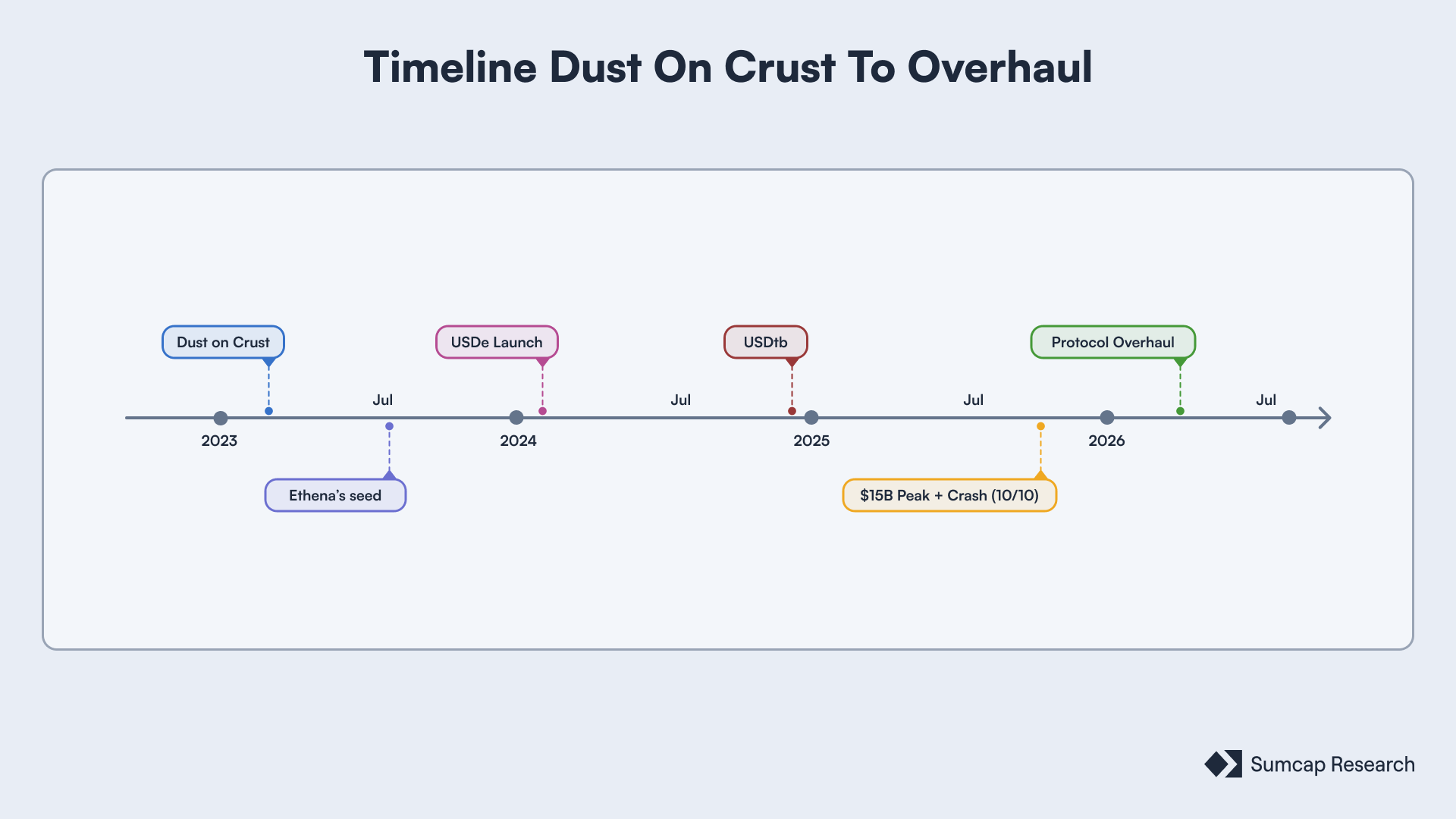
In March 2023, Arthur Hayes (Co-Founder of BitMEX) published an article titled “Dust on Crust”. In it, Hayes described a new value-preserving mechanism for stablecoins called the “NakaDollar”. The idea of the NakaDollar (NUSD) was quite simple: a tokenized fund consisting of equal parts long spot and short perp positions of BTC, such that when price moved either way, one leg’s losses would offset the other’s profits, keeping nominal value stable.
The issue was that even on paper, this idea came with clear shortfalls:
- What happens in periods of prolonged negative funding rates?
- What happens if one of the exchanges custodying the collateral fails?
- What happens when a liquidation cascade turns so violent that the exchange socializes losses, auto-deleveraging (ADL) the profitable short leg?
Hayes’ answer to all 3 questions was the introduction of a “Sinking fund”. The Sinking fund was a pool of capital, raised through sales of the NAKA governance token, that would sit between the mechanism and its holders, absorbing the hit whenever one of those scenarios played out.
With this rough outline, the NakaDollar sparked a wave of protocols all building on top of the idea, and in February 2024, Ethena launched USDe on mainnet, with Hayes as one of the seed backers.
2.2 The basis trade era
USDe launched with 2 distinct differences from NakaDollar’s structure:
- Where NUSD proposed holding plain BTC on the long leg, Ethena held staked ETH, allowing the collateral to earn yield even before the perp hedge was applied, effectively stacking 2 income sources (perp funding + staking yield).
- Hayes’ DAO would’ve let member exchanges hold the BTC, but instead, Ethena placed collateral with regulated custodians who would confirm its existence to exchanges, allowing them to credit margin against it (off-exchange settlement).
The main benefit that comes from OES is that an exchange failure would only cost Ethena its hedge, rather than its collateral, since it never left custody.
It also made Ethena a company with custodian relationships rather than just a protocol with a governance token: this was the first of several decentralization trade-offs Ethena made for durability.
For all that, the minting pipeline for USDe was quite simple, but it looked nothing like the open swap window people now associate stables with. Specifically, minting was permissioned: Ethena kept an on-chain whitelist, controlled by its dev multisig, of “benefactors” allowed to deposit collateral, who could in turn nominate the beneficiary addresses that received the minted USDe.
These benefactors were usually market makers whose interest was arbitrage between the minting contract and secondary markets: when USDe traded >$1, these MMs would mint USDe for $1 worth of stETH and sell them for more on Curve and Uniswap to users. Conversely, if USDe traded below $1, they would buy it discounted on secondary markets and redeem it for $1 of stETH.
To mint USDe the MM in question would first need to request a quote for the stETH/USDe pair from Ethena’s off-chain quoter, then pass the signed order along with the beneficiary address to the minting contract. From there the collateral is routed to Ethena’s OES custodians who delegate it as margin on CEXs and Ethena then opens the short hedge leg against the delegated margin completing the position.
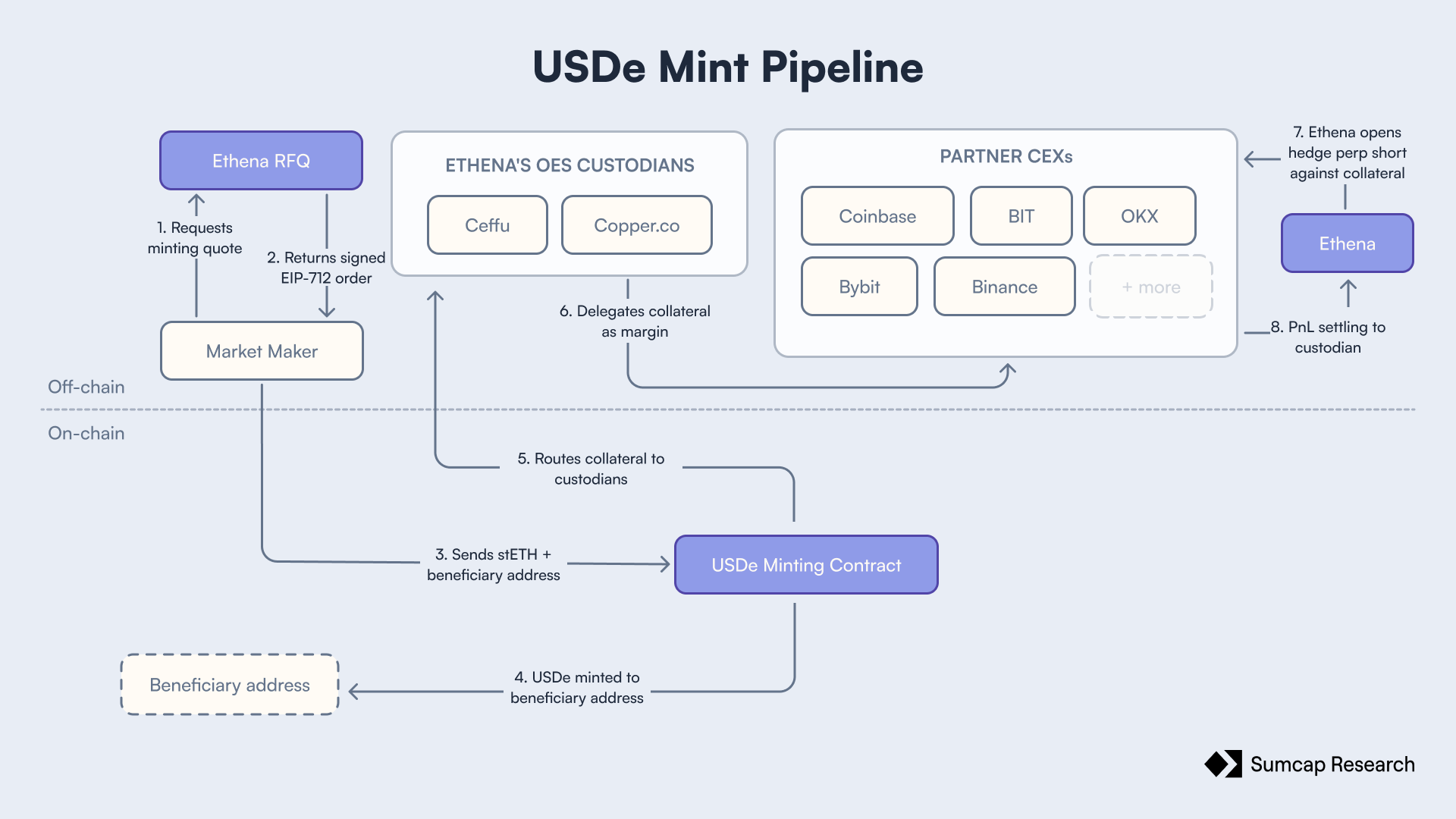
With their USDe, users could earn the headline yield by depositing it into the StakedUSDe contract, an ERC-4626 vault which the protocol periodically deposited USDe into (from staking and funding revenue) increasing sUSDe’s redemption value and bearing the users’ yield. And this yield is what did the early marketing for Ethena. With the headline frequenting 20% and peaking at 113%, the first year of the launch witnessed ~70% of USDe (~$3B) staked.
2.3 The competition
Seeing these figures, competitors followed in Ethena’s steps, and through 2024 and 2025 Elixir, Stream, Falcon, and more, all shipped their own synthetic dollars on the same chassis: collateral long, perps short, funding streamed to stakers.
Between Ethena and all its competition, the synthetic-dollar space grew from one protocol into a category: USDe alone touched $15B and was briefly the third-largest stablecoin. Every new entrant was another short in the same order books, all harvesting the same funding rate.
2.4 Pivot point: 10/10
Everyone reading this probably remembers 10/10: a Truth Social post announcing 100% tariffs on Chinese imports triggered the biggest liquidation event in the history of crypto, force-closing over $19B worth of positions in <24h, $6.9B of it in forty minutes.
During the cascade, USDe traded at 65¢, but only on Binance. On every other venue the peg barely moved, with Curve pools holding within a cent of par throughout the whole event. The reason for the Binance discount was that its oracle priced USDe off of its own (thin) books, so as the cascade sold USDe into it, every lower print liquidated more positions, feeding the cascade even more.
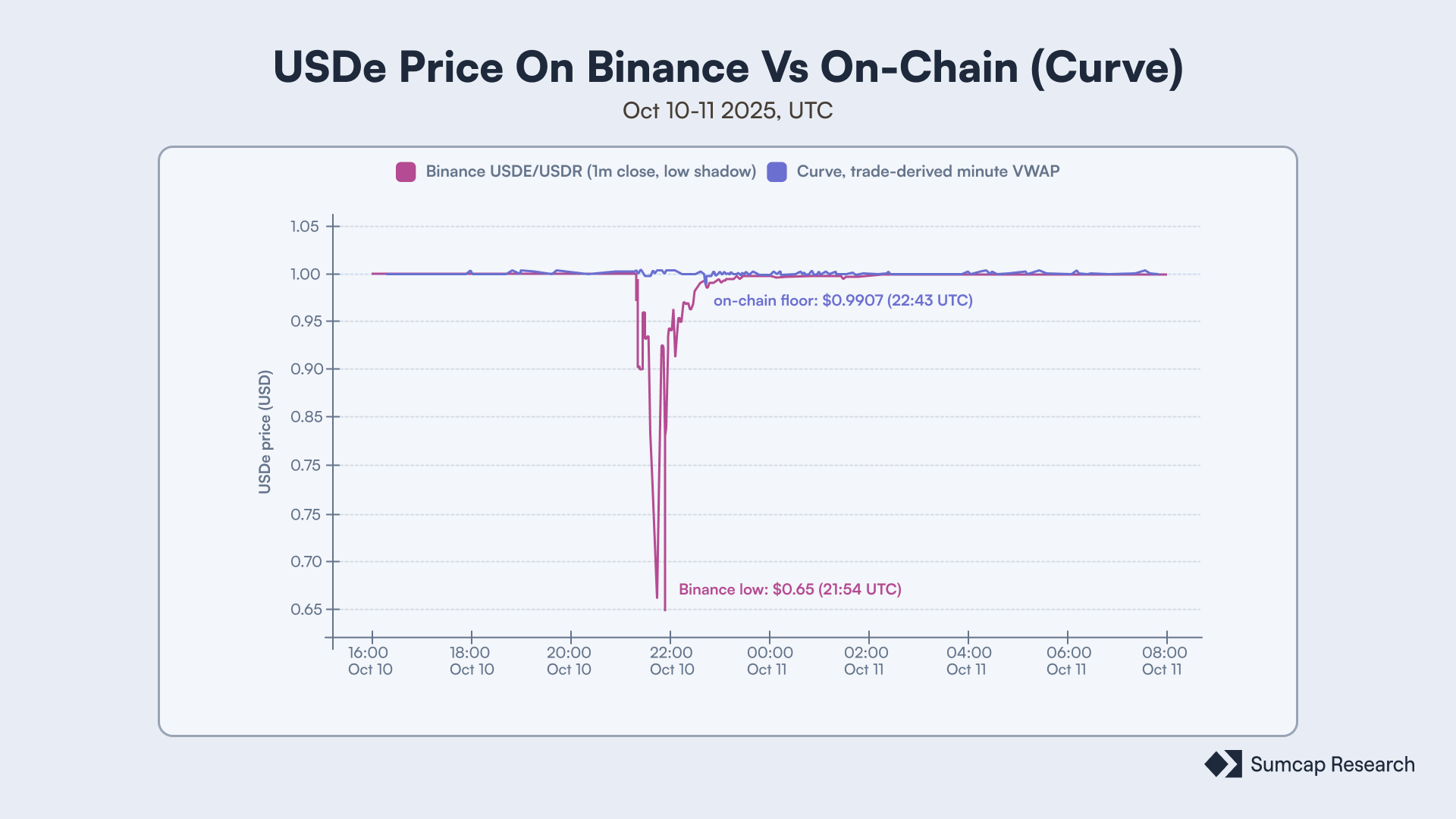
Underneath all of this, Ethena’s redemption mechanism was working as designed: the collateral sat with custodians out of the exchange’s reach, the short legs profited as prices fell, and over $2B of redemptions cleared at par in three days ($1.6B on October 11th alone). The fact that Curve pools held so well was proof of this. However, even though Ethena held up its end of the deal, in the 2 months following the crash ~$8.3B of USDe left the protocol as confidence fell.
But Ethena wasn’t the only one. Within weeks of the crash Stream’s xUSD collapsed after an external fund manager lost ~$93M of its assets and withdrawals were frozen, and Elixir, having parked 65% of deUSD’s collateral with Stream, chose to wind down the product.
2.5 Funding dries up
10/10 had marked a massive shift for the synthetic dollar space. The leveraged longs that were paying for the whole sector got liquidated, and demand tanked: ETH funding that averaged 13.0% through 2024, fell to 4.9% through 2025, and by May 2026 it had spent 96 straight days in negative (on the 30D MA). Worse still, BTC funding, which held the majority share of the early book, was averaging 11.9% through 2024, then 5.1% through 2025, and by May 2026 it had spent 85 straight days in the negative (on the 30D MA).
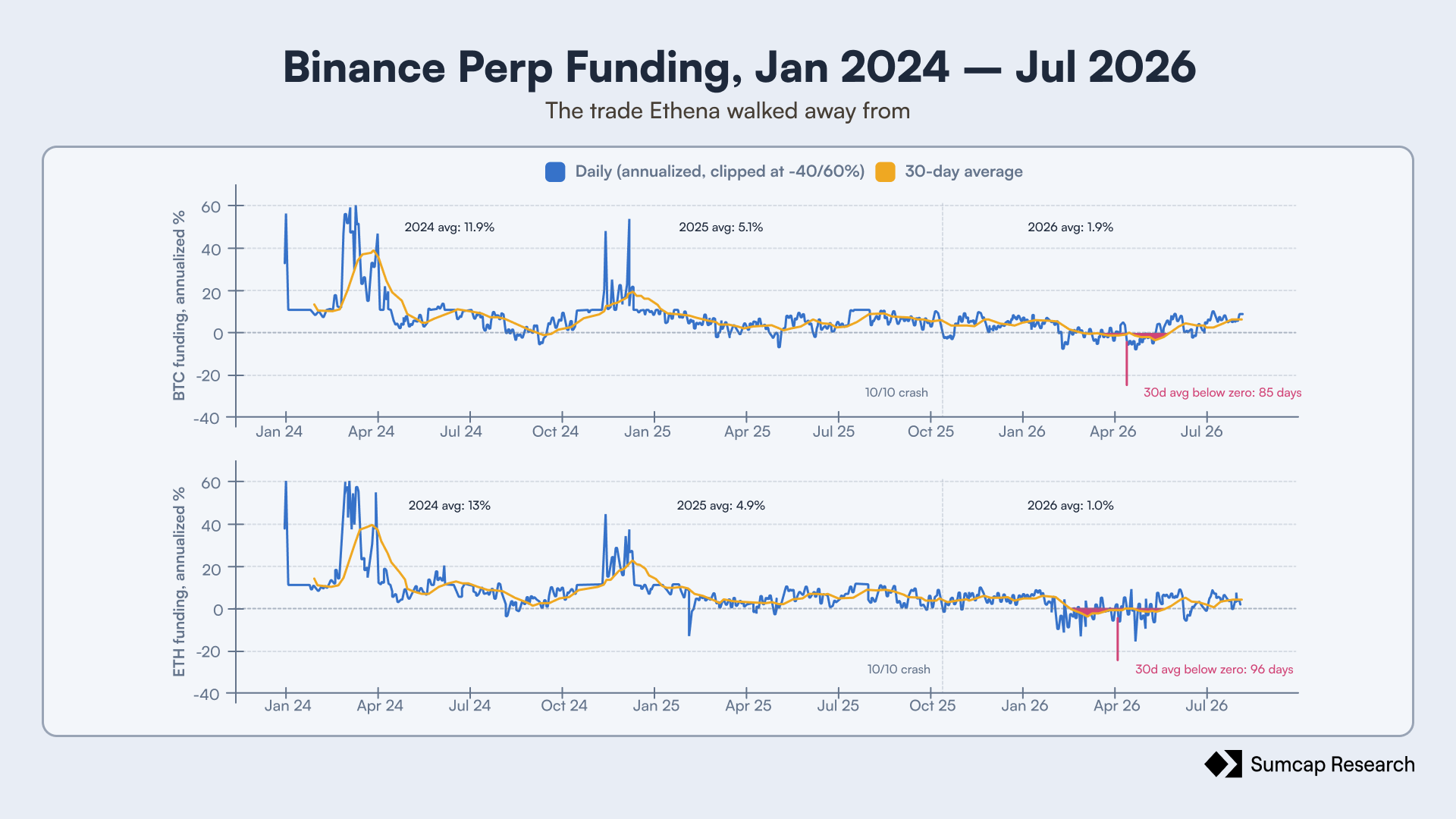
And if that wasn’t enough, TradFi had discovered the same trade in a better wrapper: spot ETFs gave hedge funds a clean long leg, while CME gave them a regulated short one, and the resulting cash-and-carry was essentially USDe’s book minus the exchange custody risk and the unstaking queue. By mid-2024 hedge funds were net short over $6B of CME bitcoin futures against the ETFs (Glassnode put it at $6.3B in June), and CME open interest peaked that November. Ethena’s yield had deteriorated to 4.7%, and when you put that up against 3.5% on T-bills, a ~1% spread for carrying exchange risk, ADL risk and every tail scenario Hayes had listed back in 2023 simply did not make sense anymore.
It was clear that if Ethena wanted to survive it would need to change its tactic. So in April 2026, the protocol formally surrendered the basis trade: capitulating at the very bottom of the funding chart, cutting the sleeve to ~11% of the book (and to 1% by June), and redeploying the rest across four new reserve categories.
3. Ethena today: anatomy of a yield fund
In essence, Ethena’s overhaul is very similar to what Sky (formerly MakerDAO) did. Maker started out as a pure crypto-collateralized issuer and later on added the USDC PSM, then T-bills, and eventually rebranded to Sky, with the balance sheet now allocated through SubDAOs/agents like Spark (DeFi and RWA deployment), Grove (credit mandates), and others. Similarly, Ethena started as a synthetic dollar and has now transformed into more of a yield fund structure managed by a Risk Committee and external reviewers.
The similarity is almost laughable: both started from opposite ends of the design space (overcollateralized CDPs vs delta-neutral perps), both traded off “decentralization purism” for more durability, and both ended up as actively managed balance sheets, holding, among other things, the exact same tokenized CLO fund (JAAA).
On the user-facing side everything is still seemingly the same:
- minting is still whitelisted (but KYC’d users can now mint/redeem against USDC at 1:1 with 0 fees)
- regular users still get USDe on secondary markets
- USDe staking is still the same
But on the backend, the playbook is completely different.
3.1 Governance
Collateral is no longer married to a perp short the moment it arrives. Instead, it is managed by a 3-layer governance system, with the Ethena Foundation taking on a purely executional role:
- External risk reviewers author the per-asset proposals
- The Risk Committee, a 3-member 6-month mandate, approves allocations, ratios, cooldown formulas and tenors
- And (s)ENA holders control “board hiring” (who makes up the Risk Committee)
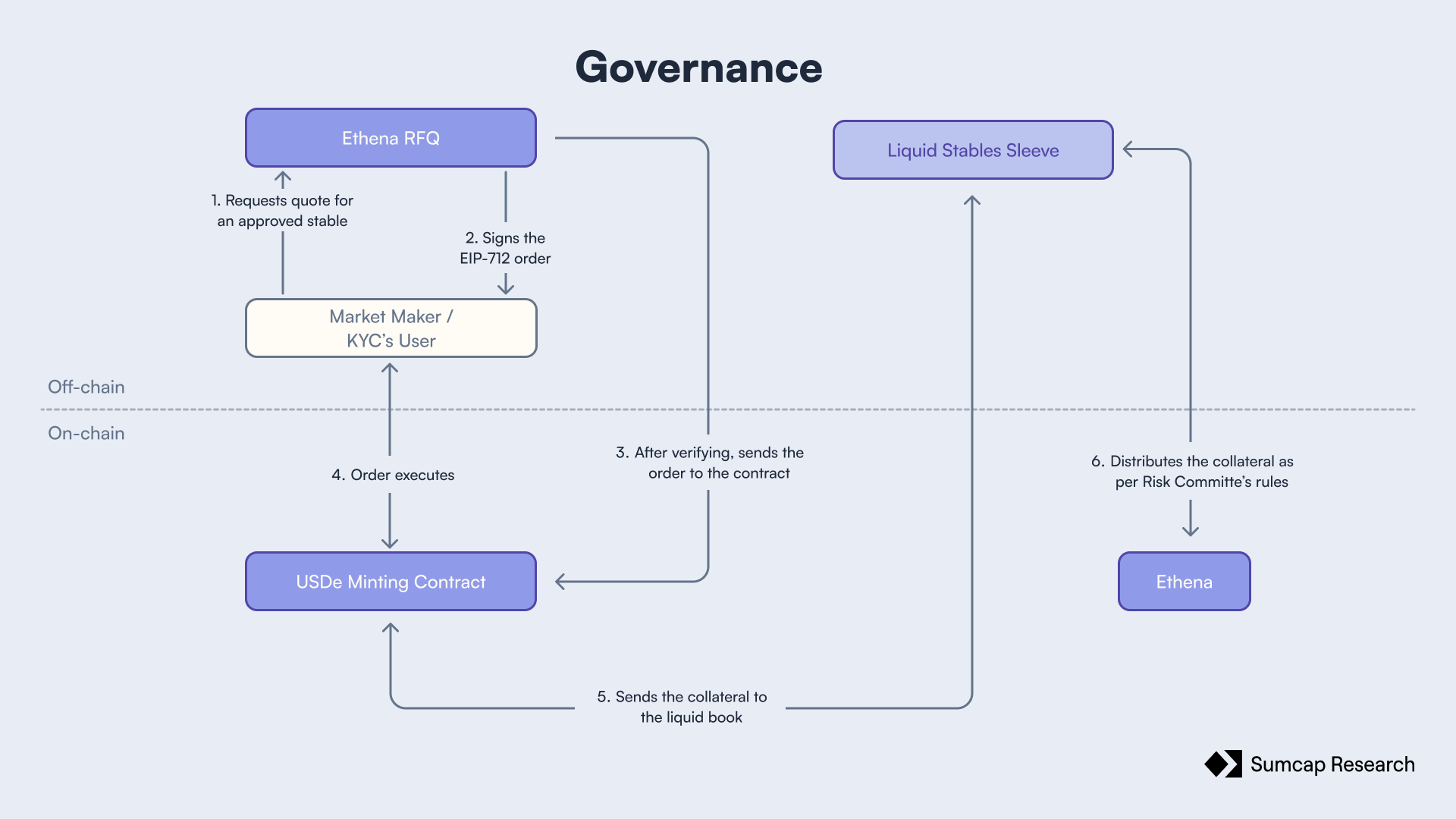
This August was the fifth vote for the Risk Committee mandate, and it elected 2 brand new “board” members, though only one of them took a seat. Those seats are filled through Snapshot: candidates apply, the Foundation screens and shortlists them, and (s)ENA holders then vote by approval, with each holder being able to approve as many candidates as they like at full token weight, and the top 3 take the seats.
The sitting committee (Blockworks Advisory, LlamaRisk, and Kairos Research) all stood for re-election, but only Kairos made the top 3:
- K3, a delta-neutral asset manager, took 1st place replacing Blockworks, which would’ve been the first time an active allocator sat on the board instead of a research shop. But after a second screening the Foundation ruled K3 ineligible for the term as its active allocator position made conflicts “structural and ongoing rather than limited to specific transactions”. Instead, the seat fell back to Blockworks, which took 4th place.
- OAK Research replaced LlamaRisk, taking the 2nd spot.
Day to day, the committee operates like an actual board: proposals sit through a 7-day deliberation window before a committee vote, members are required to recuse themselves where they hold direct conflicts, and Ethena Labs keeps a permanent seat at the table as a non-voting advisor. (s)ENA holders only pick the 3 firms who decide, twice a year, and everything in between is committee business.
So what has the committee actually built so far?
3.2 The book
As of September 9th 2026, Ethena’s $4.37B book consists of:
3.2.1 Liquid stables ($1.44B, 33.0%, ~3.9% APY)
At 33.0%, liquid stables represent the biggest sleeve of the book and generate their APY from issuer-side incentives.
The biggest of those is PYUSD ($576M), PayPal’s stablecoin, issued by Paxos Trust Company, for which Paxos runs incentive programs rewarding large holders. Similarly, USDG ($20M, held at Robinhood) is Paxos’ Global Dollar, and its Global Dollar Network shares the reserve yield with the partners who distribute it. There’s also Ethena’s own T-bill stablecoin, USDtb ($71M), whose yield is simply passed through from the BlackRock BUIDL fund backing it.
The rest of the category is made up of fiat-backed stables held for redemption liquidity and issuer diversification: USDC ($330M), USDT ($139M), and RLUSD ($300M), Ripple‘s NYDFS-regulated stablecoin, held in Copper custody.
3.2.2 DeFi lending ($1.34B, 30.7%, ~4.9% APY)
A point above liquid stables on APY and a marginally smaller position in the book. Split across Aave (V3 & V4), Morpho, Kamino, and Jupiter, this category is different from the others as it gives Ethena a growth playbook similar to Maker’s old D3M era (when it deposited DAI directly to Aave to make its borrowing cheap).
The only difference is that Maker minted fresh DAI it could always burn back, while Ethena lends capital into the same pools where USDe/sUSDe sit as collateral tokens, enabling users to: borrow other stables against (s)USDe, use the borrowed tokens to buy more (s)USDe, and loop it back. Simultaneously, the borrowed stables used to buy more (s)USDe land in Ethena’s book, and then again get used to deepen the borrowing pool.
This is good for growth, but the issue is that Ethena can only withdraw what isn’t borrowed, and in a market crash this translates to: a utilization spike, Ethena’s capital getting locked up, and redemptions kicking in all at the same time.
In fact, this exact scenario was flagged by one of Ethena’s own risk reviewers: the review attached to the Aave V4 allocation proposal modeled redemption access under 95% utilization stress and found it falls by roughly half, warning that the book’s exit layers “bind simultaneously under stress”: credit conditions tighten at the same moment USDe redemptions accelerate. (The allocation went ahead anyway, but with allocation limits set to reflect the finding.)
With that said, it seems Ethena uses this strategy to seed new markets rather than to fund the whole flywheel, and runs it through V3, not V4. Take a look at Plasma’s, Monad’s, and Mantle’s V3 instances. There, Ethena supplies a combined $439M of stables ($286M, $19M and $134M), a third of the sleeve. From those pools 66 unique wallets run a (s)USDe → stable → (s)USDe loop: 34 on Plasma, 18 on Monad, and 14 on Mantle.
Together they hold ~$770M of (s)USDe collateral built on just ~$83M of their own capital, with ~$693M of borrowed stables in between, an aggregate multiplier of 9.3x. The single biggest wallet holds $291M of (s)USDe against $26M of underlying capital (11.2x) on Plasma. On Monad and Mantle, effectively all of the (s)USDe collateral sitting in Aave belongs to these looping wallets (99 to 100%), and on Plasma it’s about 92%.
Another detail worth noting is who runs the remaining capital: the Morpho, Kamino, and Jupiter positions ($745M) sit with named external curators: Steakhouse, Sentora and Bitwise. The collateral they lend against is prime, which cuts the other way in a stress: liquidations correlate with the market, so those withdrawals free up at the same time everything else is under pressure.
3.2.3 RWA ($506M, 11.6%, ~5% APY)
At 11.6% of the book, the RWA category comprises tokenized AAA CLO funds: JAAA ($253M) Janus Henderson’s on-chain AAA CLO fund tokenized via Centrifuge, and STAC ($253M) Securitize‘s equivalent.
A AAA CLO (triple-A Collateralized Loan Obligation) is a pool of loans made to companies that are sliced into tranches. Of those tranches the triple-A tranche is the most senior one, meaning that if borrowers in the pool start defaulting, the losses eat through every junior tranche first, and the triple-A holders are the last in line to suffer.
The funds work by tokenizing that exposure: the loans sit in the real world with the fund managers, and Ethena’s share is represented as tokens on-chain (Solana, Base). Note that both allocations sit at roughly the governance-set cap of $250M.
3.2.4 Institutional lending ($482M, 11.0%, 5 to 7% APY)
The smallest sleeve at 11.0%, with loans to Maple Institutional ($303M), FalconX ($98M), Kraken ($75M), CBAM ($5M) and Anchorage ($1M).
Unlike the RWA section, where Ethena is one in a sea of lenders to a sea of borrowers, here every agreement is bilateral (between Ethena and a borrower), with a named neutral third party and a set term for the loan. The borrower posts BTC/ETH worth more than the loan, and the collateral sits with the neutral custodian until maturity.
These agreements are private, hence the APY being a range and not a figure. One caveat with this structure is that the term can’t be broken: the money is locked until the loan matures, making this the slowest capital in the book to bring home.
3.2.5 Crypto basis ($602M, 13.8%, ~5.0% APY)
What was once the whole gist of USDe is now the third sleeve by size, rebuilt from $50M in early August as funding recovered. Ethena’s capital is split across Binance ($362M), OKX ($158M), Bybit ($60M) and INTX ($22M), mostly BTC and ETH, with a little SOL and BNB, still under the same strategy we described prior.
The book’s configuration is constantly changing: between early July and September, DeFi lending fell 46→31%, while stables rose to 33% and took the top spot.
All of this just to say: even though Ethena has taken on the structure of a yield fund, the underlying vehicle is still the same, a stablecoin. Because of that, however the book is allocated, two things need to hold at all times: the exits need to stay wide enough, and the buffer behind them needs to be big enough.
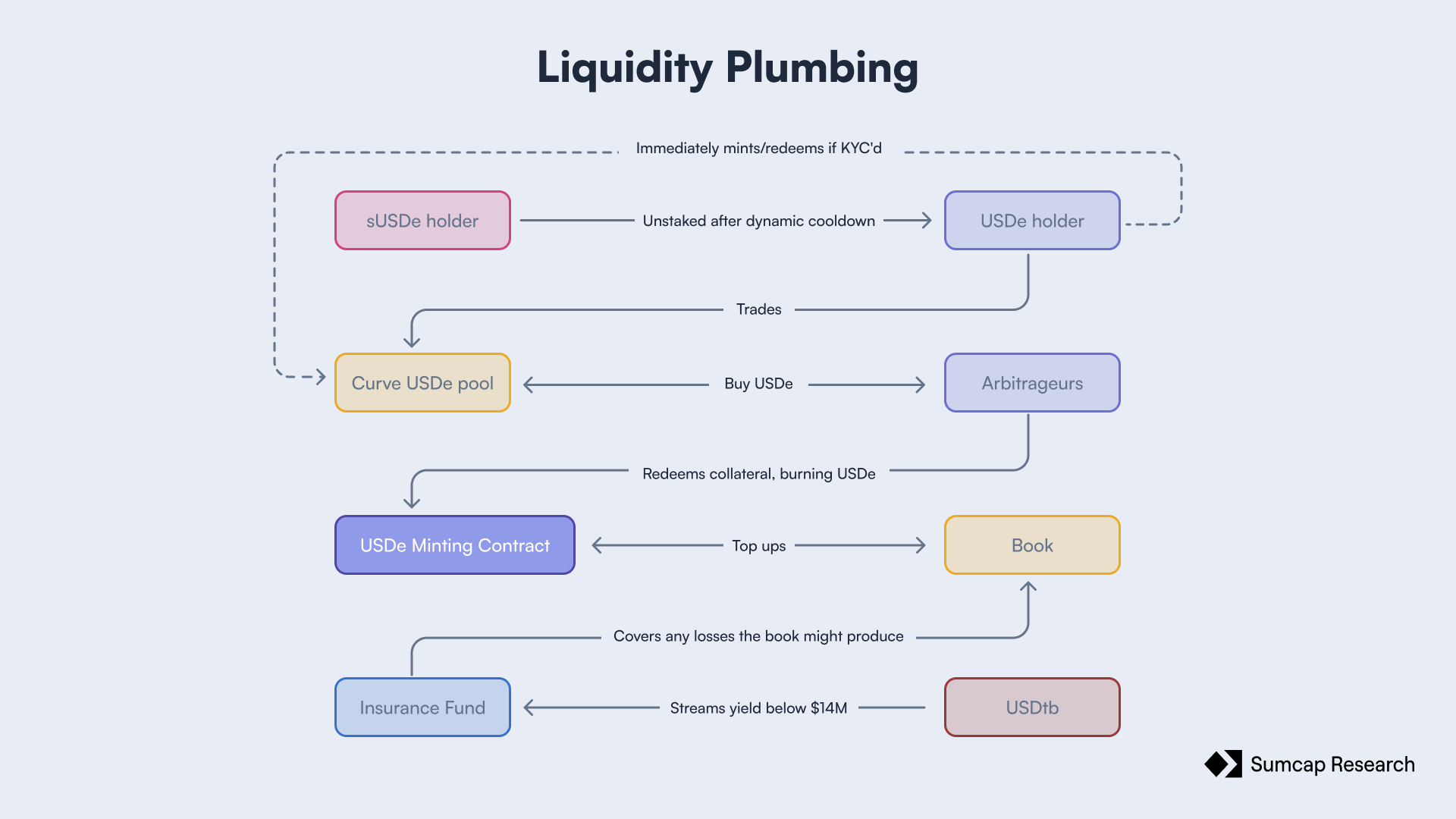
3.3 Liquidity plumbing
When someone wants out of USDe they sell it on Curve or on a CEX and the pools absorb the flow like they did on 10/10. Selling pressure only reaches Ethena once the price dips far enough for arbitrageurs or Ethena to step in, buy the discount, and carry it to the primary rail (the minting contract).
The hot contract itself holds a deliberately small amount of ~$93M (against $4.4B) that, when drained by redemptions, gets refilled from the liquid stable reserve, with an operational delay. This means the actual door is much bigger than $93M and represents the $1.12B of PYUSD, USDC, USDtb and USDT it draws from, the hot contract included.
Alongside the RFQ rail sits what Ethena calls its PSM (Peg Stability Module), which allows any KYC’d user to mint/redeem USDe against USDC at a hardcoded 1:1 with no fees.
3.4 The unstaking cooldown
On the opposite end of the product line, stakers (sUSDe holders) have an extra step on the way out: unstaking carries a dynamic cooldown controlled by the Risk Committee, which is currently set to 1 day. In Ethena’s history this cooldown has only been changed once: set to 7 days at launch, it was cut from 7 to 1 this March.
The committee moves the cooldown by hand following a strict rule: the 1-day setting is only allowed while same-day liquidity covers at least 1.5x a 99th-percentile outflow day. Simplified: take the top 1% of outflow days in sUSDe’s history. The smallest of those is about 4.1% of supply leaving in a day. Immediately available liquidity has to cover 1.5x that (~6%) for the 1-day cooldown to stay. Right now same-day liquidity sits at ~$1.1B, about 25% of supply and four times the threshold, so the short cooldown is justified.
In the other direction, two consecutive days of outflows above the 95th percentile will also snap the cooldown straight to 3 days regardless of coverage, lengthening the queue exactly when stakers are most eager to leave.
3.5 The insurance fund
And lastly, in case everything else fails, the insurance/sinking fund takes the hit. Today, the fund holds ~$62M split across $42M of USDtb and a $20M USDtb/USDC LP position, sitting in a 4-of-10 multisig outside of the backing. It acts as a final buffer between USDe holders and whatever loss the book produces: negative funding, a lending default, etc. The fund used to grow continuously, with the interest from USDtb routed straight into it, but a governance proposal passed this March redirected the interest towards sUSDe’s headline, only resuming top-ups if the fund falls below its $14M floor.
At 1.4% of supply the fund is the best-capitalized it has ever been (0.35% in October), and on paper the machine looks healthy: $1.1B staged behind the contract, a zero-fee peg rail, a short cooldown, and a $62M buffer.
3.6 Slow assets, fast liabilities
On paper, Ethena’s basis trade era looks like it should have been better at honoring redemptions. That’s because unwinding the basis trade was countercyclical: closing a portion of Ethena’s delta-neutral position meant closing a short, so it was buying into a market where everyone else was selling. The worse the crash, the easier that book was to liquidate. With the new setup it is the exact opposite. Exiting means selling CLO shares, pulling Aave liquidity and recalling loans exactly when everyone else wants out of the same doors. This pushes the delay roof for redemption capital from T+1 (basis era) to completely locked (yield fund). Meanwhile the other side of the balance sheet moved the opposite direction: the unstaking cooldown got cut to 1 day and the PSM made on-par redemptions instant at no fees. The assets got slower while the liabilities got faster:
Currently, Ethena has $2.04B available within a day, another $506M at T+3 (assuming both CLO doors are open), $1.34B depending on the utilization rate of lending pools, and the rest, set at bigger terms or stuck. Note this is a wider measure than the ~$1.1B of same-day liquidity the cooldown rule tests against: that one counts only what is reachable without selling anything, while this ladder counts everything that can be turned into cash inside a day.
Testing the new book categories will allow us to see key break points in the system, where/when queues form, and most importantly, answer something we posed from the very start:
Is the current risk composition for Ethena’s yield sources better than exchange and ADL risk? Because the yield is comparable, the difference is what’s delivering it, and at what cost.
3.7 Simulation method
Method. A 30-day, daily-step simulation of the book as measured on 9 September 2026. Each day draws a redemption/unstake pair from a band of historical stress days and applies it to remaining supply; 1,000 paths, shown as p5/p50/p95 fans. The confidence-drop band is the worst 5% of days across full history; the 10/10 band samples the heaviest 15% of days from October to December 2025 plus the 19 to 23 April 2026 run. That band is a sampler, not a replay: the model draws daily percentage moves from those days and walks them forward, so what comes out is the tail of that distribution rather than a reconstruction of what actually happened. Variance decays as the walk steps out toward day 30, so supply cannot drift to zero simply because the walk has room to run. Mints are assumed to stop, and unstakes sit in a three-day cooldown before joining the queue. A second simulation models third parties pulling out of the same Aave pools, so the DeFi sleeve returns cash on a capacity curve rather than on demand. Management is reactive, not anticipatory: the book pays what it can from liquid each day and only then orders more from the sellable sleeves: enough to cover the backlog plus the next ten days of demand, spread in proportion to what each sleeve holds, rather than de-risking ahead of the run. Ethena’s actual allocation policy isn’t public, so this is an assumption rather than a worst case (a manager who rebalances to fixed shares does worse, see below). Unpaid backlog is sold into measured secondary depth ($39M) with no arbitrage backstop. Settlement times for basis, RWA and institutional loans are assumed, not measured.
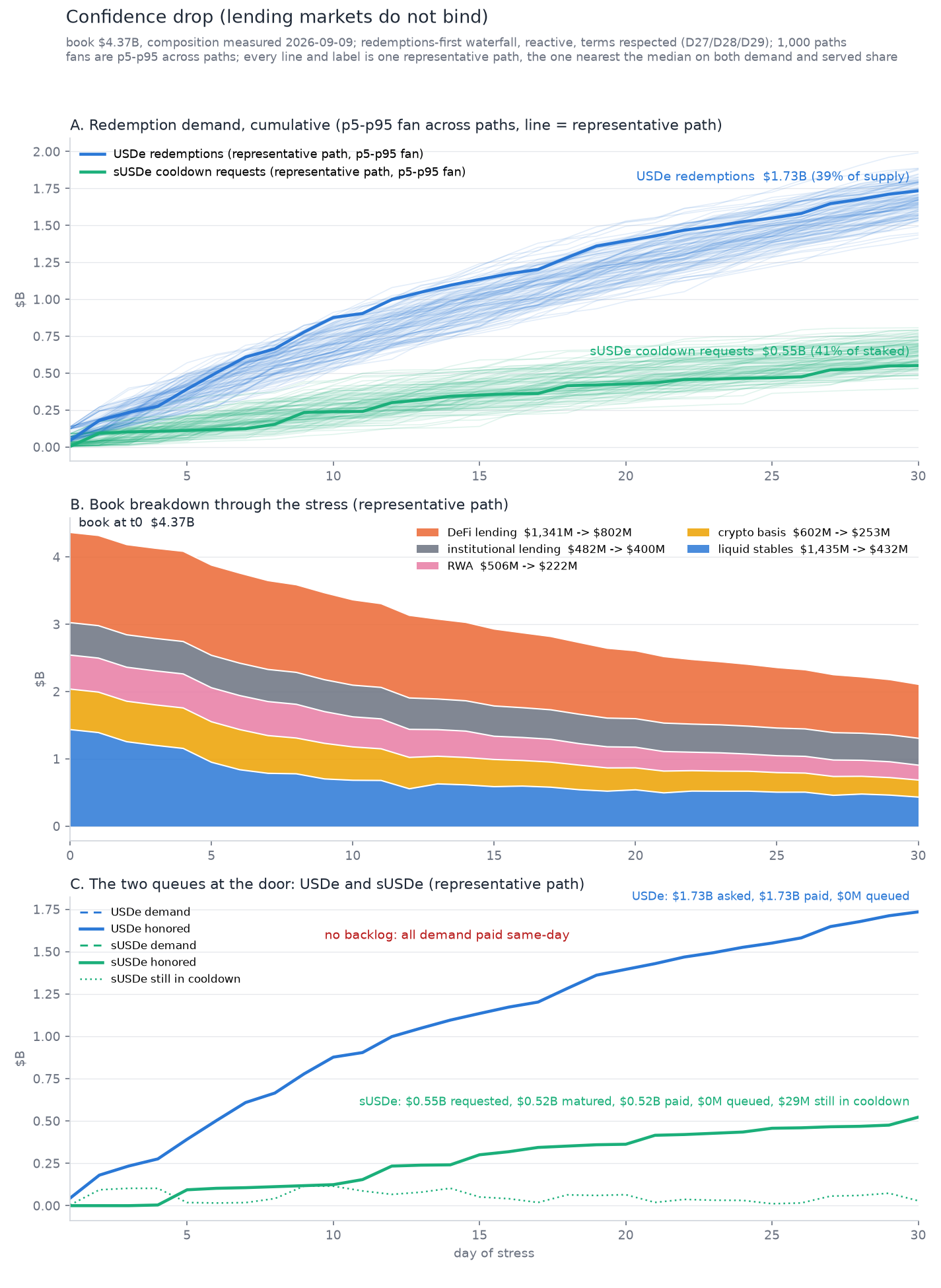
3.8 Base case: a confidence drop
For a base case scenario, a hard confidence drop in Ethena (for whatever reason) is the perfect candidate. It assumes no outside variables “go wrong” and only models redemption demand as % of total supply.
Over a 30-day period, the median demand comes out to $2.25B: $1.73B of redemptions (39% of supply) plus $520M of unstaking requests maturing out of the cooldown. Against $2.55B of money reachable within three days, this scenario clears all redemption requests by trading off the majority of its fast capital.
3.9 A month of the 10/10 tail
But the reality is that it’s never just one thing that goes wrong. So rather than replaying 10/10, we model a month of its tail: thirty days where days like the heaviest 15% of that window keep arriving, third-party depositors pull out of the same lending markets Ethena sits in, and borrowers can only repay by selling the collateral underneath them.
In such a scenario, the claims rise to $3.86B over 30 days ($2.92B of redemptions and $940M of matured unstakes, out of $1.01B requested), and the machine honors 99% of them. The door only starts falling behind on day 30, with roughly $39M of claims still waiting: $22.5M of USDe redemptions and $16.5M of matured unstakes. What keeps that queue open is the loopers. They borrowed stables against (s)USDe, so Ethena can only pull its money out of those pools as fast as they repay.
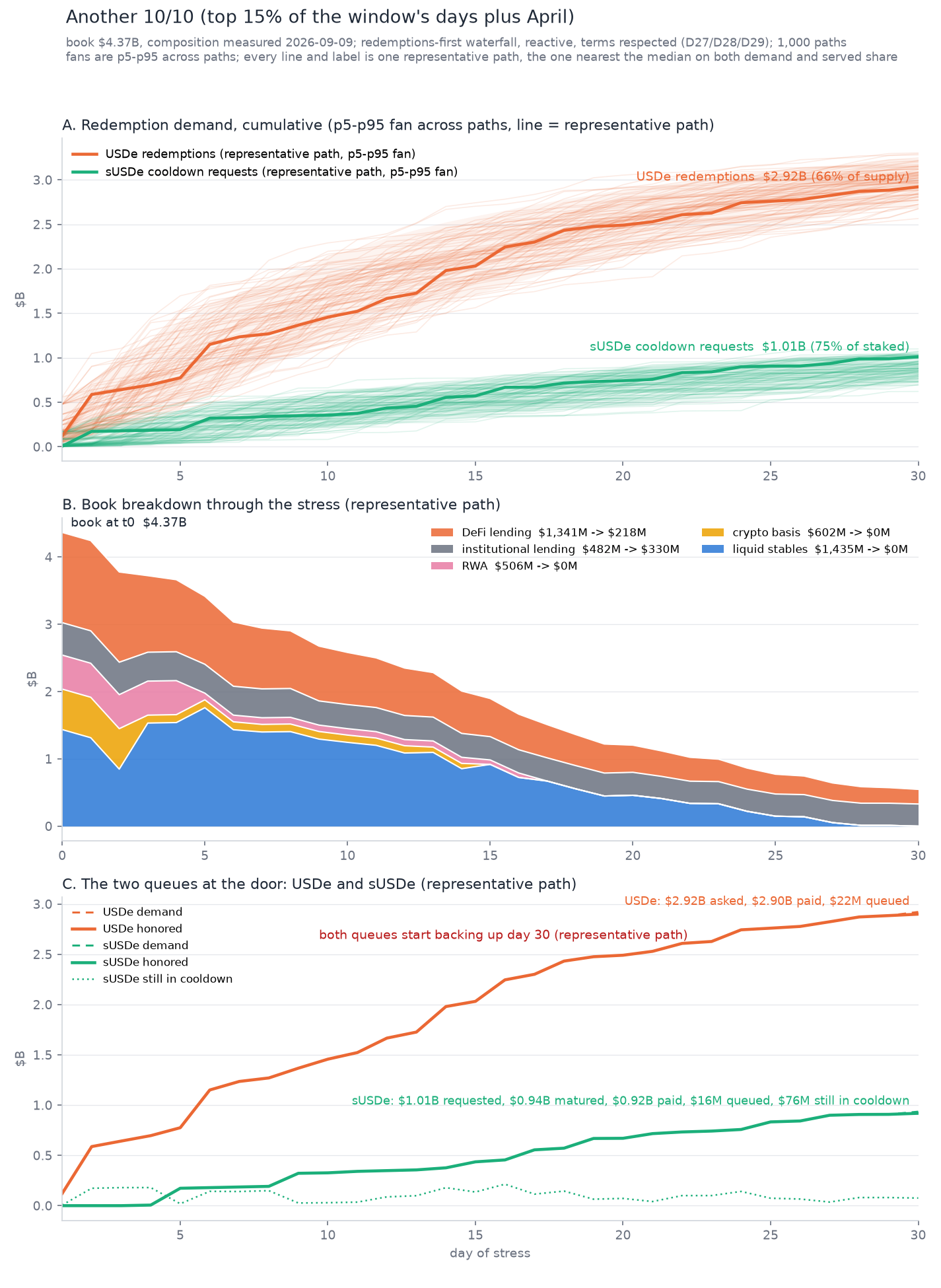
This reaches USDe itself through price. In USDe’s workflow there’s no implementation of a FIFO structure (queue): when the hot contract depletes, Ethena’s RFQ will simply stop returning quotes. And without a functioning arbitrage mechanism to restore the peg, the pent-up demand waiting for the system to come back online gets expressed through a discount in USDe’s secondary-market price.
Now, USDe only has about $39M of tradable depth globally, so the $22.5M of USDe still waiting at day 30 sits inside what the secondary market could absorb.
And it only has to hold that for a few days. The $810M of stablecoin debt sitting across those three pools (the loopers are ~$693M of it) is thin: 87% is below a 1.05 health factor. So with utilization pinned at 100% and the borrow rate climbing toward 15%, interest alone starts liquidating the weakest positions around week five. Those liquidations force-repay the borrows and push stables back into the pool, which is exactly the capital Ethena is waiting on.
The liquidations land just past the window we model, which is the only reason a queue forms at all. Push them later (thicker collateral buffers, a slower rate climb, borrowers topping up rather than getting liquidated) and the backlog at day 30 is materially bigger than $39M. The finding is not that the book is comfortable. It is that the circuit breaker trips in time. And if it trips late, there is $62M in the insurance fund against a $39M gap.
3.10 Management policy and what is left over
How the book is managed matters about as much as when the loopers blow up. Everything above assumes Ethena pays what it can each day and only then orders more, which is the reactive case. Run the same stress against a manager who instead keeps every sleeve within ±3 points of its starting share, and the result drops to 94.5% served, with the queue opening on day 24 and $213M still waiting at day 30. Roughly four and a half points of service, and five times the backlog, come down to a policy Ethena has never published.
So the answer to the question we opened with is not quite what the structure suggests. On paper this book is worse at honoring redemptions than the basis book was: slower assets, faster liabilities, and a lending sleeve that locks exactly when it is needed. However, against a tail drawn from 10/10 and April, Ethena services 99% of claims and the queue only starts backing up on the last day of the month, because the leverage that locks the pools is also what unlocks them. What is left over is compositional rather than structural: custody delivered, the basis sleeve and both RWA doors emptied on schedule, and institutional came back late but complete. The residual sits in the DeFi lending sleeve alone. A simple fix for this would be allocating less of the sleeve to seeding new markets and instead staying on more mature instances, where Ethena isn’t the entire supply side and the borrowers aren’t all running the same trade.
Since June the DeFi lending sleeve has shrunk by a third ($2B to $1.34B), while the basis sleeve went from $39M to $602M, increasing the share of fast capital. And Ethena’s trajectory suggests the book is being reshaped again, through the addition of a category with a faster time to cash.
4. Trajectory
4.1 Product lines and the fee switch
For a very long time it was genuinely hard to say what Ethena’s business plan was: there was USDe, the synthetic dollar. There was sUSDe, the yield product. There was USDtb, a fiat-backed stablecoin that competes with what it already had. There was a stablecoin-as-a-service arm launching branded dollars for other people’s ecosystems. And a Nasdaq-listed vehicle holding a fifth of the token. And all of it was built while the backing itself transitioned from a delta-neutral book into an actively managed yield fund.
But a massive part of the confusion was that each product line made money differently, and for different people:
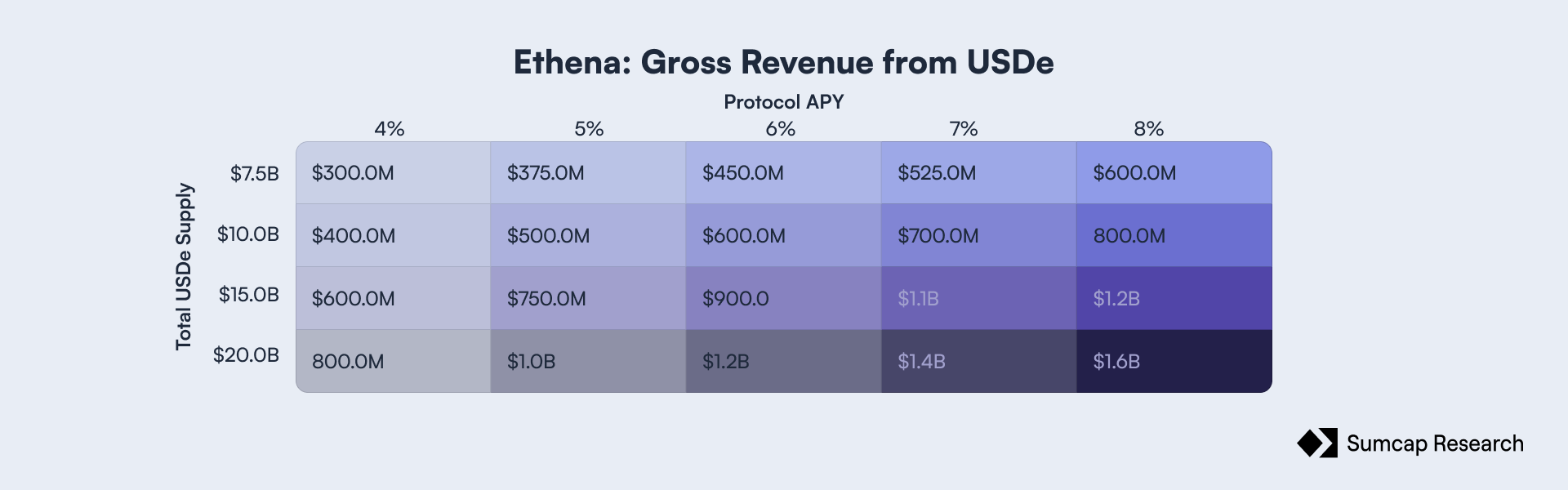
On August 27th, the Foundation and Labs signed a framework agreement assigning the IP and all value accrued by the protocol to the Foundation, governed by token holders, with no residual cash flow to Labs’ equity investors. Alongside it, the Foundation bought out the locked tokens of seed investors who had been selling, and eliminated the monthly VC unlocks that otherwise ran to April 2028 at 267.1M tokens a month. When you pair that with the fee switch vote that passed on September 2nd, ENA is essentially being turned into the equity claim on all of it. The proposal allocates a portion of gross protocol revenue to buying back ENA on the open market, with the take rate tied to USDe’s 14D average circulating supply: 5% at $7.5B, 10% at $10B, 15% at $15B, and 20% at $20B. The bigger the dollar gets, the larger the share of revenue that flows back to the token, and the way Ethena plans to get there is by raising sUSDe’s headline.
4.2 Equity basis
Ethena announced it was extending the basis trade to equities on August 28th, and the pitch is that it’s the same operation it has already run at scale, just pointed at a better paying market. Looking at the numbers it makes complete sense: Ethena ran that exact book at over $8B at its peak and processed >$30B of mint/redeem flows through it, using the same custodians and venues. What equities will provide Ethena with is something crypto can’t anymore: an unexplored market.
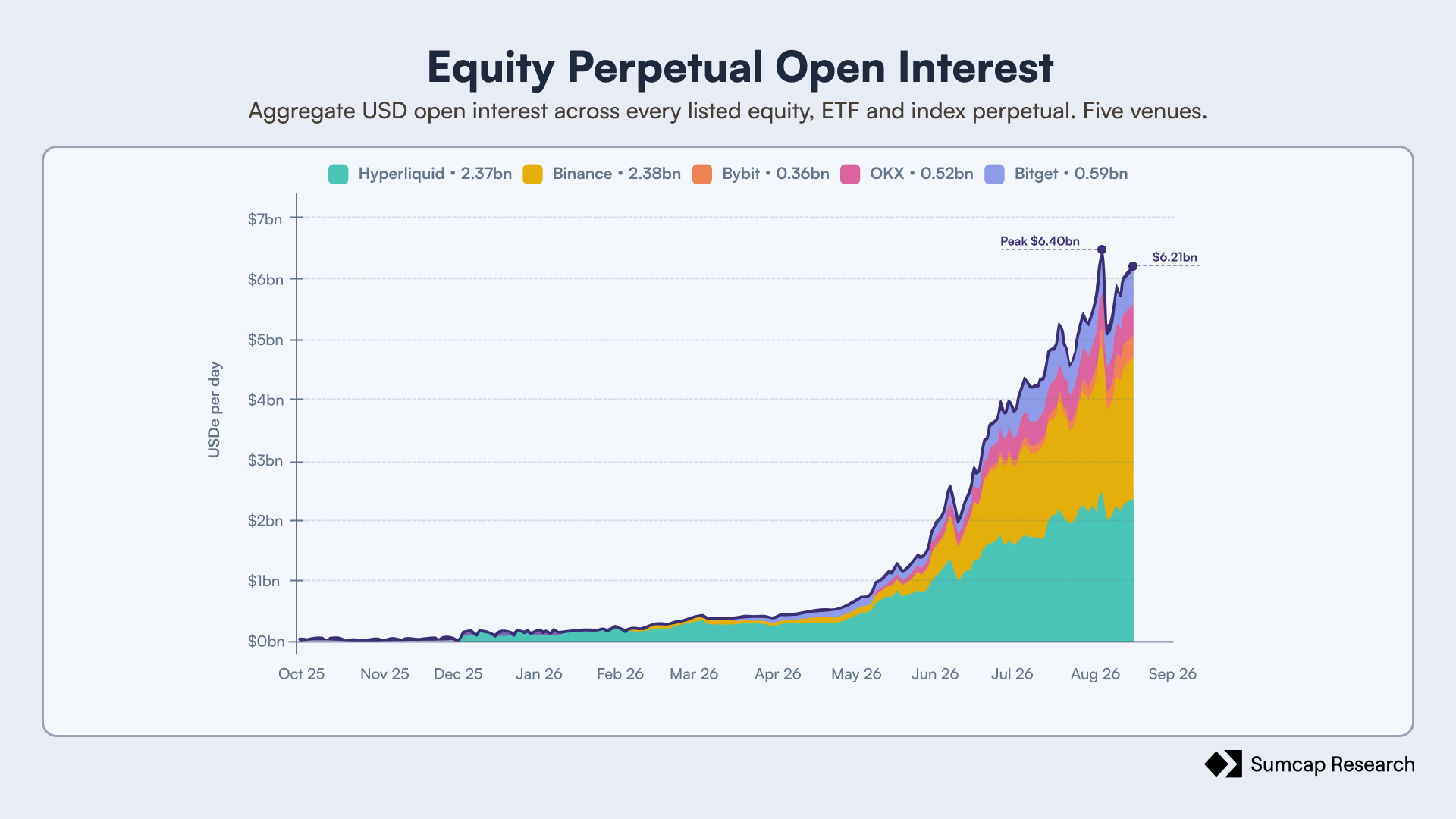
Global equity market cap reached $166.5T in July 2026, against $2.2T of all of crypto. So the pond Ethena has been fishing in is about 1.3% the size of the one it’s moving into. On top of this, the perp market is still tiny enough that it makes sense: equity perps hold $6.2B of OI against ~$94B in crypto perps, even after growing tenfold since March. When crypto perp OI peaked, it was about 2.6% of crypto’s MCap, so applying that same ratio to global equities implies something like $4T of OI.
But OI growth is a kind of double-edged sword:
1. On one side, you have massive funding that is a by-product of low competition:
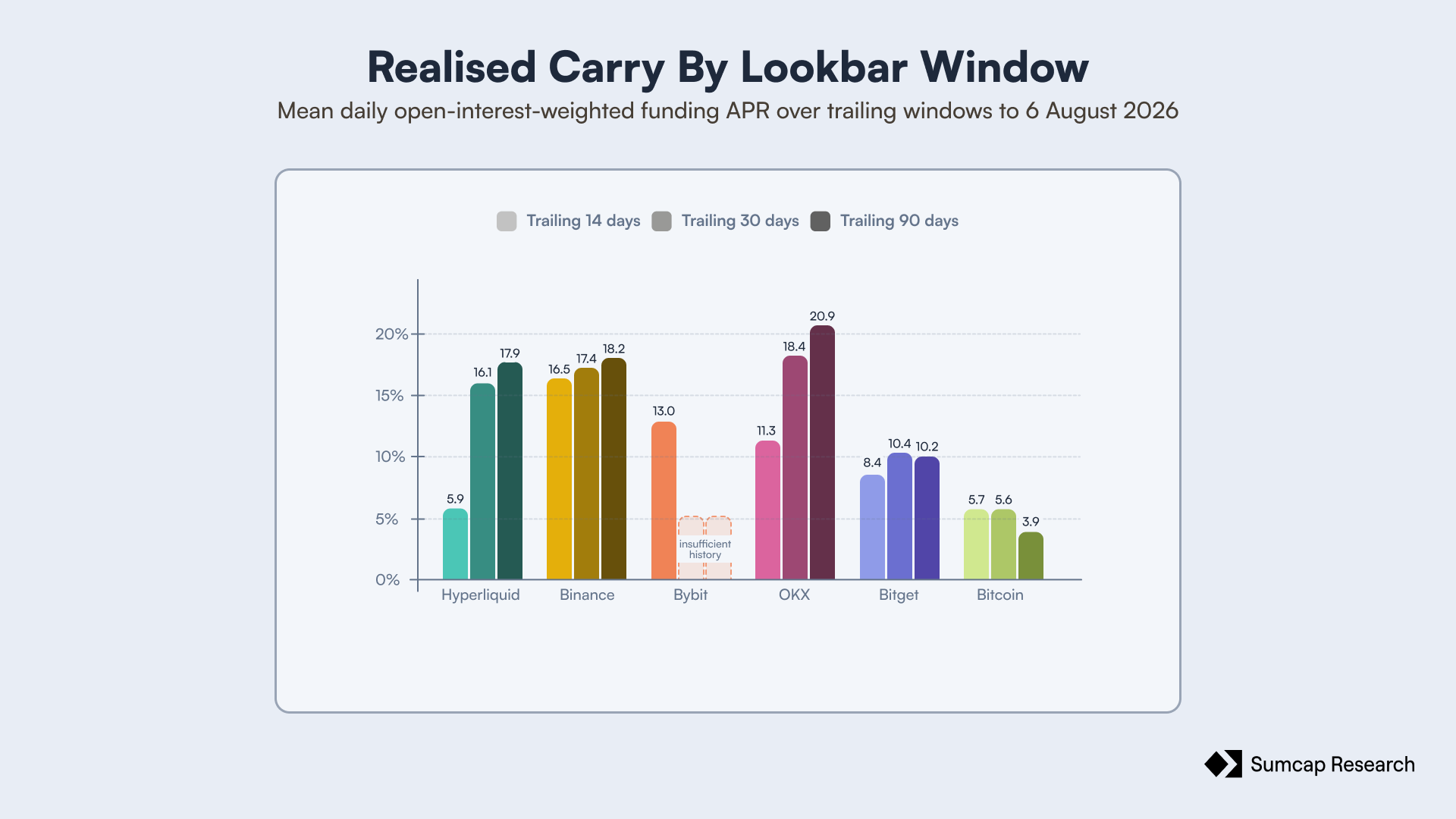
Between 20 May and 11 August OI-weighted funding averaged 14% ann. on Hyperliquid and 17.5% on Binance, against 4.1% on BTC. The median came in at 13.9%, printing positive on 94% of days on Hyperliquid and 97% on Binance.
In the 30 days to 6 August the equity venues paid up to 18.4% against BTC’s 5.6%.
2. But on the other side, that same thinness that keeps funding attractive caps how much can actually be put to work:
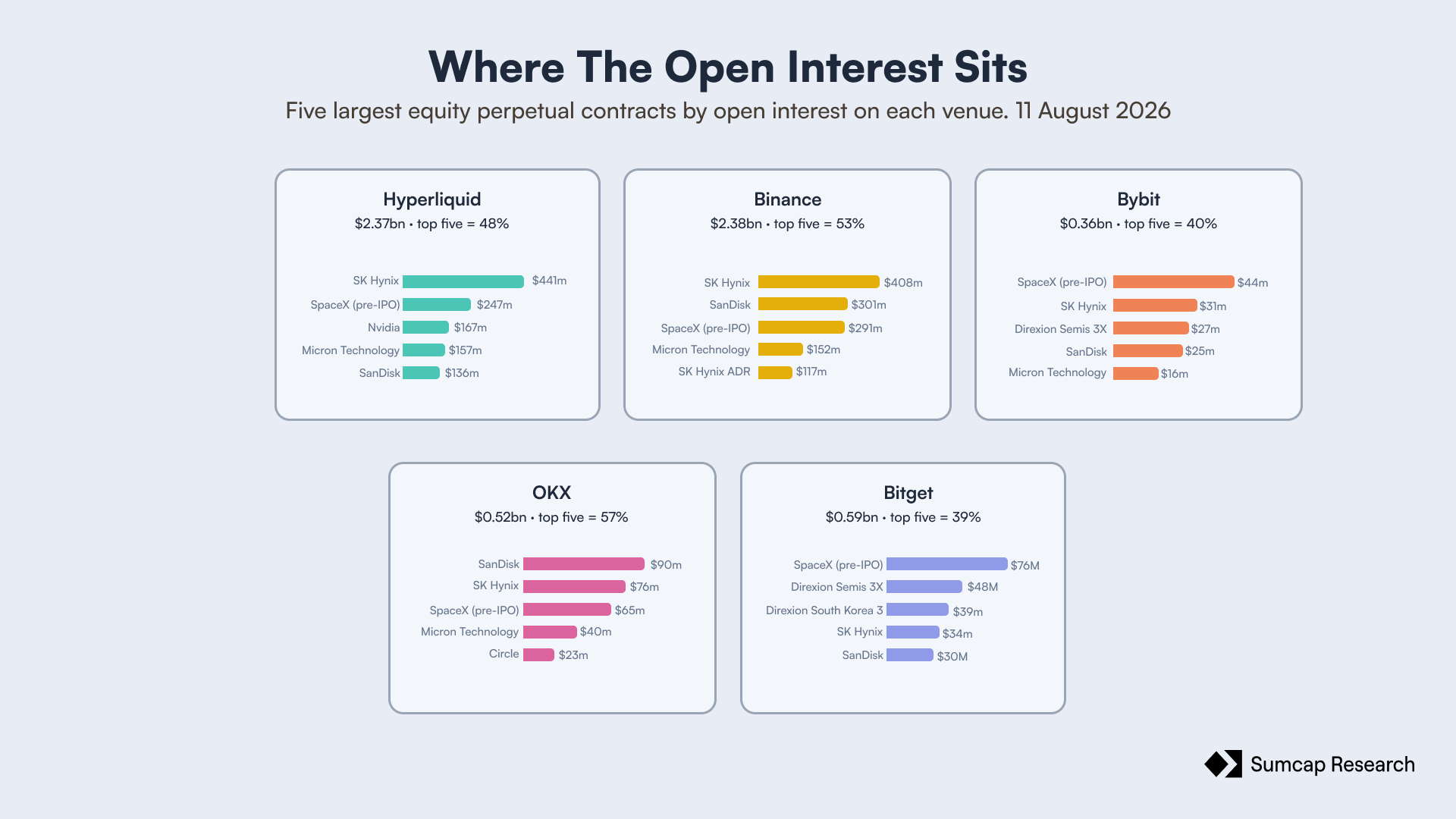
Ethena’s rules keep any position under 10% of a contract’s OI, and in the approved universe, where a contract only qualifies with at least $25M of one-sided (14D avg.) OI and >30D of funding history, there’s only about $240M worth of OI for Ethena to exercise.
That universe is 17 of Binance’s 67 matched pairs plus 3 contracts on OKX. The size is just under a fifth of the DeFi lending sleeve.
Notably, Hyperliquid, which carries much of the OI in the sector (about $2.4B of the $6.2B), isn’t in the approved framework at all.
Assuming funding holds the 14% median and Ethena moves the full $240M out of DeFi lending and into equity basis, that’s 5.5% of the book swapping from 4.9→14% APY, moving the blended book APY from 4.7→5.2%.
And that is not all: with Ethena Pay, USDe got a whole new audience to appeal to.
4.3 Ethena Pay
On September 3rd, Ethena announced its non-custodial neobanking app, whose card had been in use with early users since July, allowing users to deposit fiat or crypto and get everything a bank account comes with: a virtual Visa, a virtual IBAN, zero FX markup, no annual fee, and free transfers between users. But the meat of it all is in the fact that deposits get converted to USDe, and the way it is set up is the clever part.
Resting balances earn up to 6%. This yield is taken from sUSDe’s headline, but since it’s above what the book actually makes, Ethena is the one covering the difference between the base and the 6%. The catch however, is that the yield is capped per user, between $5k and $50k depending on the tier.
Then, it keeps users spending with cashback, paid in AVAX, that steps down fast as you spend more, and is again capped. The actual source of the cashback funds isn’t known:
- It’s either Avalanche incentives to get USDe flowing on the chain
- or sUSDe’s headline used to buy the AVAX
Either way it’s bounded, and none of it comes out of the book.
Meanwhile every dollar that comes in through the app is USDe the book earns on, which has no cap, and as of September 22nd 10,399 accounts have been created, 723 of which hold USDe. Between these accounts the app has paid out $8.8k in yield, put $1.36M through the card, and holds $3.30M of USDe (51% of all USDe on Avalanche).
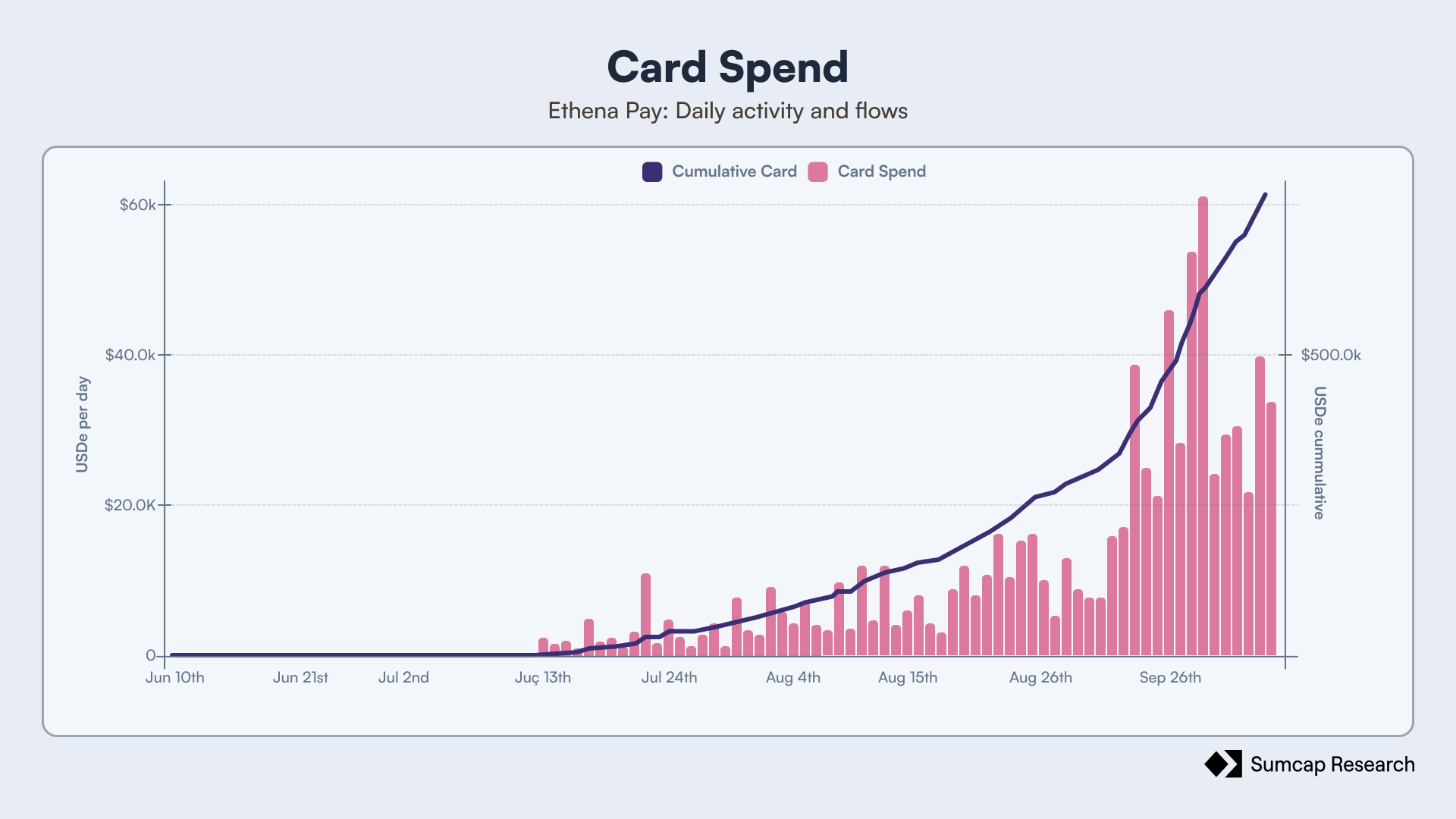
Ethena Pay essentially gives USDe a new market of users: people who hold it to actually spend it, growing supply, and bringing the fee switch closer to realization, while adding revenue.
4.4 ENA buybacks
And this is where the value alignment really kicks in, at a 5 to 6% protocol APY:
- sUSDe’s headline goes up, pulling more users towards USDe (and closer to the $7.5B mark)
- partner payouts grow, pushing USDe through the whitelabel ecosystem harder
- and the buyback grid gives $19M to $23M a year at $7.5B, $50M to $60M at $10B, $113M to $135M at $15B, and $200M to $240M at $20B.
Equity basis turns the crank and Ethena Pay widens the funnel:
Better yield → bigger headline → more supply → higher take rate → more ENA buybacks
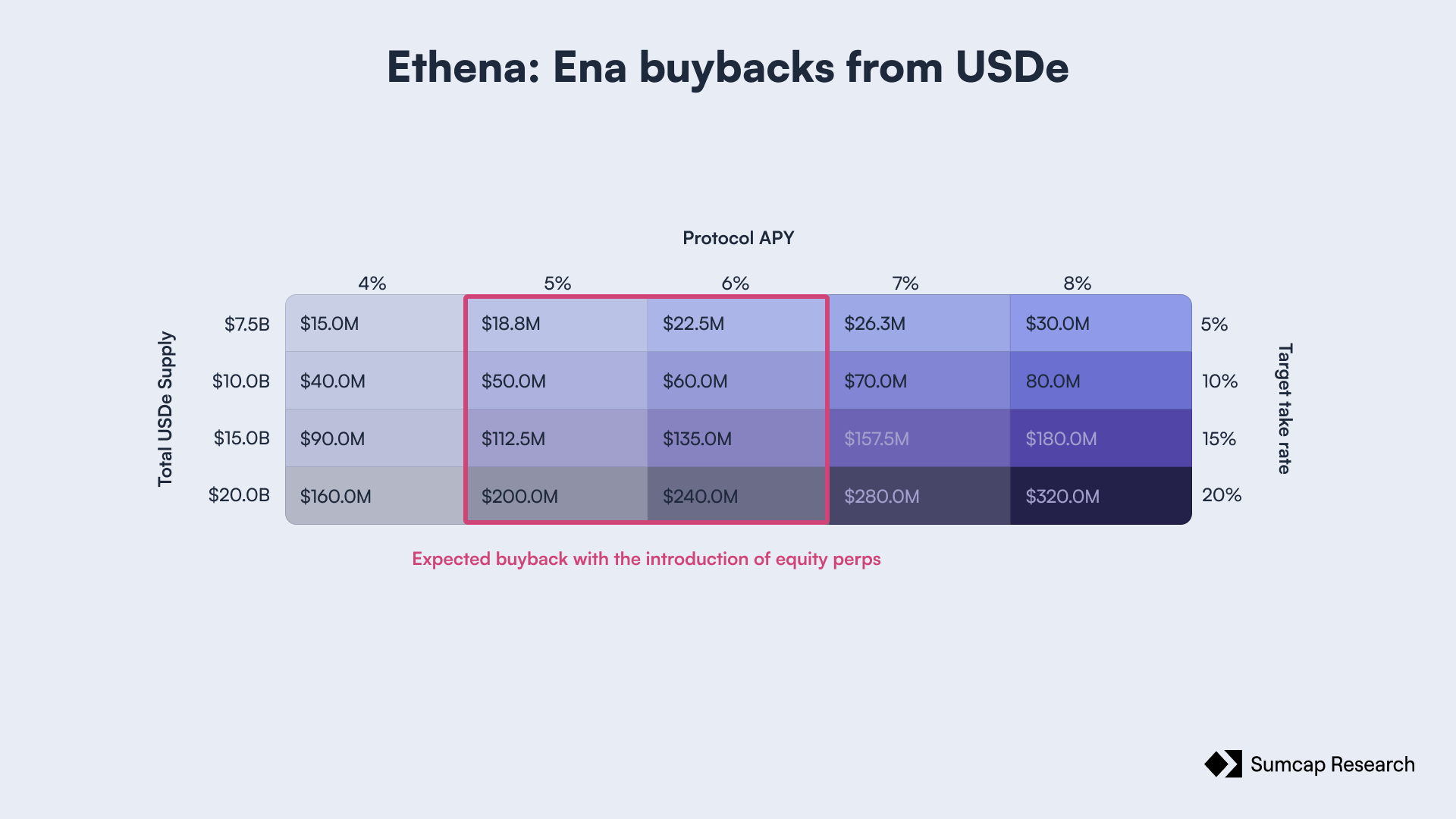
If USDe were to return to its peak of ~$15B, the take rate gets pushed to 15%, which at the current protocol APY of ~5%, would amount to $112.5M of purchasing power for ENA buybacks. But even though the numbers look enticing, USDe still has to grow by about 70% and get to $7.5B (from $4.4B today) before any buybacks start.
This is the first time Ethena’s product line has felt complete: the whitelabel deals, the savings product, the payment app, and whatever else comes next all earn separately, but feed into the same place. And that finally makes ENA worth holding on its own.
Until now it was a governance token and not much else: you could vote on who sat on the Risk Committee, but every actual claim on Ethena’s performance ran through a different product. If you wanted the yield you held sUSDe, if you wanted the equity you had to be an early investor in Labs, and if you simply thought Ethena as a business was going to work, there was no clean way to express that.
But now there is: ENA is a claim on every line at once, and unlike sUSDe, the payoff to being right about Ethena is uncapped.
5. Conclusion
Ethena has cemented itself as the largest synthetic dollar issuer in crypto, but the protocol underneath is nothing like the one that started it all. The basis trade is now one sleeve out of five, the book is run by a committee with external reviewers, and the product line finally has a structure: a dollar, a savings rate, branded dollars for other ecosystems, a neobank, and ENA as the de facto equity claim on all of it.
On the risk side, the book is in better shape than it was in June: the lending sleeve shrank, making room for crypto basis to return as funding recovered, and the newly approved equity basis framework adds another category with a fast time to cash. And against a 10/10-scale tail it now honors 99% of claims, with the USDe left unpaid at day 30 sitting inside what the secondary market can absorb. What is left over is compositional, and sits only with the DeFi lending sleeve, in pools where Ethena is a big part of the supply side and nearly every borrower is running the same (s)USDe loop.
On the growth side, the issue is that the sleeve holding redemptions up is also the one fueling the growth. USDe has to reach $7.5B before ENA captures anything, and to date that supply has partially been built by loopers borrowing Ethena’s own reserves against its own token. Every looped dollar counts toward the trigger and is also a dollar the book can’t recall in a run.
What changed in the last month is that Ethena now has two routes to supply that don’t go through the loop: equity basis raises sUSDe’s headline, increasing USDe’s allure, and Ethena Pay adds supply from users who hold USDe to spend it. If the next $3B comes from those, Ethena reaches the switch-on with a faster book than today. If it comes from the loop instead, it arrives with the same dependency it has now, only bigger.


The Reinvention of Ethena: History, Risk, and Trajectory
Ethena has cemented itself as the largest synthetic dollar issuer in crypto, but the protocol underneath is nothing like it was at launch. From delta-neutral hedging to actively managed yield, a new collateral mix, and a very different risk profile: what changed, and what does it mean for USDe?
1. Introduction
You can’t talk about stablecoin issuers without mentioning Ethena. At its peak the protocol held $15B in TVL and ran the biggest basis trade operation in the history of DeFi, all while paying ~8% APY to sUSDe holders. Nowadays however, after a 71% drawdown, Ethena sits as the 9th largest protocol by TVL (with $4.4B “under management”), and is a professionally managed balance sheet rather than a stablecoin issuer. USDe’s backing is also no longer a monolithic bet on perp funding, with Ethena cutting its basis sizing from 33% of the book to 1% between April and June, to make space for a more actively managed portfolio. It has since rebuilt to ~14% as funding recovered, but it is one sleeve among five now rather than the whole thing.
To put it in perspective, the size of the basis sleeve on its own was once bigger than everything Ethena manages today (it ran at over $8B at its peak, against ~$4.4B for everything Ethena manages today). So why did the protocol move away from a seemingly profitable strategy that allowed it to capture $15B in market share?
2. From NakaDollar to the pivot
2.1 The NakaDollar
In March 2023, Arthur Hayes (Co-Founder of BitMEX) published an article titled “Dust on Crust”. In it, Hayes described a new value-preserving mechanism for stablecoins called the “NakaDollar”. The idea of the NakaDollar (NUSD) was quite simple: a tokenized fund consisting of equal parts long spot and short perp positions of BTC, such that when price moved either way, one leg’s losses would offset the other’s profits, keeping nominal value stable.
The issue was that even on paper, this idea came with clear shortfalls:
- What happens in periods of prolonged negative funding rates?
- What happens if one of the exchanges custodying the collateral fails?
- What happens when a liquidation cascade turns so violent that the exchange socializes losses, auto-deleveraging (ADL) the profitable short leg?
Hayes’ answer to all 3 questions was the introduction of a “Sinking fund”. The Sinking fund was a pool of capital, raised through sales of the NAKA governance token, that would sit between the mechanism and its holders, absorbing the hit whenever one of those scenarios played out.
With this rough outline, the NakaDollar sparked a wave of protocols all building on top of the idea, and in February 2024, Ethena launched USDe on mainnet, with Hayes as one of the seed backers.
2.2 The basis trade era
USDe launched with 2 distinct differences from NakaDollar’s structure:
- Where NUSD proposed holding plain BTC on the long leg, Ethena held staked ETH, allowing the collateral to earn yield even before the perp hedge was applied, effectively stacking 2 income sources (perp funding + staking yield).
- Hayes’ DAO would’ve let member exchanges hold the BTC, but instead, Ethena placed collateral with regulated custodians who would confirm its existence to exchanges, allowing them to credit margin against it (off-exchange settlement).
The main benefit that comes from OES is that an exchange failure would only cost Ethena its hedge, rather than its collateral, since it never left custody.
It also made Ethena a company with custodian relationships rather than just a protocol with a governance token: this was the first of several decentralization trade-offs Ethena made for durability.
For all that, the minting pipeline for USDe was quite simple, but it looked nothing like the open swap window people now associate stables with. Specifically, minting was permissioned: Ethena kept an on-chain whitelist, controlled by its dev multisig, of “benefactors” allowed to deposit collateral, who could in turn nominate the beneficiary addresses that received the minted USDe.
These benefactors were usually market makers whose interest was arbitrage between the minting contract and secondary markets: when USDe traded >$1, these MMs would mint USDe for $1 worth of stETH and sell them for more on Curve and Uniswap to users. Conversely, if USDe traded below $1, they would buy it discounted on secondary markets and redeem it for $1 of stETH.
To mint USDe the MM in question would first need to request a quote for the stETH/USDe pair from Ethena’s off-chain quoter, then pass the signed order along with the beneficiary address to the minting contract. From there the collateral is routed to Ethena’s OES custodians who delegate it as margin on CEXs and Ethena then opens the short hedge leg against the delegated margin completing the position.
With their USDe, users could earn the headline yield by depositing it into the StakedUSDe contract, an ERC-4626 vault which the protocol periodically deposited USDe into (from staking and funding revenue) increasing sUSDe’s redemption value and bearing the users’ yield. And this yield is what did the early marketing for Ethena. With the headline frequenting 20% and peaking at 113%, the first year of the launch witnessed ~70% of USDe (~$3B) staked.
2.3 The competition
Seeing these figures, competitors followed in Ethena’s steps, and through 2024 and 2025 Elixir, Stream, Falcon, and more, all shipped their own synthetic dollars on the same chassis: collateral long, perps short, funding streamed to stakers.
Between Ethena and all its competition, the synthetic-dollar space grew from one protocol into a category: USDe alone touched $15B and was briefly the third-largest stablecoin. Every new entrant was another short in the same order books, all harvesting the same funding rate.
2.4 Pivot point: 10/10
Everyone reading this probably remembers 10/10: a Truth Social post announcing 100% tariffs on Chinese imports triggered the biggest liquidation event in the history of crypto, force-closing over $19B worth of positions in <24h, $6.9B of it in forty minutes.
During the cascade, USDe traded at 65¢, but only on Binance. On every other venue the peg barely moved, with Curve pools holding within a cent of par throughout the whole event. The reason for the Binance discount was that its oracle priced USDe off of its own (thin) books, so as the cascade sold USDe into it, every lower print liquidated more positions, feeding the cascade even more.
Underneath all of this, Ethena’s redemption mechanism was working as designed: the collateral sat with custodians out of the exchange’s reach, the short legs profited as prices fell, and over $2B of redemptions cleared at par in three days ($1.6B on October 11th alone). The fact that Curve pools held so well was proof of this. However, even though Ethena held up its end of the deal, in the 2 months following the crash ~$8.3B of USDe left the protocol as confidence fell.
But Ethena wasn’t the only one. Within weeks of the crash Stream’s xUSD collapsed after an external fund manager lost ~$93M of its assets and withdrawals were frozen, and Elixir, having parked 65% of deUSD’s collateral with Stream, chose to wind down the product.
2.5 Funding dries up
10/10 had marked a massive shift for the synthetic dollar space. The leveraged longs that were paying for the whole sector got liquidated, and demand tanked: ETH funding that averaged 13.0% through 2024, fell to 4.9% through 2025, and by May 2026 it had spent 96 straight days in negative (on the 30D MA). Worse still, BTC funding, which held the majority share of the early book, was averaging 11.9% through 2024, then 5.1% through 2025, and by May 2026 it had spent 85 straight days in the negative (on the 30D MA).
And if that wasn’t enough, TradFi had discovered the same trade in a better wrapper: spot ETFs gave hedge funds a clean long leg, while CME gave them a regulated short one, and the resulting cash-and-carry was essentially USDe’s book minus the exchange custody risk and the unstaking queue. By mid-2024 hedge funds were net short over $6B of CME bitcoin futures against the ETFs (Glassnode put it at $6.3B in June), and CME open interest peaked that November. Ethena’s yield had deteriorated to 4.7%, and when you put that up against 3.5% on T-bills, a ~1% spread for carrying exchange risk, ADL risk and every tail scenario Hayes had listed back in 2023 simply did not make sense anymore.
It was clear that if Ethena wanted to survive it would need to change its tactic. So in April 2026, the protocol formally surrendered the basis trade: capitulating at the very bottom of the funding chart, cutting the sleeve to ~11% of the book (and to 1% by June), and redeploying the rest across four new reserve categories.
3. Ethena today: anatomy of a yield fund
In essence, Ethena’s overhaul is very similar to what Sky (formerly MakerDAO) did. Maker started out as a pure crypto-collateralized issuer and later on added the USDC PSM, then T-bills, and eventually rebranded to Sky, with the balance sheet now allocated through SubDAOs/agents like Spark (DeFi and RWA deployment), Grove (credit mandates), and others. Similarly, Ethena started as a synthetic dollar and has now transformed into more of a yield fund structure managed by a Risk Committee and external reviewers.
The similarity is almost laughable: both started from opposite ends of the design space (overcollateralized CDPs vs delta-neutral perps), both traded off “decentralization purism” for more durability, and both ended up as actively managed balance sheets, holding, among other things, the exact same tokenized CLO fund (JAAA).
On the user-facing side everything is still seemingly the same:
- minting is still whitelisted (but KYC’d users can now mint/redeem against USDC at 1:1 with 0 fees)
- regular users still get USDe on secondary markets
- USDe staking is still the same
But on the backend, the playbook is completely different.
3.1 Governance
Collateral is no longer married to a perp short the moment it arrives. Instead, it is managed by a 3-layer governance system, with the Ethena Foundation taking on a purely executional role:
- External risk reviewers author the per-asset proposals
- The Risk Committee, a 3-member 6-month mandate, approves allocations, ratios, cooldown formulas and tenors
- And (s)ENA holders control “board hiring” (who makes up the Risk Committee)
This August was the fifth vote for the Risk Committee mandate, and it elected 2 brand new “board” members, though only one of them took a seat. Those seats are filled through Snapshot: candidates apply, the Foundation screens and shortlists them, and (s)ENA holders then vote by approval, with each holder being able to approve as many candidates as they like at full token weight, and the top 3 take the seats.
The sitting committee (Blockworks Advisory, LlamaRisk, and Kairos Research) all stood for re-election, but only Kairos made the top 3:
- K3, a delta-neutral asset manager, took 1st place replacing Blockworks, which would’ve been the first time an active allocator sat on the board instead of a research shop. But after a second screening the Foundation ruled K3 ineligible for the term as its active allocator position made conflicts “structural and ongoing rather than limited to specific transactions”. Instead, the seat fell back to Blockworks, which took 4th place.
- OAK Research replaced LlamaRisk, taking the 2nd spot.
Day to day, the committee operates like an actual board: proposals sit through a 7-day deliberation window before a committee vote, members are required to recuse themselves where they hold direct conflicts, and Ethena Labs keeps a permanent seat at the table as a non-voting advisor. (s)ENA holders only pick the 3 firms who decide, twice a year, and everything in between is committee business.
So what has the committee actually built so far?
3.2 The book
As of September 9th 2026, Ethena’s $4.37B book consists of:
3.2.1 Liquid stables ($1.44B, 33.0%, ~3.9% APY)
At 33.0%, liquid stables represent the biggest sleeve of the book and generate their APY from issuer-side incentives.
The biggest of those is PYUSD ($576M), PayPal’s stablecoin, issued by Paxos Trust Company, for which Paxos runs incentive programs rewarding large holders. Similarly, USDG ($20M, held at Robinhood) is Paxos’ Global Dollar, and its Global Dollar Network shares the reserve yield with the partners who distribute it. There’s also Ethena’s own T-bill stablecoin, USDtb ($71M), whose yield is simply passed through from the BlackRock BUIDL fund backing it.
The rest of the category is made up of fiat-backed stables held for redemption liquidity and issuer diversification: USDC ($330M), USDT ($139M), and RLUSD ($300M), Ripple‘s NYDFS-regulated stablecoin, held in Copper custody.
3.2.2 DeFi lending ($1.34B, 30.7%, ~4.9% APY)
A point above liquid stables on APY and a marginally smaller position in the book. Split across Aave (V3 & V4), Morpho, Kamino, and Jupiter, this category is different from the others as it gives Ethena a growth playbook similar to Maker’s old D3M era (when it deposited DAI directly to Aave to make its borrowing cheap).
The only difference is that Maker minted fresh DAI it could always burn back, while Ethena lends capital into the same pools where USDe/sUSDe sit as collateral tokens, enabling users to: borrow other stables against (s)USDe, use the borrowed tokens to buy more (s)USDe, and loop it back. Simultaneously, the borrowed stables used to buy more (s)USDe land in Ethena’s book, and then again get used to deepen the borrowing pool.
This is good for growth, but the issue is that Ethena can only withdraw what isn’t borrowed, and in a market crash this translates to: a utilization spike, Ethena’s capital getting locked up, and redemptions kicking in all at the same time.
In fact, this exact scenario was flagged by one of Ethena’s own risk reviewers: the review attached to the Aave V4 allocation proposal modeled redemption access under 95% utilization stress and found it falls by roughly half, warning that the book’s exit layers “bind simultaneously under stress”: credit conditions tighten at the same moment USDe redemptions accelerate. (The allocation went ahead anyway, but with allocation limits set to reflect the finding.)
With that said, it seems Ethena uses this strategy to seed new markets rather than to fund the whole flywheel, and runs it through V3, not V4. Take a look at Plasma’s, Monad’s, and Mantle’s V3 instances. There, Ethena supplies a combined $439M of stables ($286M, $19M and $134M), a third of the sleeve. From those pools 66 unique wallets run a (s)USDe → stable → (s)USDe loop: 34 on Plasma, 18 on Monad, and 14 on Mantle.
Together they hold ~$770M of (s)USDe collateral built on just ~$83M of their own capital, with ~$693M of borrowed stables in between, an aggregate multiplier of 9.3x. The single biggest wallet holds $291M of (s)USDe against $26M of underlying capital (11.2x) on Plasma. On Monad and Mantle, effectively all of the (s)USDe collateral sitting in Aave belongs to these looping wallets (99 to 100%), and on Plasma it’s about 92%.
Another detail worth noting is who runs the remaining capital: the Morpho, Kamino, and Jupiter positions ($745M) sit with named external curators: Steakhouse, Sentora and Bitwise. The collateral they lend against is prime, which cuts the other way in a stress: liquidations correlate with the market, so those withdrawals free up at the same time everything else is under pressure.
3.2.3 RWA ($506M, 11.6%, ~5% APY)
At 11.6% of the book, the RWA category comprises tokenized AAA CLO funds: JAAA ($253M) Janus Henderson’s on-chain AAA CLO fund tokenized via Centrifuge, and STAC ($253M) Securitize‘s equivalent.
A AAA CLO (triple-A Collateralized Loan Obligation) is a pool of loans made to companies that are sliced into tranches. Of those tranches the triple-A tranche is the most senior one, meaning that if borrowers in the pool start defaulting, the losses eat through every junior tranche first, and the triple-A holders are the last in line to suffer.
The funds work by tokenizing that exposure: the loans sit in the real world with the fund managers, and Ethena’s share is represented as tokens on-chain (Solana, Base). Note that both allocations sit at roughly the governance-set cap of $250M.
3.2.4 Institutional lending ($482M, 11.0%, 5 to 7% APY)
The smallest sleeve at 11.0%, with loans to Maple Institutional ($303M), FalconX ($98M), Kraken ($75M), CBAM ($5M) and Anchorage ($1M).
Unlike the RWA section, where Ethena is one in a sea of lenders to a sea of borrowers, here every agreement is bilateral (between Ethena and a borrower), with a named neutral third party and a set term for the loan. The borrower posts BTC/ETH worth more than the loan, and the collateral sits with the neutral custodian until maturity.
These agreements are private, hence the APY being a range and not a figure. One caveat with this structure is that the term can’t be broken: the money is locked until the loan matures, making this the slowest capital in the book to bring home.
3.2.5 Crypto basis ($602M, 13.8%, ~5.0% APY)
What was once the whole gist of USDe is now the third sleeve by size, rebuilt from $50M in early August as funding recovered. Ethena’s capital is split across Binance ($362M), OKX ($158M), Bybit ($60M) and INTX ($22M), mostly BTC and ETH, with a little SOL and BNB, still under the same strategy we described prior.
The book’s configuration is constantly changing: between early July and September, DeFi lending fell 46→31%, while stables rose to 33% and took the top spot.
All of this just to say: even though Ethena has taken on the structure of a yield fund, the underlying vehicle is still the same, a stablecoin. Because of that, however the book is allocated, two things need to hold at all times: the exits need to stay wide enough, and the buffer behind them needs to be big enough.
3.3 Liquidity plumbing
When someone wants out of USDe they sell it on Curve or on a CEX and the pools absorb the flow like they did on 10/10. Selling pressure only reaches Ethena once the price dips far enough for arbitrageurs or Ethena to step in, buy the discount, and carry it to the primary rail (the minting contract).
The hot contract itself holds a deliberately small amount of ~$93M (against $4.4B) that, when drained by redemptions, gets refilled from the liquid stable reserve, with an operational delay. This means the actual door is much bigger than $93M and represents the $1.12B of PYUSD, USDC, USDtb and USDT it draws from, the hot contract included.
Alongside the RFQ rail sits what Ethena calls its PSM (Peg Stability Module), which allows any KYC’d user to mint/redeem USDe against USDC at a hardcoded 1:1 with no fees.
3.4 The unstaking cooldown
On the opposite end of the product line, stakers (sUSDe holders) have an extra step on the way out: unstaking carries a dynamic cooldown controlled by the Risk Committee, which is currently set to 1 day. In Ethena’s history this cooldown has only been changed once: set to 7 days at launch, it was cut from 7 to 1 this March.
The committee moves the cooldown by hand following a strict rule: the 1-day setting is only allowed while same-day liquidity covers at least 1.5x a 99th-percentile outflow day. Simplified: take the top 1% of outflow days in sUSDe’s history. The smallest of those is about 4.1% of supply leaving in a day. Immediately available liquidity has to cover 1.5x that (~6%) for the 1-day cooldown to stay. Right now same-day liquidity sits at ~$1.1B, about 25% of supply and four times the threshold, so the short cooldown is justified.
In the other direction, two consecutive days of outflows above the 95th percentile will also snap the cooldown straight to 3 days regardless of coverage, lengthening the queue exactly when stakers are most eager to leave.
3.5 The insurance fund
And lastly, in case everything else fails, the insurance/sinking fund takes the hit. Today, the fund holds ~$62M split across $42M of USDtb and a $20M USDtb/USDC LP position, sitting in a 4-of-10 multisig outside of the backing. It acts as a final buffer between USDe holders and whatever loss the book produces: negative funding, a lending default, etc. The fund used to grow continuously, with the interest from USDtb routed straight into it, but a governance proposal passed this March redirected the interest towards sUSDe’s headline, only resuming top-ups if the fund falls below its $14M floor.
At 1.4% of supply the fund is the best-capitalized it has ever been (0.35% in October), and on paper the machine looks healthy: $1.1B staged behind the contract, a zero-fee peg rail, a short cooldown, and a $62M buffer.
3.6 Slow assets, fast liabilities
On paper, Ethena’s basis trade era looks like it should have been better at honoring redemptions. That’s because unwinding the basis trade was countercyclical: closing a portion of Ethena’s delta-neutral position meant closing a short, so it was buying into a market where everyone else was selling. The worse the crash, the easier that book was to liquidate. With the new setup it is the exact opposite. Exiting means selling CLO shares, pulling Aave liquidity and recalling loans exactly when everyone else wants out of the same doors. This pushes the delay roof for redemption capital from T+1 (basis era) to completely locked (yield fund). Meanwhile the other side of the balance sheet moved the opposite direction: the unstaking cooldown got cut to 1 day and the PSM made on-par redemptions instant at no fees. The assets got slower while the liabilities got faster:
Currently, Ethena has $2.04B available within a day, another $506M at T+3 (assuming both CLO doors are open), $1.34B depending on the utilization rate of lending pools, and the rest, set at bigger terms or stuck. Note this is a wider measure than the ~$1.1B of same-day liquidity the cooldown rule tests against: that one counts only what is reachable without selling anything, while this ladder counts everything that can be turned into cash inside a day.
Testing the new book categories will allow us to see key break points in the system, where/when queues form, and most importantly, answer something we posed from the very start:
Is the current risk composition for Ethena’s yield sources better than exchange and ADL risk? Because the yield is comparable, the difference is what’s delivering it, and at what cost.
3.7 Simulation method
Method. A 30-day, daily-step simulation of the book as measured on 9 September 2026. Each day draws a redemption/unstake pair from a band of historical stress days and applies it to remaining supply; 1,000 paths, shown as p5/p50/p95 fans. The confidence-drop band is the worst 5% of days across full history; the 10/10 band samples the heaviest 15% of days from October to December 2025 plus the 19 to 23 April 2026 run. That band is a sampler, not a replay: the model draws daily percentage moves from those days and walks them forward, so what comes out is the tail of that distribution rather than a reconstruction of what actually happened. Variance decays as the walk steps out toward day 30, so supply cannot drift to zero simply because the walk has room to run. Mints are assumed to stop, and unstakes sit in a three-day cooldown before joining the queue. A second simulation models third parties pulling out of the same Aave pools, so the DeFi sleeve returns cash on a capacity curve rather than on demand. Management is reactive, not anticipatory: the book pays what it can from liquid each day and only then orders more from the sellable sleeves: enough to cover the backlog plus the next ten days of demand, spread in proportion to what each sleeve holds, rather than de-risking ahead of the run. Ethena’s actual allocation policy isn’t public, so this is an assumption rather than a worst case (a manager who rebalances to fixed shares does worse, see below). Unpaid backlog is sold into measured secondary depth ($39M) with no arbitrage backstop. Settlement times for basis, RWA and institutional loans are assumed, not measured.
3.8 Base case: a confidence drop
For a base case scenario, a hard confidence drop in Ethena (for whatever reason) is the perfect candidate. It assumes no outside variables “go wrong” and only models redemption demand as % of total supply.
Over a 30-day period, the median demand comes out to $2.25B: $1.73B of redemptions (39% of supply) plus $520M of unstaking requests maturing out of the cooldown. Against $2.55B of money reachable within three days, this scenario clears all redemption requests by trading off the majority of its fast capital.
3.9 A month of the 10/10 tail
But the reality is that it’s never just one thing that goes wrong. So rather than replaying 10/10, we model a month of its tail: thirty days where days like the heaviest 15% of that window keep arriving, third-party depositors pull out of the same lending markets Ethena sits in, and borrowers can only repay by selling the collateral underneath them.
In such a scenario, the claims rise to $3.86B over 30 days ($2.92B of redemptions and $940M of matured unstakes, out of $1.01B requested), and the machine honors 99% of them. The door only starts falling behind on day 30, with roughly $39M of claims still waiting: $22.5M of USDe redemptions and $16.5M of matured unstakes. What keeps that queue open is the loopers. They borrowed stables against (s)USDe, so Ethena can only pull its money out of those pools as fast as they repay.
This reaches USDe itself through price. In USDe’s workflow there’s no implementation of a FIFO structure (queue): when the hot contract depletes, Ethena’s RFQ will simply stop returning quotes. And without a functioning arbitrage mechanism to restore the peg, the pent-up demand waiting for the system to come back online gets expressed through a discount in USDe’s secondary-market price.
Now, USDe only has about $39M of tradable depth globally, so the $22.5M of USDe still waiting at day 30 sits inside what the secondary market could absorb.
And it only has to hold that for a few days. The $810M of stablecoin debt sitting across those three pools (the loopers are ~$693M of it) is thin: 87% is below a 1.05 health factor. So with utilization pinned at 100% and the borrow rate climbing toward 15%, interest alone starts liquidating the weakest positions around week five. Those liquidations force-repay the borrows and push stables back into the pool, which is exactly the capital Ethena is waiting on.
The liquidations land just past the window we model, which is the only reason a queue forms at all. Push them later (thicker collateral buffers, a slower rate climb, borrowers topping up rather than getting liquidated) and the backlog at day 30 is materially bigger than $39M. The finding is not that the book is comfortable. It is that the circuit breaker trips in time. And if it trips late, there is $62M in the insurance fund against a $39M gap.
3.10 Management policy and what is left over
How the book is managed matters about as much as when the loopers blow up. Everything above assumes Ethena pays what it can each day and only then orders more, which is the reactive case. Run the same stress against a manager who instead keeps every sleeve within ±3 points of its starting share, and the result drops to 94.5% served, with the queue opening on day 24 and $213M still waiting at day 30. Roughly four and a half points of service, and five times the backlog, come down to a policy Ethena has never published.
So the answer to the question we opened with is not quite what the structure suggests. On paper this book is worse at honoring redemptions than the basis book was: slower assets, faster liabilities, and a lending sleeve that locks exactly when it is needed. However, against a tail drawn from 10/10 and April, Ethena services 99% of claims and the queue only starts backing up on the last day of the month, because the leverage that locks the pools is also what unlocks them. What is left over is compositional rather than structural: custody delivered, the basis sleeve and both RWA doors emptied on schedule, and institutional came back late but complete. The residual sits in the DeFi lending sleeve alone. A simple fix for this would be allocating less of the sleeve to seeding new markets and instead staying on more mature instances, where Ethena isn’t the entire supply side and the borrowers aren’t all running the same trade.
Since June the DeFi lending sleeve has shrunk by a third ($2B to $1.34B), while the basis sleeve went from $39M to $602M, increasing the share of fast capital. And Ethena’s trajectory suggests the book is being reshaped again, through the addition of a category with a faster time to cash.
4. Trajectory
4.1 Product lines and the fee switch
For a very long time it was genuinely hard to say what Ethena’s business plan was: there was USDe, the synthetic dollar. There was sUSDe, the yield product. There was USDtb, a fiat-backed stablecoin that competes with what it already had. There was a stablecoin-as-a-service arm launching branded dollars for other people’s ecosystems. And a Nasdaq-listed vehicle holding a fifth of the token. And all of it was built while the backing itself transitioned from a delta-neutral book into an actively managed yield fund.
But a massive part of the confusion was that each product line made money differently, and for different people:
On August 27th, the Foundation and Labs signed a framework agreement assigning the IP and all value accrued by the protocol to the Foundation, governed by token holders, with no residual cash flow to Labs’ equity investors. Alongside it, the Foundation bought out the locked tokens of seed investors who had been selling, and eliminated the monthly VC unlocks that otherwise ran to April 2028 at 267.1M tokens a month. When you pair that with the fee switch vote that passed on September 2nd, ENA is essentially being turned into the equity claim on all of it. The proposal allocates a portion of gross protocol revenue to buying back ENA on the open market, with the take rate tied to USDe’s 14D average circulating supply: 5% at $7.5B, 10% at $10B, 15% at $15B, and 20% at $20B. The bigger the dollar gets, the larger the share of revenue that flows back to the token, and the way Ethena plans to get there is by raising sUSDe’s headline.
4.2 Equity basis
Ethena announced it was extending the basis trade to equities on August 28th, and the pitch is that it’s the same operation it has already run at scale, just pointed at a better paying market. Looking at the numbers it makes complete sense: Ethena ran that exact book at over $8B at its peak and processed >$30B of mint/redeem flows through it, using the same custodians and venues. What equities will provide Ethena with is something crypto can’t anymore: an unexplored market.
Global equity market cap reached $166.5T in July 2026, against $2.2T of all of crypto. So the pond Ethena has been fishing in is about 1.3% the size of the one it’s moving into. On top of this, the perp market is still tiny enough that it makes sense: equity perps hold $6.2B of OI against ~$94B in crypto perps, even after growing tenfold since March. When crypto perp OI peaked, it was about 2.6% of crypto’s MCap, so applying that same ratio to global equities implies something like $4T of OI.
But OI growth is a kind of double-edged sword:
1. On one side, you have massive funding that is a by-product of low competition:
Between 20 May and 11 August OI-weighted funding averaged 14% ann. on Hyperliquid and 17.5% on Binance, against 4.1% on BTC. The median came in at 13.9%, printing positive on 94% of days on Hyperliquid and 97% on Binance.
In the 30 days to 6 August the equity venues paid up to 18.4% against BTC’s 5.6%.
2. But on the other side, that same thinness that keeps funding attractive caps how much can actually be put to work:
Ethena’s rules keep any position under 10% of a contract’s OI, and in the approved universe, where a contract only qualifies with at least $25M of one-sided (14D avg.) OI and >30D of funding history, there’s only about $240M worth of OI for Ethena to exercise.
That universe is 17 of Binance’s 67 matched pairs plus 3 contracts on OKX. The size is just under a fifth of the DeFi lending sleeve.
Notably, Hyperliquid, which carries much of the OI in the sector (about $2.4B of the $6.2B), isn’t in the approved framework at all.
Assuming funding holds the 14% median and Ethena moves the full $240M out of DeFi lending and into equity basis, that’s 5.5% of the book swapping from 4.9→14% APY, moving the blended book APY from 4.7→5.2%.
And that is not all: with Ethena Pay, USDe got a whole new audience to appeal to.
4.3 Ethena Pay
On September 3rd, Ethena announced its non-custodial neobanking app, whose card had been in use with early users since July, allowing users to deposit fiat or crypto and get everything a bank account comes with: a virtual Visa, a virtual IBAN, zero FX markup, no annual fee, and free transfers between users. But the meat of it all is in the fact that deposits get converted to USDe, and the way it is set up is the clever part.
Resting balances earn up to 6%. This yield is taken from sUSDe’s headline, but since it’s above what the book actually makes, Ethena is the one covering the difference between the base and the 6%. The catch however, is that the yield is capped per user, between $5k and $50k depending on the tier.
Then, it keeps users spending with cashback, paid in AVAX, that steps down fast as you spend more, and is again capped. The actual source of the cashback funds isn’t known:
- It’s either Avalanche incentives to get USDe flowing on the chain
- or sUSDe’s headline used to buy the AVAX
Either way it’s bounded, and none of it comes out of the book.
Meanwhile every dollar that comes in through the app is USDe the book earns on, which has no cap, and as of September 22nd 10,399 accounts have been created, 723 of which hold USDe. Between these accounts the app has paid out $8.8k in yield, put $1.36M through the card, and holds $3.30M of USDe (51% of all USDe on Avalanche).
Ethena Pay essentially gives USDe a new market of users: people who hold it to actually spend it, growing supply, and bringing the fee switch closer to realization, while adding revenue.
4.4 ENA buybacks
And this is where the value alignment really kicks in, at a 5 to 6% protocol APY:
- sUSDe’s headline goes up, pulling more users towards USDe (and closer to the $7.5B mark)
- partner payouts grow, pushing USDe through the whitelabel ecosystem harder
- and the buyback grid gives $19M to $23M a year at $7.5B, $50M to $60M at $10B, $113M to $135M at $15B, and $200M to $240M at $20B.
Equity basis turns the crank and Ethena Pay widens the funnel:
Better yield → bigger headline → more supply → higher take rate → more ENA buybacks
If USDe were to return to its peak of ~$15B, the take rate gets pushed to 15%, which at the current protocol APY of ~5%, would amount to $112.5M of purchasing power for ENA buybacks. But even though the numbers look enticing, USDe still has to grow by about 70% and get to $7.5B (from $4.4B today) before any buybacks start.
This is the first time Ethena’s product line has felt complete: the whitelabel deals, the savings product, the payment app, and whatever else comes next all earn separately, but feed into the same place. And that finally makes ENA worth holding on its own.
Until now it was a governance token and not much else: you could vote on who sat on the Risk Committee, but every actual claim on Ethena’s performance ran through a different product. If you wanted the yield you held sUSDe, if you wanted the equity you had to be an early investor in Labs, and if you simply thought Ethena as a business was going to work, there was no clean way to express that.
But now there is: ENA is a claim on every line at once, and unlike sUSDe, the payoff to being right about Ethena is uncapped.
5. Conclusion
Ethena has cemented itself as the largest synthetic dollar issuer in crypto, but the protocol underneath is nothing like the one that started it all. The basis trade is now one sleeve out of five, the book is run by a committee with external reviewers, and the product line finally has a structure: a dollar, a savings rate, branded dollars for other ecosystems, a neobank, and ENA as the de facto equity claim on all of it.
On the risk side, the book is in better shape than it was in June: the lending sleeve shrank, making room for crypto basis to return as funding recovered, and the newly approved equity basis framework adds another category with a fast time to cash. And against a 10/10-scale tail it now honors 99% of claims, with the USDe left unpaid at day 30 sitting inside what the secondary market can absorb. What is left over is compositional, and sits only with the DeFi lending sleeve, in pools where Ethena is a big part of the supply side and nearly every borrower is running the same (s)USDe loop.
On the growth side, the issue is that the sleeve holding redemptions up is also the one fueling the growth. USDe has to reach $7.5B before ENA captures anything, and to date that supply has partially been built by loopers borrowing Ethena’s own reserves against its own token. Every looped dollar counts toward the trigger and is also a dollar the book can’t recall in a run.
What changed in the last month is that Ethena now has two routes to supply that don’t go through the loop: equity basis raises sUSDe’s headline, increasing USDe’s allure, and Ethena Pay adds supply from users who hold USDe to spend it. If the next $3B comes from those, Ethena reaches the switch-on with a faster book than today. If it comes from the loop instead, it arrives with the same dependency it has now, only bigger.
.svg)