
The State of Crypto Cards
Monthly crypto card spend passed $1B in August. Four layers share every swipe and the app keeps less than $1 of each $100, so who pays for the rewards?
TL;DR
Monthly crypto card spend rose to ~$1.1B in a year, across 287,640 active addresses. RedotPay’s share fell from 69% to 37% as the rest of the sector grew 5.4x. Four layers (Visa, issuer, processor, app) share each swipe, and the app keeps $0.70 to $0.97 per $100 of spend. That is less than most programmes pay out, so rewards are funded by tokens, chains or treasuries. We estimate that 8 of the 11 programmes we track spend more to win a user than that user earns back.
1. Crypto cards: why, history, and the revival
The first generation of crypto cards came out more than 12 years ago, when ANX released a prepaid $BTC card in July 2014, followed by Xapo’s $BTC debit card in August.
By 2017, at least six bitcoin cards were live across the US and Europe:
But none of these cards caught on.
Back then, people held $BTC as an investment, not as a medium of exchange. So when the cards launched, nobody was keen on paying for lunch or coffee with something they thought was going up.
Worse still, timing wasn’t the only problem. Most of these cards were issued by the same Gibraltar e-money firm, WaveCrest, and when Visa cut it off for breaking its rules on 5 January 2018, the whole first generation was basically killed in a day. Only Wirex survived, because it was already an app with close to a million customers that kept running without the card.
1.1 Exchange cards
The next generation of cards was led by exchanges: Crypto.com shipped its card in 2018, followed by Coinbase in 2019 and Binance in 2020. From the get-go these cards had what the first generation was missing: millions of users and a whole business around the card.
And that is what allowed them to pay for rewards: Crypto.com paid cashback in its own token and saved the best rates for users who staked it, which is still the model most programmes run on today. It also meant the card could take a hit without total ruin: when Crypto.com’s European card issuer (Wirecard) collapsed in June 2020, the exchange was fine for the 3.5 days without the card.
However, what these exchanges missed was the whole reason people held crypto in the first place: to own their money. They weren’t crypto cards but exchange-linked debit cards, meaning your money sat with the exchange, and every tap sold some of your crypto.
The conditions weren’t there yet either, since in late 2018 there was under $3B of stablecoins in total, almost entirely for trading, not transacting.
Most of these cards are still around today, but the growth transferred to newer competition.
1.2 The 2023 revival: true crypto cards
Stablecoin supply reached $187.1B in March 2022, fell to $123.5B by September 2023, then rose to $307.3B by August 2026.
A big part of the space was now getting paid in stables, paying with them and earning yield on them. And if your money is already sitting in stablecoins you’re transacting with, going through an exchange to cash out every time you want to buy something gets old fast.
So for the first time ever there was a real market for these cards (people who held stables for payments), and projects were determined to get it right: self-custody, a business around the card, and incentives.
Gnosis Pay built the first one in 2023: a Visa debit card that spends stablecoins straight from your own Safe wallet, with Monavate as the licensed issuer behind it, and it didn’t take long for others to follow:
By renting out their Visa and Mastercard memberships, Rain and Reap let new apps launch without a licence, and spend rose to ~$1.1B a month in a year. Most listed programmes exclude the US or EU, so MiCA and GENIUS mainly shaped who could sell where, not demand.
Most of that growth sits with a few names: RedotPay, KAST and Ether.fi made up 55% of the ~$1.1B in August, and RedotPay alone barely moved from September to February ($280M to $270M), while the rest of the sector nearly tripled. Another 27% ($297M) runs on Rain and Wirex cards with no app attached.
Active addresses grew 4.2x over the year to 287,640 in August. They ran 11.1M transactions, about 38 each, down from 83 a year earlier as new addresses diluted the base.
It’s clear that people are actually carrying these cards around and using them, and a big part of that adoption comes from the incentives. Users get up to 8% cashback at Wirex One and up to 6% on savings at Plasma One. On top of skipping the exchange, there’s a real reason to reach for the crypto card over the bank one every time.
From the outside in, neobanking seems like the only positive-sum game in crypto:
- Users are getting paid to spend their own money.
- Apps are growing fast: RedotPay said in December 2025 it had passed 6M users and was growing profitably on $150M+ of annual revenue.
- Issuers are getting valued at billions: Rain raised $250M at a $1.95B valuation in January, and Kraken agreed to buy Reap for up to $600M in May.
- Networks are all in: Visa’s crypto card spend is up nearly 200% on the year, and it now counts 160+ stablecoin card programmes, up from about 40 in 2024.
But if everyone is getting paid, where does the money actually come from?
2. Infrastructure economics: how modern crypto cards work
In the second between the tap and the beep, the card machine sends a short message to the shop’s bank, which passes it to Visa or Mastercard, which then forwards it to whoever actually issued your card. The issuer checks your balance on its own books and answers yes or no (Stripe gives its programmes 2 seconds to answer).
On a crypto card, your stablecoins come in during the balance check. If the app is custodial, the issuer just checks its own ledger, but if you hold your own assets, the app pulls the stablecoins from your wallet to the issuer the moment it approves.
Whatever the case is, the shop doesn’t get paid until the next day, when the network adds up what every bank owes and settles it in one lump. Until then the issuer owes Visa for your coffee, and Visa is on the hook to the shop if the issuer can’t pay.
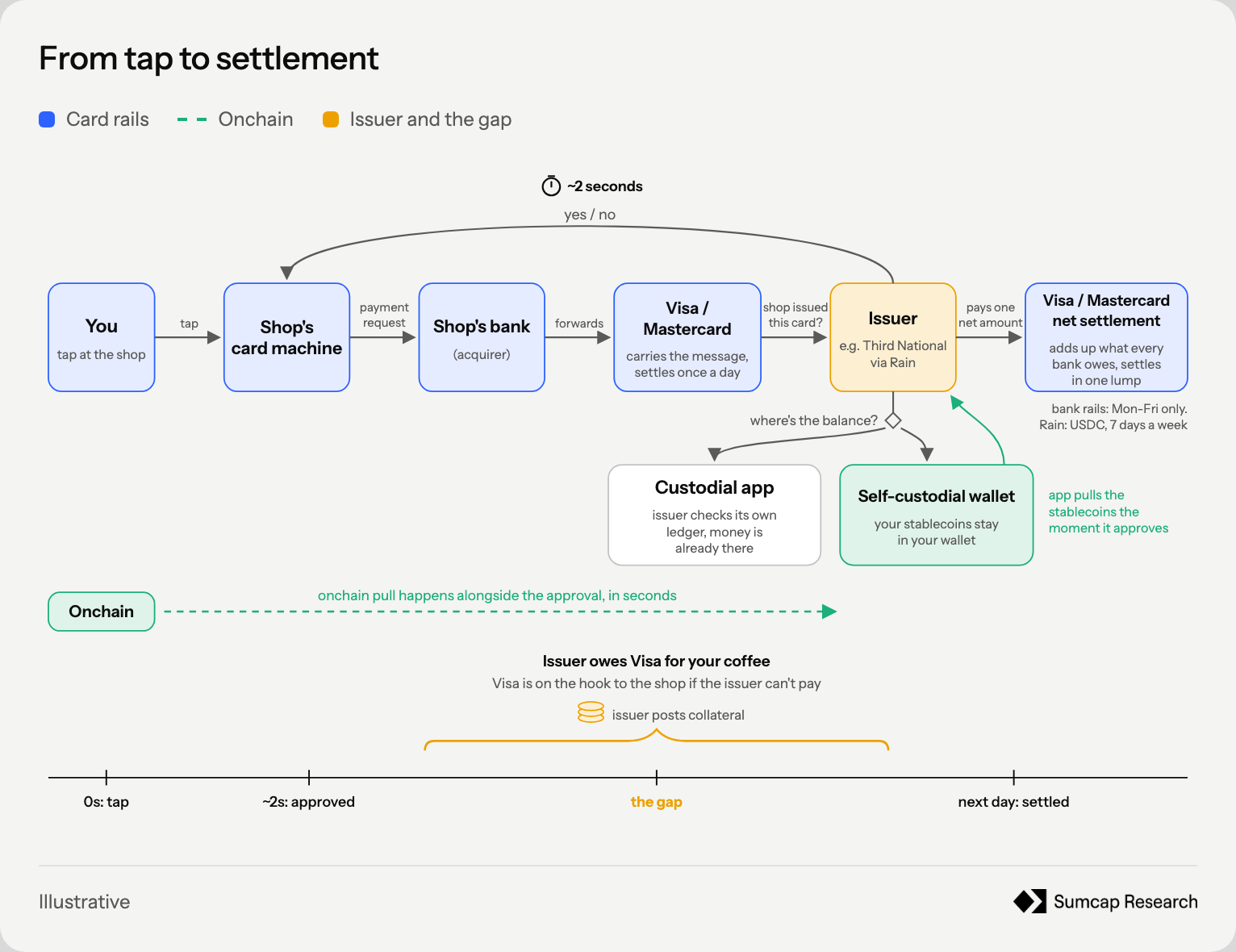
Every layer in that gap gets paid, and it starts with the one everything runs on.
2.1 Networks
At the bottom sit Visa and Mastercard. For Visa, crypto is a small payout, but it’s growing 25x faster than the rest (+8% vs +200% YTD).
About 96% of crypto card spend runs on Visa. At the roughly 0.28% Visa keeps across its network, that is about $35M a year on $13.1B of annualised spend.
These networks don’t issue cards or hold your money. Instead, they run private networks that carry every authorisation in a standard format called ISO 8583, and settle the money between banks once a day.
Visa and Mastercard own the pipeline and charge a toll on everything in it, about 0.13% to 0.15% plus fixed fees.
2.2 Issuers
The issuer is the company that actually gives you the card, and in normal banking it’s always your bank, but crypto cards are almost never issued by the programme itself.
That’s because becoming an issuer is expensive:
- You need a licence to hold and move other people’s money, which is a deciding factor in where you can sell. In the US that means a separate licence in 49 states at $1M to $3M each, while an offshore licence costs less and earns more per swipe, hence all the “everywhere except the US”.
- You need a membership with Visa or Mastercard. The top-tier principal membership means settling with the network directly, taking responsibility for every card programme under you, and posting collateral in case you can’t pay.
So there are really only 2 ways a card programme can run: (a) get the membership and licence yourself, or (b) rent someone else’s. And in crypto, there are currently only a handful of companies renting to everyone else:
- Rain has been a Visa principal member since 2024 and a Mastercard one since May 2026, and runs the programmes for Ether.fi, KAST, Karta, Plasma One and Tria. Its money transmitter licence sits with Third National, its own subsidiary founded in 2023.
- Reap holds a Visa membership in Hong Kong and Mexico, has its own money transmitter registration in Mexico, and runs the programme for the biggest card in the sector, RedotPay.
- Wirex (the first-gen survivor) holds both networks and its own UK e-money licence, and rents them to Coca and Kolo. In the EU, though, its cards are issued by a Maltese e-money firm, since the UK licence doesn’t cover the EU after Brexit.
In this layer the issuer keeps a cut of the interchange before passing the rest to the app. None of the crypto issuers publish theirs, but in US card programmes the bank or platform usually keeps 20-30%.
2.3 Processors
Between the issuer and the network sits the processor, the software that approves or declines your card, runs the fraud rules, keeps the ledger and handles Apple Pay and disputes. For crypto cards it matters especially since your balance doesn’t sit with a bank.
They run on just-in-time (JIT) funding: the processor asks the app whether your stablecoins cover the payment, the app says yes, and the actual money follows later.
But self-custodial apps have a weak spot: since you hold your own funds, the app needs to move them to its book, and if you were to spend your funds in the time between the approval and your stablecoins leaving your wallet, the issuer would still owe Visa for a payment nothing covers. So the fix is a cooldown: Gnosis Pay makes every non-card transfer wait 3 minutes and pauses the card while one is pending.
Because of this hassle, neither Rain nor Reap processes in-house. Instead, they sell the licences, programme management, compliance and settlement as one contract and plug a processor in underneath.
In crypto, the main processors are:
Which processor runs which app is rarely public, so outside Coinbase most of these links are inferred from the issuer.
In this layer, the processor takes a small cut of every swipe plus fixed fees per card and per dispute.
For reference, Marqeta (which publishes its figures) earned $625M last year on $382.5B of spend, about 16bps. Stripe, by comparison, charges $0.10 per virtual card, $3.50 per physical card and $15 per dispute.
If Marqeta’s 16bps held across crypto processors, the layer would earn about $21M a year on $13.1B of annualised spend.
2.4 Settlement
Once a day, the issuer pays Visa one net amount for all its cards. Until it does, Visa is on the hook to the shops, so it makes every issuer post collateral against whatever is still unsettled.
On bank rails, though, the pile builds up to 3 days of spend because nothing settles from Friday to Monday, forcing classic issuers to put up a lot of collateral.
Rain, however, avoids this by settling with Visa in $USDC, 7 days a week, meaning its pile never gets deeper than a day. This cuts its collateral by up to 60%, freeing up capital to take on more programmes, and since users already pay in stablecoins, Rain never has to convert them into bank dollars first.
In this layer there’s no separate fee: the economics come down to where and how much user capital is stored, and whatever’s left after all 4 layers take their cut.
3. The app: sector overview
In the end, after 4-5 companies have been paid, what the app gets is a split of the interchange, the small cut of every purchase that the shop’s bank pays the card issuer.
How big that fee is depends on where the card and the shop are:
- US card: about 1.2-1.6%. US Regulation II caps debit fees for big banks, but prepaid cards, which most crypto cards are, are exempt. Those averaged 1.21%, and consumer programmes blend 1.2-1.6%.
- EU card at an EU shop: 0.2% on debit, 0.3% on credit.
- Non-EU card at an EU shop: 1.15% on debit and 1.5% on credit online. That’s because the EU cap doesn’t apply, while Visa and Mastercard’s own limits only hold in-person payments down at 0.2-0.3%.
On interchange alone, the same online purchase earns an offshore card ~6x what it earns a European one ($1.15 against $0.20 per $100), though the network’s cross-border fee takes most of that back.
But on top of interchange there’s the FX spread, and for a stablecoin card spending local currency it’s often the bigger number, anywhere from 0% at Wirex One to 1.2% at RedotPay, while Coinbase charges 2.5% on assets other than $USDC and nothing on $USDC.
Put together, the app keeps $0.70 to $0.97 per $100 of spend:
Scheme fees, processor costs and FX spreads are our estimates.
It’s clear interchange alone is not much of a business (in Europe it nets to nothing, so FX is all there is), but it isn’t treated as one either: the real business is in the custody model.
Custodial apps hold your balance and earn interest on it: a $500 balance at 4-5% makes $20 to $25 a year, about what interchange earns on $2,000 to $2,500 of spend.
Non-custodial apps let your money stay in your wallet, but route the balance into their own products instead:
- Plasma One puts balances into Aave at up to 6%.
- Ether.fi sends them into its Liquid vaults and lends against them.
- Ethena Pay makes it mandatory to hold balances in $USDe, so it earns on the backing.
But past custody, apps differ on rewards, fees and where they work:
Big rewards are what gets users in the door, and a card with good UX (plus low cost and wide range) keeps them. Once a user puts their card in their Apple Wallet, the subscriptions run through it and the KYC is done. An extra $50 a year in credits or cashback elsewhere isn’t worth the switch.
Ether.fi Cash’s April to August 2025 cohorts came in while it paid extra $ETHFI on card spend. The chart marks the end of those rewards in October 2025. Pooled across the five cohorts (7,336 wallets), 67% were still spending in November, 63% in December and 60% in January. Later cohorts (October 2025 to February 2026) held less: about 40% after six months.
And the users who do leave are the ones a promo alone brought in. In September 2025, 21,490 wallets signed up. After a month, 76% had stopped spending, and 11% were still active a year later (September 2026 is a partial month).
Rewards bring in users, but only the ones who arrive without a promo stay. Apps still chase the biggest incentives available, wherever a chain or treasury will pay for them.
Ether.fi, for example, launched on Scroll in September 2024, and a year later Scroll had little left to offer: $SCR was down 75% from its peak and its DAO had paused governance after its lead resigned. In February 2026, with about 70k active cards, 300k accounts and $160M+ in the app, Ether.fi announced a move to OP Mainnet. The stated reasons were liquidity, more assets and covered gas, and Optimism said users would get access to $OP rewards.
In essence, every app makes a similar bet: develop a good UX and “pay” a lot for users who stay long enough to pay it back. The entire bet comes down to customer acquisition cost (CAC) and their lifetime value (LTV).
On mid-point estimates, 8 of the 11 programmes we track spend more to win a user than that user has earned them. Only Karta clears the line across its full range. RedotPay’s range straddles it, and Plasma One has four months of data. Karta and RedotPay pay little to win users, an estimated $5 and $10 each, and charge users 1.5% and 2.2% on spend, while Plasma One earns $97 on a user it pays $47 for. The biggest spenders sit furthest below: Tria pays $300 for a user worth $52, and Ether.fi $212 for $121.
Red on the chart does not mean the app is losing that money: every incentive counts as acquisition cost, whoever pays for it. Ethena Pay is the clearest case: a user costs $77 and earns $5.91. But Ethena hasn’t said who funds the $AVAX cashback, and on Avalanche it may well be Avalanche.
4. Where the space is headed
In large part, the trajectory of the space depends on regulation. Crypto cards grew in the gaps between rules written for banks, exchanges and card networks, and most of what happens next comes down to which of those gaps close.
4.1 Who owns the crypto-to-fiat conversion
Every crypto card has one step nobody wants to own: the moment crypto becomes fiat. In Europe that’s normally where tax happens: selling crypto for euros realises the gain, and since January 2026, DAC8 has crypto service providers reporting those sales to tax authorities.
On a card, that moment is split across the stack:
- The app doesn’t hold the funds, so it’s software.
- Rain is the infrastructure provider.
- Visa settles and handles the FX.
Each layer can explain why the conversion, and the reporting that comes with it, belongs to someone else.
And the issue is that MiCA leaves room for it. A firm outside the EU that doesn’t hold users’ assets (non-custodial) and doesn’t market to EU users can argue it isn’t a crypto-asset service provider (CASP). That keeps it outside MiCA and outside DAC8 reporting. The line is thin: ESMA counts almost any promotion aimed at the EU as solicitation, influencers included. So a card can be available to Europeans as long as it never asks them to sign up.
But none of this is new. Between 2016 and 2019, people bought Amazon and Uber gift cards with $BTC so they could spend it without cashing out through an exchange. The cards provide a similar benefit but at a much bigger scale.
For stablecoins there’s little gain to tax, so it’s mostly a reporting question. It matters more for cards that spend volatile assets. That’s why Ether.fi lets users borrow against their $ETH to spend: a loan is not a sale, so in most jurisdictions there’s nothing to tax.
But the rules are starting to decide who holds the potato:
- US: The GENIUS Act takes effect by 18 January 2027 and bans stablecoin issuers from paying yield. The OCC wants to treat an issuer funding someone else’s yield as a breach, which lands on any card whose rewards trace back to the issuer. A Senate bill to limit rewards paid by apps failed on 15 September, so those survive for now.
- EU: Since March, a custodial stablecoin card needs a MiCA licence and a payment licence. MiCA also caps $USDC at 1M transactions and €200M a day in the euro area. The sector spends ~$36M a day worldwide, so that’s far off, but it’s still a ceiling.
- UK: The PSR wants to cut interchange on European cards used online at UK shops from 1.15%/1.5% to 0.2%/0.3%.
Two of the three rules, the EU licences and the US yield limits, fall mainly on cards that hold customer money, which is why new cards are choosing not to hold it.
4.2 How new entrants compete
A custodial card earns the float, which is where the big money is. But in Europe it now needs 2 licences, and in the US any yield it passes on is under watch. A self-custodial card gives up the float. In exchange, it holds no customer money and has the strongest case that it isn’t a CASP at all. When the issuer Kulipa wound down in July, its self-custodial programmes (Ready, Solflare) stopped but lost nothing, while the custodial app nSave gave its users 5 days to move their balances.
So the new cards lean self-custodial, and they make up for the missing float with loops. The balance goes into the app’s own products, and those pay for the card:
- Plasma One puts balances into Aave.
- Ether.fi sends them into its Liquid vaults and lends against them.
- Ethena Pay keeps them in $USDe.
The more loops, the less the card has to earn on its own.
But self-custody moves the risk into the contracts. On 28 August, an outdated Rain card contract on Solana let an attacker drain ~$500.8K from Avici users and ~$430K from Tria users. Everyone was repaid in full, plus 10% from the two apps, and nobody said whose money it was.
That said, the rest of the stack is ready to rent. Ethena Pay went live on 3 September in 48 countries with no licence, BIN or processor of its own, and two weeks later it had done $716K in volume.
The companies renting out that stack are being bought up: Exodus is buying Baanx and Monavate for $175M, Kraken is buying Reap, and Mastercard closed its BVNK deal in August.
That leaves new apps competing on rewards, and since settled users rarely switch, a new card has to heavily outbid the one already in someone’s Apple Wallet. The ones that manage it either charge for the card (Karta, RedotPay) or get someone else to pay, since interchange alone isn’t enough.
And Gnosis Pay is the perfect example: it built the first self-custodial card in 2023 and paid $GNO rewards out of Gnosis’s own funds. As a European card it earned 0.2% in interchange, charged no FX, and reported revenue of 0.40% of spend. It paid back about 1% in $GNO cashback, a net loss of about $1.2M on $200M of spend. It planned for 103k cards by the end of 2025 and got to about 10k active users, spending ~$8.8M a month against the $27M it needed to break even. In June, co-founder Friederike Ernst called the unit economics of acquiring individual consumers in payments “brutal”. Cashback stopped on 30 September and the consumer card shuts on 20 December.
So the positive-sum picture from the start falls apart when you take into account that someone has to cover user rewards: either the app pays until it can’t, like Gnosis Pay, or a token or chain takes the loss, like $ETHFI for Ether.fi.
At $0.70 to $0.97 kept per $100 of spend, and with 8 of the 11 programmes we track spending more to win a user than the user earns back, the open question is who keeps paying for the rewards.


The State of Crypto Cards
Monthly crypto card spend passed $1B in August. Four layers share every swipe and the app keeps less than $1 of each $100, so who pays for the rewards?
TL;DR
Monthly crypto card spend rose to ~$1.1B in a year, across 287,640 active addresses. RedotPay’s share fell from 69% to 37% as the rest of the sector grew 5.4x. Four layers (Visa, issuer, processor, app) share each swipe, and the app keeps $0.70 to $0.97 per $100 of spend. That is less than most programmes pay out, so rewards are funded by tokens, chains or treasuries. We estimate that 8 of the 11 programmes we track spend more to win a user than that user earns back.
1. Crypto cards: why, history, and the revival
The first generation of crypto cards came out more than 12 years ago, when ANX released a prepaid $BTC card in July 2014, followed by Xapo’s $BTC debit card in August.
By 2017, at least six bitcoin cards were live across the US and Europe:
But none of these cards caught on.
Back then, people held $BTC as an investment, not as a medium of exchange. So when the cards launched, nobody was keen on paying for lunch or coffee with something they thought was going up.
Worse still, timing wasn’t the only problem. Most of these cards were issued by the same Gibraltar e-money firm, WaveCrest, and when Visa cut it off for breaking its rules on 5 January 2018, the whole first generation was basically killed in a day. Only Wirex survived, because it was already an app with close to a million customers that kept running without the card.
1.1 Exchange cards
The next generation of cards was led by exchanges: Crypto.com shipped its card in 2018, followed by Coinbase in 2019 and Binance in 2020. From the get-go these cards had what the first generation was missing: millions of users and a whole business around the card.
And that is what allowed them to pay for rewards: Crypto.com paid cashback in its own token and saved the best rates for users who staked it, which is still the model most programmes run on today. It also meant the card could take a hit without total ruin: when Crypto.com’s European card issuer (Wirecard) collapsed in June 2020, the exchange was fine for the 3.5 days without the card.
However, what these exchanges missed was the whole reason people held crypto in the first place: to own their money. They weren’t crypto cards but exchange-linked debit cards, meaning your money sat with the exchange, and every tap sold some of your crypto.
The conditions weren’t there yet either, since in late 2018 there was under $3B of stablecoins in total, almost entirely for trading, not transacting.
Most of these cards are still around today, but the growth transferred to newer competition.
1.2 The 2023 revival: true crypto cards
Stablecoin supply reached $187.1B in March 2022, fell to $123.5B by September 2023, then rose to $307.3B by August 2026.
A big part of the space was now getting paid in stables, paying with them and earning yield on them. And if your money is already sitting in stablecoins you’re transacting with, going through an exchange to cash out every time you want to buy something gets old fast.
So for the first time ever there was a real market for these cards (people who held stables for payments), and projects were determined to get it right: self-custody, a business around the card, and incentives.
Gnosis Pay built the first one in 2023: a Visa debit card that spends stablecoins straight from your own Safe wallet, with Monavate as the licensed issuer behind it, and it didn’t take long for others to follow:
By renting out their Visa and Mastercard memberships, Rain and Reap let new apps launch without a licence, and spend rose to ~$1.1B a month in a year. Most listed programmes exclude the US or EU, so MiCA and GENIUS mainly shaped who could sell where, not demand.
Most of that growth sits with a few names: RedotPay, KAST and Ether.fi made up 55% of the ~$1.1B in August, and RedotPay alone barely moved from September to February ($280M to $270M), while the rest of the sector nearly tripled. Another 27% ($297M) runs on Rain and Wirex cards with no app attached.
Active addresses grew 4.2x over the year to 287,640 in August. They ran 11.1M transactions, about 38 each, down from 83 a year earlier as new addresses diluted the base.
It’s clear that people are actually carrying these cards around and using them, and a big part of that adoption comes from the incentives. Users get up to 8% cashback at Wirex One and up to 6% on savings at Plasma One. On top of skipping the exchange, there’s a real reason to reach for the crypto card over the bank one every time.
From the outside in, neobanking seems like the only positive-sum game in crypto:
- Users are getting paid to spend their own money.
- Apps are growing fast: RedotPay said in December 2025 it had passed 6M users and was growing profitably on $150M+ of annual revenue.
- Issuers are getting valued at billions: Rain raised $250M at a $1.95B valuation in January, and Kraken agreed to buy Reap for up to $600M in May.
- Networks are all in: Visa’s crypto card spend is up nearly 200% on the year, and it now counts 160+ stablecoin card programmes, up from about 40 in 2024.
But if everyone is getting paid, where does the money actually come from?
2. Infrastructure economics: how modern crypto cards work
In the second between the tap and the beep, the card machine sends a short message to the shop’s bank, which passes it to Visa or Mastercard, which then forwards it to whoever actually issued your card. The issuer checks your balance on its own books and answers yes or no (Stripe gives its programmes 2 seconds to answer).
On a crypto card, your stablecoins come in during the balance check. If the app is custodial, the issuer just checks its own ledger, but if you hold your own assets, the app pulls the stablecoins from your wallet to the issuer the moment it approves.
Whatever the case is, the shop doesn’t get paid until the next day, when the network adds up what every bank owes and settles it in one lump. Until then the issuer owes Visa for your coffee, and Visa is on the hook to the shop if the issuer can’t pay.
Every layer in that gap gets paid, and it starts with the one everything runs on.
2.1 Networks
At the bottom sit Visa and Mastercard. For Visa, crypto is a small payout, but it’s growing 25x faster than the rest (+8% vs +200% YTD).
About 96% of crypto card spend runs on Visa. At the roughly 0.28% Visa keeps across its network, that is about $35M a year on $13.1B of annualised spend.
These networks don’t issue cards or hold your money. Instead, they run private networks that carry every authorisation in a standard format called ISO 8583, and settle the money between banks once a day.
Visa and Mastercard own the pipeline and charge a toll on everything in it, about 0.13% to 0.15% plus fixed fees.
2.2 Issuers
The issuer is the company that actually gives you the card, and in normal banking it’s always your bank, but crypto cards are almost never issued by the programme itself.
That’s because becoming an issuer is expensive:
- You need a licence to hold and move other people’s money, which is a deciding factor in where you can sell. In the US that means a separate licence in 49 states at $1M to $3M each, while an offshore licence costs less and earns more per swipe, hence all the “everywhere except the US”.
- You need a membership with Visa or Mastercard. The top-tier principal membership means settling with the network directly, taking responsibility for every card programme under you, and posting collateral in case you can’t pay.
So there are really only 2 ways a card programme can run: (a) get the membership and licence yourself, or (b) rent someone else’s. And in crypto, there are currently only a handful of companies renting to everyone else:
- Rain has been a Visa principal member since 2024 and a Mastercard one since May 2026, and runs the programmes for Ether.fi, KAST, Karta, Plasma One and Tria. Its money transmitter licence sits with Third National, its own subsidiary founded in 2023.
- Reap holds a Visa membership in Hong Kong and Mexico, has its own money transmitter registration in Mexico, and runs the programme for the biggest card in the sector, RedotPay.
- Wirex (the first-gen survivor) holds both networks and its own UK e-money licence, and rents them to Coca and Kolo. In the EU, though, its cards are issued by a Maltese e-money firm, since the UK licence doesn’t cover the EU after Brexit.
In this layer the issuer keeps a cut of the interchange before passing the rest to the app. None of the crypto issuers publish theirs, but in US card programmes the bank or platform usually keeps 20-30%.
2.3 Processors
Between the issuer and the network sits the processor, the software that approves or declines your card, runs the fraud rules, keeps the ledger and handles Apple Pay and disputes. For crypto cards it matters especially since your balance doesn’t sit with a bank.
They run on just-in-time (JIT) funding: the processor asks the app whether your stablecoins cover the payment, the app says yes, and the actual money follows later.
But self-custodial apps have a weak spot: since you hold your own funds, the app needs to move them to its book, and if you were to spend your funds in the time between the approval and your stablecoins leaving your wallet, the issuer would still owe Visa for a payment nothing covers. So the fix is a cooldown: Gnosis Pay makes every non-card transfer wait 3 minutes and pauses the card while one is pending.
Because of this hassle, neither Rain nor Reap processes in-house. Instead, they sell the licences, programme management, compliance and settlement as one contract and plug a processor in underneath.
In crypto, the main processors are:
Which processor runs which app is rarely public, so outside Coinbase most of these links are inferred from the issuer.
In this layer, the processor takes a small cut of every swipe plus fixed fees per card and per dispute.
For reference, Marqeta (which publishes its figures) earned $625M last year on $382.5B of spend, about 16bps. Stripe, by comparison, charges $0.10 per virtual card, $3.50 per physical card and $15 per dispute.
If Marqeta’s 16bps held across crypto processors, the layer would earn about $21M a year on $13.1B of annualised spend.
2.4 Settlement
Once a day, the issuer pays Visa one net amount for all its cards. Until it does, Visa is on the hook to the shops, so it makes every issuer post collateral against whatever is still unsettled.
On bank rails, though, the pile builds up to 3 days of spend because nothing settles from Friday to Monday, forcing classic issuers to put up a lot of collateral.
Rain, however, avoids this by settling with Visa in $USDC, 7 days a week, meaning its pile never gets deeper than a day. This cuts its collateral by up to 60%, freeing up capital to take on more programmes, and since users already pay in stablecoins, Rain never has to convert them into bank dollars first.
In this layer there’s no separate fee: the economics come down to where and how much user capital is stored, and whatever’s left after all 4 layers take their cut.
3. The app: sector overview
In the end, after 4-5 companies have been paid, what the app gets is a split of the interchange, the small cut of every purchase that the shop’s bank pays the card issuer.
How big that fee is depends on where the card and the shop are:
- US card: about 1.2-1.6%. US Regulation II caps debit fees for big banks, but prepaid cards, which most crypto cards are, are exempt. Those averaged 1.21%, and consumer programmes blend 1.2-1.6%.
- EU card at an EU shop: 0.2% on debit, 0.3% on credit.
- Non-EU card at an EU shop: 1.15% on debit and 1.5% on credit online. That’s because the EU cap doesn’t apply, while Visa and Mastercard’s own limits only hold in-person payments down at 0.2-0.3%.
On interchange alone, the same online purchase earns an offshore card ~6x what it earns a European one ($1.15 against $0.20 per $100), though the network’s cross-border fee takes most of that back.
But on top of interchange there’s the FX spread, and for a stablecoin card spending local currency it’s often the bigger number, anywhere from 0% at Wirex One to 1.2% at RedotPay, while Coinbase charges 2.5% on assets other than $USDC and nothing on $USDC.
Put together, the app keeps $0.70 to $0.97 per $100 of spend:
Scheme fees, processor costs and FX spreads are our estimates.
It’s clear interchange alone is not much of a business (in Europe it nets to nothing, so FX is all there is), but it isn’t treated as one either: the real business is in the custody model.
Custodial apps hold your balance and earn interest on it: a $500 balance at 4-5% makes $20 to $25 a year, about what interchange earns on $2,000 to $2,500 of spend.
Non-custodial apps let your money stay in your wallet, but route the balance into their own products instead:
- Plasma One puts balances into Aave at up to 6%.
- Ether.fi sends them into its Liquid vaults and lends against them.
- Ethena Pay makes it mandatory to hold balances in $USDe, so it earns on the backing.
But past custody, apps differ on rewards, fees and where they work:
Big rewards are what gets users in the door, and a card with good UX (plus low cost and wide range) keeps them. Once a user puts their card in their Apple Wallet, the subscriptions run through it and the KYC is done. An extra $50 a year in credits or cashback elsewhere isn’t worth the switch.
Ether.fi Cash’s April to August 2025 cohorts came in while it paid extra $ETHFI on card spend. The chart marks the end of those rewards in October 2025. Pooled across the five cohorts (7,336 wallets), 67% were still spending in November, 63% in December and 60% in January. Later cohorts (October 2025 to February 2026) held less: about 40% after six months.
And the users who do leave are the ones a promo alone brought in. In September 2025, 21,490 wallets signed up. After a month, 76% had stopped spending, and 11% were still active a year later (September 2026 is a partial month).
Rewards bring in users, but only the ones who arrive without a promo stay. Apps still chase the biggest incentives available, wherever a chain or treasury will pay for them.
Ether.fi, for example, launched on Scroll in September 2024, and a year later Scroll had little left to offer: $SCR was down 75% from its peak and its DAO had paused governance after its lead resigned. In February 2026, with about 70k active cards, 300k accounts and $160M+ in the app, Ether.fi announced a move to OP Mainnet. The stated reasons were liquidity, more assets and covered gas, and Optimism said users would get access to $OP rewards.
In essence, every app makes a similar bet: develop a good UX and “pay” a lot for users who stay long enough to pay it back. The entire bet comes down to customer acquisition cost (CAC) and their lifetime value (LTV).
On mid-point estimates, 8 of the 11 programmes we track spend more to win a user than that user has earned them. Only Karta clears the line across its full range. RedotPay’s range straddles it, and Plasma One has four months of data. Karta and RedotPay pay little to win users, an estimated $5 and $10 each, and charge users 1.5% and 2.2% on spend, while Plasma One earns $97 on a user it pays $47 for. The biggest spenders sit furthest below: Tria pays $300 for a user worth $52, and Ether.fi $212 for $121.
Red on the chart does not mean the app is losing that money: every incentive counts as acquisition cost, whoever pays for it. Ethena Pay is the clearest case: a user costs $77 and earns $5.91. But Ethena hasn’t said who funds the $AVAX cashback, and on Avalanche it may well be Avalanche.
4. Where the space is headed
In large part, the trajectory of the space depends on regulation. Crypto cards grew in the gaps between rules written for banks, exchanges and card networks, and most of what happens next comes down to which of those gaps close.
4.1 Who owns the crypto-to-fiat conversion
Every crypto card has one step nobody wants to own: the moment crypto becomes fiat. In Europe that’s normally where tax happens: selling crypto for euros realises the gain, and since January 2026, DAC8 has crypto service providers reporting those sales to tax authorities.
On a card, that moment is split across the stack:
- The app doesn’t hold the funds, so it’s software.
- Rain is the infrastructure provider.
- Visa settles and handles the FX.
Each layer can explain why the conversion, and the reporting that comes with it, belongs to someone else.
And the issue is that MiCA leaves room for it. A firm outside the EU that doesn’t hold users’ assets (non-custodial) and doesn’t market to EU users can argue it isn’t a crypto-asset service provider (CASP). That keeps it outside MiCA and outside DAC8 reporting. The line is thin: ESMA counts almost any promotion aimed at the EU as solicitation, influencers included. So a card can be available to Europeans as long as it never asks them to sign up.
But none of this is new. Between 2016 and 2019, people bought Amazon and Uber gift cards with $BTC so they could spend it without cashing out through an exchange. The cards provide a similar benefit but at a much bigger scale.
For stablecoins there’s little gain to tax, so it’s mostly a reporting question. It matters more for cards that spend volatile assets. That’s why Ether.fi lets users borrow against their $ETH to spend: a loan is not a sale, so in most jurisdictions there’s nothing to tax.
But the rules are starting to decide who holds the potato:
- US: The GENIUS Act takes effect by 18 January 2027 and bans stablecoin issuers from paying yield. The OCC wants to treat an issuer funding someone else’s yield as a breach, which lands on any card whose rewards trace back to the issuer. A Senate bill to limit rewards paid by apps failed on 15 September, so those survive for now.
- EU: Since March, a custodial stablecoin card needs a MiCA licence and a payment licence. MiCA also caps $USDC at 1M transactions and €200M a day in the euro area. The sector spends ~$36M a day worldwide, so that’s far off, but it’s still a ceiling.
- UK: The PSR wants to cut interchange on European cards used online at UK shops from 1.15%/1.5% to 0.2%/0.3%.
Two of the three rules, the EU licences and the US yield limits, fall mainly on cards that hold customer money, which is why new cards are choosing not to hold it.
4.2 How new entrants compete
A custodial card earns the float, which is where the big money is. But in Europe it now needs 2 licences, and in the US any yield it passes on is under watch. A self-custodial card gives up the float. In exchange, it holds no customer money and has the strongest case that it isn’t a CASP at all. When the issuer Kulipa wound down in July, its self-custodial programmes (Ready, Solflare) stopped but lost nothing, while the custodial app nSave gave its users 5 days to move their balances.
So the new cards lean self-custodial, and they make up for the missing float with loops. The balance goes into the app’s own products, and those pay for the card:
- Plasma One puts balances into Aave.
- Ether.fi sends them into its Liquid vaults and lends against them.
- Ethena Pay keeps them in $USDe.
The more loops, the less the card has to earn on its own.
But self-custody moves the risk into the contracts. On 28 August, an outdated Rain card contract on Solana let an attacker drain ~$500.8K from Avici users and ~$430K from Tria users. Everyone was repaid in full, plus 10% from the two apps, and nobody said whose money it was.
That said, the rest of the stack is ready to rent. Ethena Pay went live on 3 September in 48 countries with no licence, BIN or processor of its own, and two weeks later it had done $716K in volume.
The companies renting out that stack are being bought up: Exodus is buying Baanx and Monavate for $175M, Kraken is buying Reap, and Mastercard closed its BVNK deal in August.
That leaves new apps competing on rewards, and since settled users rarely switch, a new card has to heavily outbid the one already in someone’s Apple Wallet. The ones that manage it either charge for the card (Karta, RedotPay) or get someone else to pay, since interchange alone isn’t enough.
And Gnosis Pay is the perfect example: it built the first self-custodial card in 2023 and paid $GNO rewards out of Gnosis’s own funds. As a European card it earned 0.2% in interchange, charged no FX, and reported revenue of 0.40% of spend. It paid back about 1% in $GNO cashback, a net loss of about $1.2M on $200M of spend. It planned for 103k cards by the end of 2025 and got to about 10k active users, spending ~$8.8M a month against the $27M it needed to break even. In June, co-founder Friederike Ernst called the unit economics of acquiring individual consumers in payments “brutal”. Cashback stopped on 30 September and the consumer card shuts on 20 December.
So the positive-sum picture from the start falls apart when you take into account that someone has to cover user rewards: either the app pays until it can’t, like Gnosis Pay, or a token or chain takes the loss, like $ETHFI for Ether.fi.
At $0.70 to $0.97 kept per $100 of spend, and with 8 of the 11 programmes we track spending more to win a user than the user earns back, the open question is who keeps paying for the rewards.
.svg)