
Tokenized Stocks: What You Actually Own
In a little over a year, tokenized stocks went from $34M to >$3B, and most of them live as a claim on an offshore SPV holding the shares. That setup is what lets the tokens trade around the clock and plug into DeFi, but it also means the vote stays with the issuer. So what do you actually own?

Key takeaways
tbc
Tokenisation
Back in 2014, Tether was the first to introduce tokenization through USDT. Since then, the idea of having a token redeemable for something held off-chain has been applied to almost every asset class: gold in 2019, funds in ‘21, ETFs in ‘23, and loans in ‘25.
But recently, one asset class in particular has become the center of attention for tokenization: stocks.
The history of tokenised stocks
In January 2019, DX.Exchange launched 10 Nasdaq-stock backed tokens, with shares held by a Cypriot broker (MarketPlace Securities). The pitch was 24/7 US stock availability for anyone outside the US. But, their success was short lived because the broker lost its license less than a year in.
A few months later, FTX tried again and went much further with stocks and ETFs, including Tesla, Apple, Amazon and SPY. The shares were held by CM-equity (a licensed German broker) while the tokens were built by Digital Assets AG (DAAG), a Swiss firm that also ran stock tokens for Binance and Bittrex.
By June 2021: FTX had listed around 60 stocks, and DAAG had moved them from a private chain onto Solana and gotten a Liechtenstein regulator to approve the tokens (prospectus) in the European Economic Area.
This was the first project with a public chain and regulatory approval - however, the tokens still only traded on FTX with withdrawals to outside wallets promised for later.
In late 2021 FTX ended up buying DAAG for $323M, and after filing for bankruptcy on November 11th 2022, its stock tokens went down with it.
Meanwhile Binance, who launched the same kind of tokens with CM-Equity in April 2021, stopped selling them that July after German regulators pointed out no prospectus had been published.
But 2 startups founded in 2021 finally revived the space 2 years later.
In Zug, Switzerland, Backed Finance AG raised a seed round from Gnosis and others in May 2021, and by February 2023 it had its first token on Ethereum: bCSPX, which tracked BlackRock’s S&P 500 ETF. Unlike FTX’s tokens, it didn’t need an exchange - anyone could trade it on Uniswap, and KYC only came in when you wanted to redeem it. Legally it was a certificate under Switzerland’s DLT law, sold in Europe under a prospectus, with the ETF held 1:1 by a licensed custodian and US buyers kept out.
While in the US, Dinari launched dShares on Arbitrum around December 2023, backed 1:1 by shares held at Alpaca, the broker that now sits under most of this market. They were sold only to buyers outside the US until June 2025, when Dinari became the first company with a US broker-dealer registration for tokenized stocks.
That same month, Backed and Kraken partnered to launch xStocks: 60 stocks and ETFs on Solana, built the same way as bCSPX. At the end of June 2025 there was about $34M of tokenized stock on-chain, and over the next year, everyone else followed:
- Ondo launched in September 2025,
- Bitget launched Reality tokens in May 2026
- Binance came back in June with bStocks, five years after pulling its first attempt
- Robinhood launched its own chain and new tokens in July
- Securitize put its own stock on-chain in July as well
- and Coinbase followed on Base in August.
Each launch pushed the total up: $579M at the end of 2025, $1.68B by the end of May 2026, and $2.94B by September 11th.
Almost all of that growth happened outside the US. The wrappers were sold only to non-US buyers, and the only tokens Americans could legally hold were the few that are the share itself, only $514M of the total. Which is funny because the country whose stocks these were, and the world’s largest stock market, was mostly locked out in the regulated way.
Then, finally on September 17th, the SEC caught up, issuing its Innovation Exemption.
The exemption lets firms in the US run AMMs on public chains for tokenized US stocks for the next five years, without registering as a full stock exchange, and lets the liquidity providers in those pools skip registering as dealers. The catch is a list of conditions: every trader has to be screened, there’s no margin, trading halts whenever the real stock halts, volume is capped at a small share of the stock’s normal trading, and a company gets 30 days to block third-party tokens of its own stock.
Putting that against what the offshore versions were doing, all of these conditions are really quite debilitating and don’t leave much room for experimentation: no margin rules out leverage and the volume cap keeps it to a fraction of the real stock’s trading.
But what the US version does offer is the same rights: a venue can only list tokens that give holders the same dividends, vote and claim as the real share.
The exemption pretty much split the market clean in 2: offshore stocks that give you freedom and composability, and onshore stocks that give you rights inside an on-chain fence.
This leaves anyone interested in tokenized stocks questioning what they actually own with an offshore token, and are they even holding the right thing?
What do you actually own?
Take Ondo’s SPY as an example - in its letter to the SEC, Ondo explained the whole structure layer by layer: when a user buys an Ondo stock on Binance, Bitget or Metamask, its broker buys the share on the exchange, and Ondo's token manager contract mints $SPYon into the user's wallet.
The actual share, like in normal stock trading, is registered to Cede & Co, the name the Depository Trust Company (DTC) holds shares under. DTC settles US trades and keeps a record of how many shares each broker owns, while each broker keeps a record of what each customer owns.
This is parallel to the way centralized crypto exchanges work, with DTC comparable to a shared ledger like Ethereum and brokers being something like Coinbase or Binance, who keep their own records.
So if you buy Apple through a normal US broker, you're in that broker's records and that's enough to get your dividends and your vote.
But a tokenized stock adds one more layer: Ondo's broker is Alpaca, and the customer on Alpaca's books isn't you, but Ondo Global Markets (BVI) Ltd - a company Ondo set up in the British Virgin Islands only to hold these shares (a special purpose vehicle, SPV).
The thing you actually own is a debt note issued by that company, for which they owe you whatever the share is worth upon redemption. To make that promise safer, Ondo holds slightly more shares than there are tokens, and an outside firm (Ankura Trust) has a first claim on those shares on the holders’ behalf and attests to them every day. So if Ondo's company went under, Ankura would be there to sell the shares and pay the holders out.

And if you were to swap Ondo for any other offshore issuer, the chain barely changes - 6/7 name Alpaca as a broker or custodian, and at the end of 2025 it held about 94% of US tokenized stock custody. What does change however, is the claim the token gives you:
- A secured note (Ondo) means the user is a creditor of a BVI company, with collateral pledged to a security agent.
- A tracker certificate or tokenised debt security (xStocks, Robinhood) is the same idea in a European wrapper: a debt that tracks the share, issued by a company in Jersey under a prospectus approved in Liechtenstein, so it can be sold across the EU, with the security agent based in Zug.
- A certificate or beneficial claim (bStocks, Coinbase) come from a company in Abu Dhabi’s financial center, but they give you different things. Binance’s bStocks are certificates: a claim on the issuer, backed by shares “or other eligible assets”, and the prospectus says outright that they’re “not stocks or shares”. Coinbase’s token is a beneficial claim on a real share, held in trust for token holders at Alpaca, which puts the holder closer to owning the share itself. But neither name a security agent.
- Economic exposure (Reality, Dinari) tracks the price, but the paperwork doesn’t say what you could claim if something went wrong. Reality names the company behind its tokens only in its website footer (BG El Salvador), and Dinari’s 2024 terms say the tokens carry no rights beyond the platform’s own functions.
Both say the shares are bought 1:1 and held at Alpaca.
But what does all of this mean for dividends and voting?
Dividends and redemption
Dividends travel down the same chain as the shares: the company pays DTC, DTC pays the brokers, and each broker pays whoever owns the account. For a tokenized stock that’s the SPV, so what reaches you depends on what the SPV does with it.
Ondo, xStocks, bStocks, Robinhood and Coinbase work like wstETH - they raise a multiplier on the token so each stands for slightly more than one share after every payout, net of US withholding (30% by default for non-US holders).
While Dinari and Reality pay cash instead.
But the problem is that redeeming means handing the token back to the issuer for the share’s value, instead of selling it to someone else on the market:
- Ondo allows redeems >$1 for verified/eligible users,
- xStocks requires a whitelisted wallet and $5,000,
- On Robinhood only the authorised participant mints and redeems,
- Coinbase redeems only for allowlisted holders,
- while bStocks "redeems" by converting back into a stock position inside a Binance account
Delivery of the actual share exists only at Ondo since 22 Sep, but for approved institutions.
Who holds the vote
For every shareholder meeting, DTC is the one that “actually” holds the voting rights, since the shares are registered in its name. But it passes them down to the brokers, who then send a proxy (a ballot with a unique control number) to whoever owns the account on the meeting’s record date. After the account owners vote on the ballot, an outside firm adds up everyone’s ballots and passes the totals to the company’s executives who actually cast the votes at the meeting.
Since a token holder is only a creditor of the SPV that owns the account, they don’t get sent anything - but Ondo and xStocks have started collecting holder "preferences" through Broadridge, the company that runs most US proxy voting.
Meanwhile Robinhood said on September 14th that "in-kind redemption and voting are coming", after AMC's CEO called its AMC token "vile" and asked it to stop. Coinbase says the same, "coming soon".
But none of the documents we read say what the SPVs do with the votes they hold today.
Where the KYC stops
Very few tokens actually KYC on every transfer, for example: a Securitize token can only move to a registered investor’s wallet, while Figure tokens only move between wallets with Figure’s KYC attribute, and WisdomTree’s only to a wallet holding a non-transferable “KYC token”.
But wrappers like Ondo, xStocks, bStocks, Robinhood, etc. all work like USDC: Circle checks who you are when you mint or redeem with it directly, but once USDC is minted it can move to any wallet that isn’t blacklisted. Tokenized stocks are the same in that regard: ID gets checked at the edges, when a token is created or cashed in, and nowhere in between.
Let’s call that in-between the open middle.
The open middle: stocks across DeFi
The open middle is what makes these tokens actually useful to crypto users, and it’s what differentiates them from their onshore counterparts.
A composable stock token allows non KYCd users to pick up stocks on secondary markets, at any hour, in any size. The IMF found that about 80% of tokenized stock trades are smaller than one share.
And because the pools never close, the trading doesn’t stop when Wall Street does. The NYSE is open 6.5h a day, five days a week, and the IMF found that more than half of tokenized stock trading happens outside those hours. DefiLlama’s numbers on bStocks this summer line up with this: only 46% of volume traded during NYSE hours, 48% traded on weekday nights and about 6% on weekends.
Tokenized stocks allow for after-hours price discovery. And while a normal shareholder waits until Monday’s open to act on Saturday’s information, a token holder can act on Saturday, and the price they trade at carries information: the IMF found that overnight moves in tokenized stocks show up in the real stock’s price shortly after the market opens.
So someone who reads a situation right doesn’t have to sit on their hands and wait.
Binance’s own data shows that over seven weekends, bStocks prices captured a median 92% of the move the real stocks made when they reopened on Monday. On the 41 Mondays where a stock gapped more than 3%, the token had already moved the right way every single time, capturing a median 99.6% of the gap.
And the mechanisms at play here are really quite fruitful for everyone. The few market makers who pass the issuer’s KYC are the only ones who can mint and redeem. When a token trades away from the share’s real value, they step in - maintaining the peg so long as the spread between the pool price and the primary rail is wide enough to cover the issuer fees: if the token trades below, they buy it on the pool and redeem it with the issuer for the full value, and if it trades above, they mint new tokens and sell them into the pool.
And because redeeming stops with the market close, over the weekend, the pool price is set by traders betting on Monday’s open - and when Monday comes, the market makers close whatever gap is left. During the week the peg holds well enough that the deep pools trade within 0.3% of the real share.
So the arbitrage that pays the market makers is also what lets everyone else in. A holder without KYC can buy the stock in any size and still get the full value, dividends included, because the market makers keep the pool tight against the real share.
A trader who’d normally be stuck with their broker’s hours, and at the mercy of Monday’s open, can now act on what they know - and since anybody can trade on a DEX, the only real limit on that size is how much the pools can take.
Over the past 3 months to October 20th, a $1k trade on a DEX cost about 0.7bps, and a $100k one about 8.8bps - it’s only past $100K that the venue starts to matter. In a normal pool a big order drags the price with it, so trades between $100K-$1M cost a median of 14.5bps, and one in ten paid >65bps.
But prop AMMs like Metric quote off the real share’s price instead, so size barely moves them: the same trades there cost a median 3.7bps, and nine in ten stayed <9.3bps. That’s why, on BNB, Metric and Tessera V, another venue like it, filled over half of all bStocks trading on DEXs in October.
But on the other side of the trading spectrum, equity perps on Hyperliquid and Lighter trade around the clock too, and by late September they held $3.3B in open positions, as much as every tokenized stock combined, with SPY, NVDA and TSLA perps trading about 10x the volume of their xStocks counterparts.
However, holding perps isn’t free: longs pay funding to shorts every hour, roughly 6-11% a year on NVDA, and since perps only get you price exposure, you pay doubly as there’s no dividends (or vote). But that cost is someone else’s income - anyone holding the token can short the matching perp and collect the funding + the token’s dividends, while the price moves on the two cancel out.
And with both on-chain, you can now run an equity basis trade without a broker account on either side.
Then there are uses no one could’ve predicted, like StonkFun - a launchpad on Solana where anyone can launch a meme coin priced in a stock token instead of SOL, so a coin quoted in NVDAx moves with both its own hype and Nvidia’s share price. Its own coin, STONK, launched in July paired with SPYx and hit about a $140M market cap in early September, and by mid-September StonkFun said $1.47B had traded on it, around $427M of that in pools quoted in stocks and other real-world assets.
Beyond just trading, tokenized stocks can be put to work elsewhere.
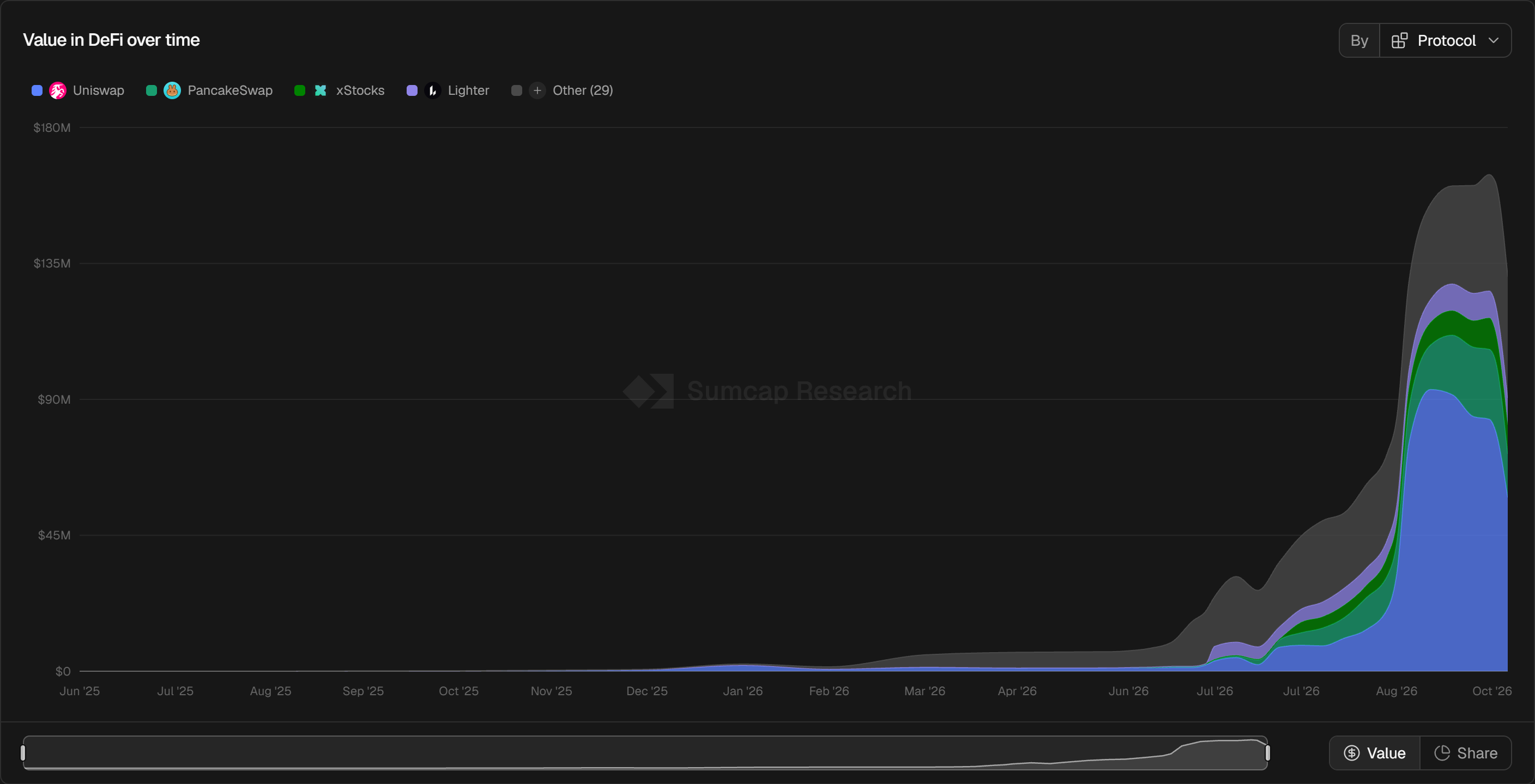
About $61M sits in lending markets like Kamino ($26M), Jupiter Lend ($14M) and Morpho ($3.7M), where holders post them as collateral and borrow stables - allowing them to keep exposure, free up cash, and get liquidated if the price falls far enough, all without a broker’s margin account.
But, a lending market needs to know what the collateral is worth at all times, and since most oracles follow the real stock market, those feeds stop updating over weekends. A token that keeps trading while the lender still sees Friday’s price is a problem each venue handles differently:
- Aave, Morpho and Jupiter Lend hold the closing price and cover the gap in their own ways.LlamaRisk sized Aave’s borrowing limits to survive the longest closure (about 92 hours). Jupiter pauses its vaults at every session change and before corporate actions. Morpho just reads the last price and relies on conservative loan limits (62.5% on most of Coinbase’s tokens). But on all of these, whatever happens over the weekend lands in one jump when the feed restarts on Sunday night.
- Kamino also holds on weekends, but on weeknights it takes Chainlink’s after-hours and overnight prices, only within a band around the last close.
So if you want to trade a stock token cheaply, or borrow against it without a surprise on Sunday night, it all comes back to the question from the start: which one should you actually hold?
Issuers side by side
Depending on your needs, which issuer you choose can make a world of difference.
One thing we haven’t talked about yet is what the business even is for the issuers. Each one gets paid at a different point in a token’s life: minting, redeeming, holding, or the dividends themselves - and depending on which part of that chain they profit from, the choice either doesn’t matter at all or works against you.
A simple example is a user interested in holding a stock long term on-chain for dividends.
You’d think Coinbase would be a fine pick, since it’s the closest a wrapper gets to the real thing (real shares held with Alpaca), it’s a listed US company, and the dividends get reinvested automatically. But the reality is that it’s probably the worst one, since Coinbase keeps 5% of every dividend on top of US withholding, so the longer you hold, the more it takes.
While Ondo is the opposite - it doesn’t charge a fee or take dividends, instead it makes money on the spread: when a user buys a stock from Ondo, the quote they get is different from the price Ondo’s broker bought it at so Ondo keeps the gap (selling back works the same way). So someone who buys once and holds pays that gap once, and every dividend after that goes back into the token in full, minus withholding.
The rest sit somewhere in between:
So the issuers aren’t making much from this - Coinbase and Robinhood are the only ones whose fees show up on-chain, and together they’ve made about $149K since launch from roughly $1.4B of tokens minted and redeemed - around $1.6M a year at current flows. xStocks moved even more, $3.7B in and out, without charging anything to mint or redeem: its cut comes from the ~1% Kraken takes in its app, which doesn’t show up on-chain.
But for users, dividends aren’t the only use case.
If you want to trade the token or use it on-chain, the issuer’s cut barely matters, since you’re buying and selling on pools where the fees go to the LPs. What matters is where the liquidity is, and that follows the business too. Robinhood makes money when you stay on Robinhood Chain, so that’s where it built: about $92M of its $162M sits in DeFi there, mostly in Uniswap pools. xStocks was made to move and has the most places to go on Solana, with $77M across Kamino, Jupiter Lend, Raydium and StonkFun. Ondo, which earns when you mint and redeem, is the biggest issuer, but under 2% of it is in DeFi.
And if you’re interested in on-chain voting coming to stocks, right now only Securitize, Figure, and WisdomTree give you one, which are also the only legal option for someone in the US. None of the wrappers do yet, but a few are heading that way.
So no single token does it all - the rights, using it on-chain and an easy way out pull in different directions. Each issuer sits wherever its business puts it:
Conclusion
In a little over a year, tokenized stocks went from $34M to >$3B, and most of it sits as a claim on an offshore SPV holding the share. That’s what lets the tokens move freely and plug into DeFi, but it’s also why the vote stops at the SPV, and none of the issuers say what they do with it.
For now, that means accepting a trade-off depending on what you need more: the full rights of the share, with every wallet checked, or a token you can trade at any hour and plug into DeFi, while the issuer keeps the vote.
The issuers themselves don’t seem to be making much from any of it. Their on-chain fees are small, and the shares don’t seem to make up for it: Robinhood’s and xStocks’ terms let them lend the shares out to borrowers like short sellers, but neither says it does, and the one party that clearly earns from them is Alpaca, the broker underneath it all. Robinhood’s own prospectus even says its token issuer “is currently not profitable”. For Binance, Bitget, Robinhood and Coinbase, the token looks less like a business on its own and more like a way to keep users trading on their exchange or chain.
As the space grows we’ll probably see more developments like StonkFun and Metric, and the gaps that are still clear in DeFi start getting patched: LlamaRisk, Aave and Chainlink are already working on a price that keeps running through the weekend, with 24/7 feeds expected for Coinbase’s tokens on Base.
The questions for next year are whether the wrappers pass the vote through, and whether any of them start meeting the SEC’s rules to reach US buyers.
Until then, what you actually own comes down to who you bought it from.


